I. Introduction
Born to Be the One is a television drama that has recently been popular. I had seen all kinds of online commentary about it long before. Having some time recently, I read its source novel, I Am Not a Loser. At 200,000 Chinese characters, it took me a little over ten hours to finish, spread intermittently over three days.
This book report offers a few simple observations. I have not seen the television adaptation, or even looked carefully at its publicity stills, so I imagined the characters' appearances entirely from the novel's descriptions. Friends who have not read the book can use this report to get a quick understanding of its contents; those who have can use it to review them. If you plan to read the original, proceed with caution, because this article contains many spoilers.
II. The Author and the Background to the Book
The author, Ji Jingrong, was born in 1978 in Shange Town, Pinghe County, Zhangzhou, Fujian Province, and dreamed of becoming a writer from childhood. After graduating from vocational secondary school in 1996, she left southern Fujian to study in Beijing. She worked while studying and entered Beijing Normal University through self-study examinations. Later, she worked in the media, including as an entertainment reporter for CCTV and in new-media public relations and marketing. She has now lived in Beijing for more than twenty years.
Her writing career: in 2017 she published Dangerous Liaisons; in 2018 she created the original web drama Beautiful Trainee; in 2019 she published Secondhand Life and Being Sensible; in July 2020 she wrote the full-length novel If Running Is My Destiny; and in 2021 she published I Am Not a Loser. In January 2024, the television drama If Running Is My Life, adapted from If Running Is My Destiny, premiered. On August 31 of the same year, The Story of Ordinary People aired, adapted from I Am Not a Loser.

(Information sourced online.)
Looking at Ji Jingrong's writing career, we can identify three characteristics:
① Her major works were published after she turned 39, making her a late bloomer. Of course, most writers are late bloomers; youthful prodigies are a minority. Even writers who become famous young often reach their creative peak in middle or even old age.
② Her work is closely connected to her experiences and identity. Whether depicting “career and family conflicts among working women,” “ordinary people's journeys in pursuit of their dreams,” “inspirational novels about women, parents, and children,” or “the many crises of middle age,” the themes fit her age, gender, and experience. We have reason to believe that Ji has collected a wealth of writing material from life, filled throughout with personal experience and genuine feeling.
③ Her work is strongly market-oriented and commercially successful. I suspect that she also published a fair amount of purely literary work earlier in life, but since 2017 her major works have succeeded in the market, presumably as she intended. Her subjects already have large audiences, and she knows what those audiences like to read.
For additional background to this book, here is the author's own review on WeChat Books:
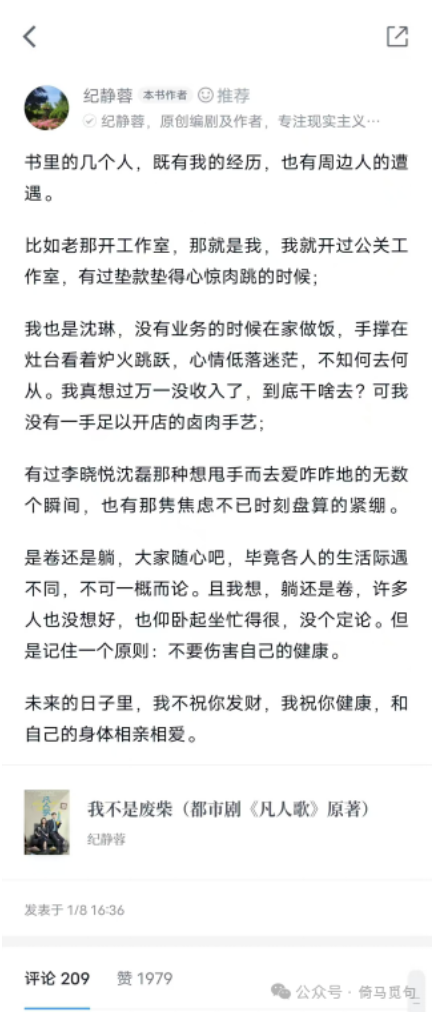
The people in the book draw on both my own experiences and those of people around me.
For example, Lao Na starting a studio—that was me. I ran a PR studio and had times when advancing money for clients left me terrified;
I am also Shen Lin, cooking at home when there was no work, leaning my hands on the counter and watching the flames flicker, feeling low and lost, unsure where to go. I really did wonder: if I had no income, what on earth could I do? But I did not have braising skills good enough to open a shop;
I have had countless moments like Li Xiaoyue and Shen Lei, wanting to throw up my hands and let things take their course, and moments of Na Jun's anxiety, tense and constantly calculating.
Whether you compete or lie flat, follow your heart. Everyone's circumstances differ, after all, and cannot be treated alike. I also think many people have not decided whether to lie flat or compete; they are busy doing sit-ups between the two, with no final answer. But remember one principle: do not harm your health.
In the days ahead, I do not wish you riches. I wish you health and a loving relationship with your own body.
III. The Book's Main Story and Characters
The book follows the upheavals experienced by three couples over a little more than a year, exploring the difficulties of middle age: having and raising children, pay cuts and resignations, broken relationships, illness, and psychological collapse. These reflect present realities and resonate with many readers.
Beyond these three couples, many other characters have troubles of their own. Below is an outline of the main characters; their eventual outcomes also provide a way to understand the plot.
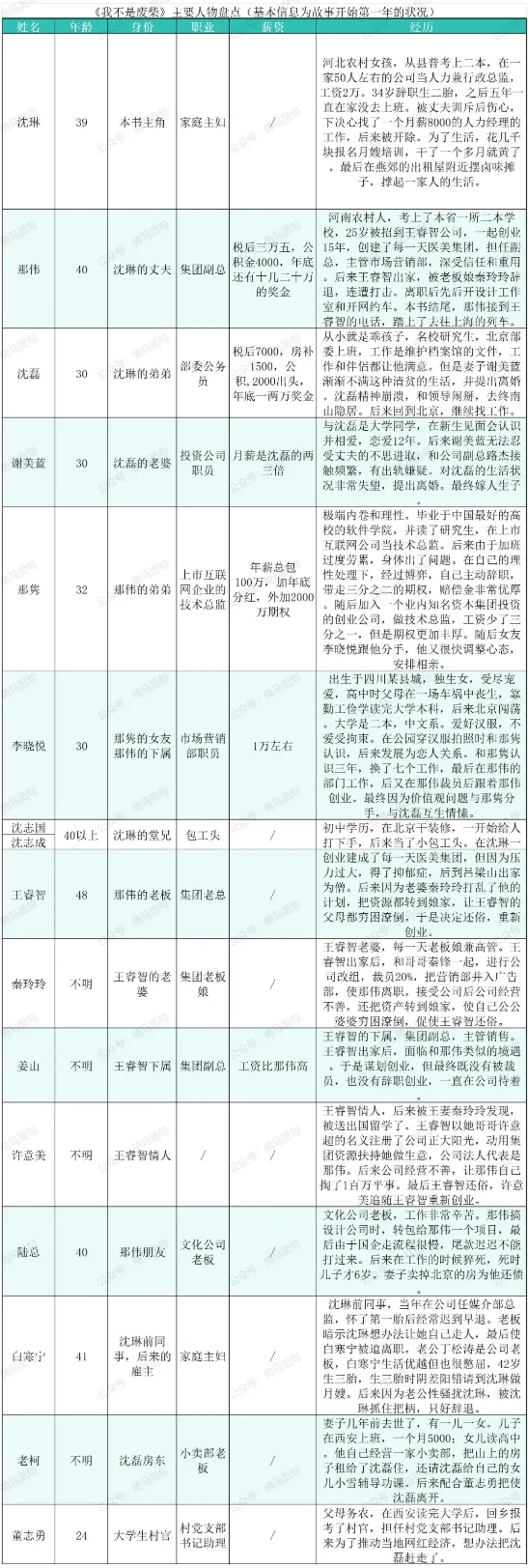
(Information compiled from the novel.)
IV. Some Reflections
This book is rich in content and touches on many contemporary issues. Here are some of my thoughts.
1. As a worker, understand your position and prepare for life's many difficulties
In Wages Are Just Money for Food, I explained that people's wages are only just enough to support their lives. Some people earn high salaries but also spend heavily, and those salaries may not last. Others make money by exhausting their bodies, but the extra earnings may not even cover future medical bills.
I Am Not a Loser was adapted into the television drama Born to Be the One. Across China as a whole, the three central couples are actually outstanding people, ahead of at least 99% of the population, with high incomes and even good looks. Yet in essence they are still just workers, albeit at the very top among workers—or among “ordinary people.” If even the ceiling fares like this, someone like me at floor level will probably have an even harder time.
Na Wei and Na Jun both hold stock options in their companies, making them something like half-bosses, but the options have not been cashed in, and they risk losing their jobs at any moment. In fact, both do lose them. Had Na Wei's old patron Wang Ruizhi not returned to secular life, and had Na Jun not used extreme rationality to secure the best possible terms on leaving, their heavy mortgages might well have crushed them and cost them their former social standing.
Before resigning, Shen Lin earned 20,000 yuan a month as the administrative and HR director of a fifty-person company—a highly successful position. Yet after five years out of work, she could find a job paying 8,000 yuan a month only through a former subordinate, and she did not even pass probation. She had to switch to working as a postpartum nanny and selling braised foods. But there was no alternative: that was the market's choice. Youth is an advantage. If you do not find another advantage before losing it, middle age will leave you with none.
Li Xiaoyue and Xie Meilan now earn ten to twenty thousand yuan a month and live without a care. In reality, Shen Lin's present is their future; the book simply covers only a year and does not develop this further.
Shen Lei actually has the most security of the six. Though his wages are not high now, they are certain to rise steadily. Whatever those old Beijing men have, he will eventually have too. If he were a little more ambitious and became an official, his prospects would be limitless. Unfortunately, his wife cannot tolerate their present modest life, and he ends up losing the job himself.
People therefore need to take the long view, considering future risks as well as current success. Na Jun is the clearest-headed on this point. His only miscalculation is overestimating his body: he thinks he can hold out until 35, only to find at 32 that it can take no more. Still, because he handles things well, the final outcome is acceptable.
2. Health always matters most
This is also the author's strongest feeling. Competing relentlessly or lying flat are individual choices, but protecting your health must come first. With a healthy body, anything remains possible.
We often recognize things' value only after losing them. When young, you just think you are amazing and everything is moving in the right direction. In middle age, bodily functions decline and illnesses emerge. Only then do you realize that youth, health, and looks are all forms of capital—how much capital you once possessed, and how recklessly secure you felt.
3. Control your emotions and avoid speaking cruelly to those close to you
Na Wei's boss becomes a monk, and Na Wei, as a company's legal representative, finds himself inexplicably pursued for debts. Under immense pressure, he argues with his wife Shen Lin and says many deeply hurtful things:
Lao Na suddenly flies into a rage: “All these years, you've eaten my food and spent my money without earning a penny. I earned it all. I'll spend it however I like—what right have you to interfere?”
Several more paragraphs follow, which I will not reproduce. Suffice it to say that they are very hurtful. Shen Lin is deeply wounded and cannot let it go.
Of course, these are angry words. Na Wei has never mistreated Shen Lin. Apart from this argument, he is an excellent husband in every respect.
But those words are still far too hurtful, leaving the other person no dignity at all. Saying them may feel good for you, but what is the other person supposed to do? You supported Shen Lin becoming a homemaker, and she has done an excellent job. Speaking that way denies her value entirely.
So however emotional you feel, consider everyone's dignity. A moment of careless speech can leave someone cold and create a permanent rift between you. Problems still need to be resolved, of course, but pay attention to how you express yourself.
4. View people with tolerance and an understanding that they can develop; allow them to correct mistakes
People always think their own approach is right and then find fault with others. Na Wei and Na Jun consider Shen Lei unambitious and unwilling to shoulder a man's responsibilities. They also see the brothers Shen Zhiguo and Shen Zhicheng as uneducated men doing undignified manual labor. The two brothers disapprove of each other too: Na Wei thinks Na Jun is exhausting his body and acting too paternalistically, while Na Jun thinks Na Wei is vain, lacks core skills, and occupies a precarious professional position. Xie Meilan thinks Shen Lei earns too little; Li Xiaoyue thinks Na Jun has no life.
In short, this sort of dissatisfaction with others is everywhere.
Yet the outcome shows that everyone has their own way of surviving. No approach is absolutely correct or free of risk. People have ways of living that feel most comfortable to them, and they adjust when upheaval comes. They may already know about the hidden dangers you point out. Why remind them so often?
Everyone has shortcomings. If you deliberately search for other people's faults, you may be dissatisfied with everyone and spoil your own mood. But if you are good at discovering their strengths, encourage them often, view their weaknesses tolerantly, and believe that people can change, more people will want to spend time with you.
Comments
No account needed. A nickname is required; email is optional. Successful submissions appear publicly without manual pre-moderation.
Comments and nicknames are public. Optional email addresses are not displayed. The selected Waline backend and its hosting provider process comments, nicknames, optional email, IP and browser information. Comments show IP region, without the full IP address or browser and operating system labels. Hosting: Vercel; database: Neon.