I. How I Came to Read It
More than ten days ago, a friend recommended the television series Bianshui Wangshi to me. I took note of it but did not watch it. A few days later, I happened across the book on WeChat Reading. I opened it and was deeply drawn in, reading it on and off over many days. I finished it today with a great many feelings, so I wrote this report to record my thoughts and what I learned, and to offer other readers a reference.
II. The Book’s Background
Shen Xing, from Zhejiang, was born in 1991. At 18, he ran away from home to Kunming and collected debts for a lending company, effectively joining the criminal underworld. He later gained the trust of the leader, Brother Bazi, who recommended him for transporting goods to Jinbianpo.
He entered Mianbang in March 2009. Under Uncle Cai’s protection and guidance, he joined the local underworld and gained an in-depth understanding of its drug-trafficking supply chain and other social conditions. Later, fearing that Uncle Cai would kill him, he fled Mianbang and returned to China in the early hours of April 18, 2010, ending more than 300 days of life in the borderlands.
On May 13, 2010, with nowhere left to turn, Shen Xing surrendered to the authorities. He helped the police solve a major case, earning credit for significant meritorious service, and was released from prison on August 30, 2010.
In 2017, through his girlfriend, Shen Xing learned about the WeChat official account “Genius Catcher Project” and met its editor Chen Zhuo. With Chen’s help, he wrote this book.
III. Narrative Method and Structure
The book uses a narrative method resembling biographical history. It has twelve chapters; apart from the first and the final two, each essentially centers on one or several principal characters. The chapters are arranged so skillfully that reading them in order presents no difficulty. Although biographical in form, the story still feels as though it unfolds through time, striking a fine balance between background information and suspense.
The principal characters in each chapter are listed below. They can serve as threads for following the book’s plot:
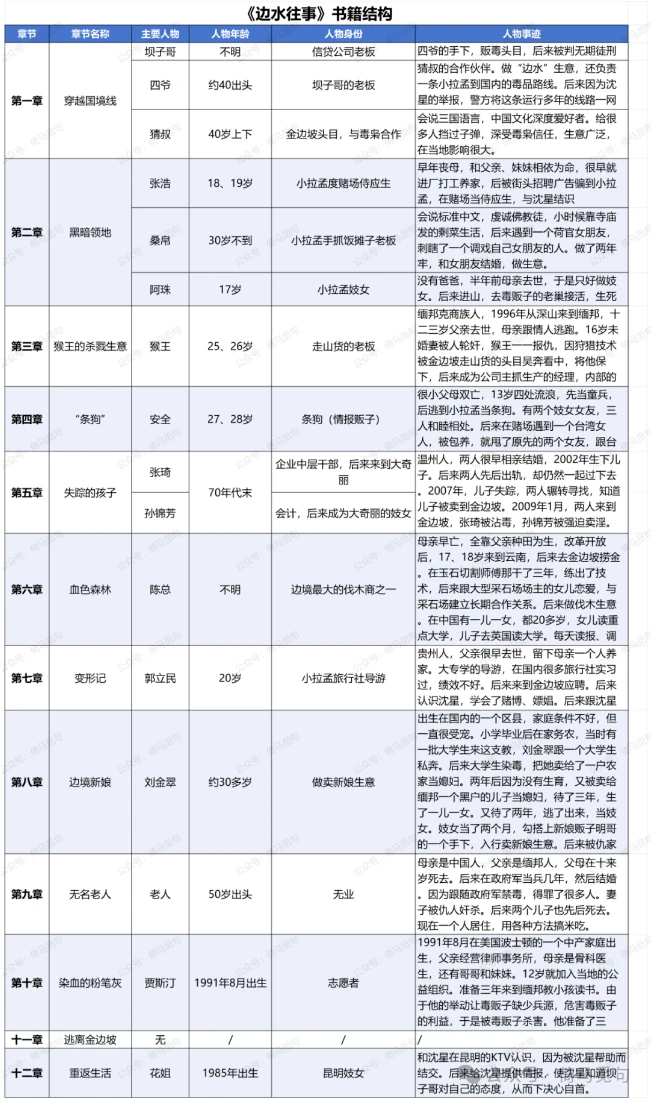
(Reply “边水往事” to the WeChat official account to obtain the original image and a watermark-free table file.)
IV. Some Reflections
The book is rich in content. Here are the points that affected me most after reading it.
1. Approach the Unknown with Humility and Awe
People always distill principles from their own experiences and treat them as eternal truths. In fact, the places they live in and the periods they witness are limited. These supposed truths are therefore often mistaken, valid only at a particular time and place.
Living in China today, for example, we become accustomed to domestic stability. Yet none of it should be taken for granted: it has causes and a history. Unless we recognize this, we will struggle to adapt if we later change environments or circumstances shift.
The male tourist in the book, for example, had no understanding of Jinbianpo’s dangers. He remained as full of himself as he was in China, speaking disrespectfully to powerful local figures. Without Shen Xing’s protection, he would have died far from home long before.
Without Shen Xing’s record, we might never learn of many things happening in Jinbianpo. They would continue beyond the reach of our imagination.
We should therefore always recognize how small we are and approach the unknown with humility and awe.
2. Never Judge Others by Your Own Narrow Morality
Many actions in the book—drug use, buying sex, gambling, killing, and domestic violence—conflict with our mainstream values. Many readers would regard these people as thoroughly evil.
But even hateful people have pitiable histories. Someone who traffics brides was once a trafficked bride herself; someone who raids a home and kills its occupants once survived such an attack. Nobody is born bad. In their circumstances, you might become even worse.
There is no eternal morality. Morality applies only to particular places and periods. If you have not suffered what others have suffered, do not urge them to be good. Never judge others by your own narrow morality.
Morality is a demand you make of yourself, not of others. It is enough to keep yourself in order.
3. Whatever You Do, Be Educated and Keep Learning
Shen Xing had a high-school diploma, and his college entrance examination score exceeded the threshold for first-tier universities. Even the women selling sex at the KTV thought more highly of him for that.
In fact, Shen Xing was an educated person who loved learning. Within a few months of reaching Kunming, he became Brother Bazi’s confidant. In Mianbang, he again won Uncle Cai’s admiration.
His 300-plus days in Mianbang amounted to a comprehensive anthropological investigation. He not only learned the local circumstances inside out but also moved through them with ease and escaped unharmed.
After experiencing so much, he was still only 19. That was truly remarkable.
4. The Finest Quality Is Facing Your Own Inner Self
Shen Xing’s greatest characteristic was his ability to adapt quickly to the local environment while retaining much of his innocence. Otherwise, he would not have paid attention to so many stories unrelated to his own money-making and pleasure.
All this came from his ability to face his own inner self.
Because he faced himself honestly, he did not put on airs of moral purity and could survive in a place like Mianbang. Because he faced himself honestly, he could care about all kinds of people and record their stories.
The book is equally frank. He conceals none of his smoking, drinking, buying sex, gambling, or fighting, which makes its truthfulness very convincing.
I am a history enthusiast, so I regard truthfulness as the finest quality. Genuine ugliness is better than false goodness. Only by facing reality can we find ways to build a better world.
Comments
No account needed. A nickname is required; email is optional. Successful submissions appear publicly without manual pre-moderation.
Comments and nicknames are public. Optional email addresses are not displayed. The selected Waline backend and its hosting provider process comments, nicknames, optional email, IP and browser information. Comments show IP region, without the full IP address or browser and operating system labels. Hosting: Vercel; database: Neon.