Yesterday I finished reading the prefaces and afterwords and took many notes, but forgot to save them and lost everything. I had to start again, hence the delay.
After much thought, I have decided to write Reading Capital as a series of questions and answers, because a question-led approach should make it easier for readers. Quotations will be followed by page numbers in parentheses. All page numbers in this series refer to the Collected Works of Marx and Engels; Book One of Capital corresponds to Volume Five of that collection.
Question:
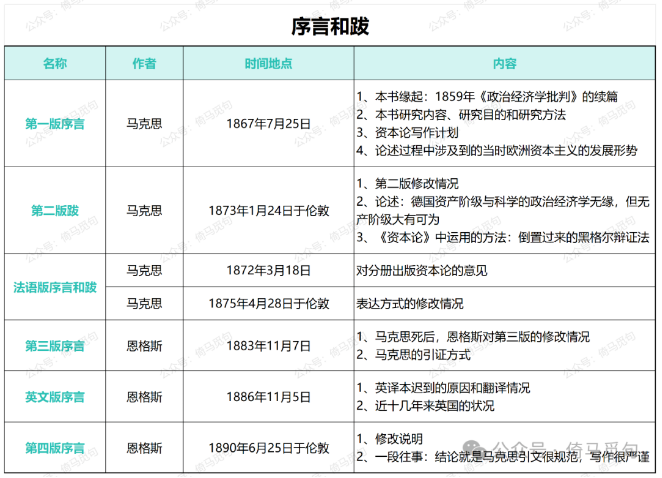
What prefaces and afterwords does Capital have? When were they written, by whom, and what are their main contents? How do you think we should approach them?
Answer:
A preface comes before the main text, while an afterword, also called a postscript, comes after it. Generally, they introduce the author’s intentions and writing process, the main contents, sources, and other information. Capital went through many editions, so naturally it has many prefaces and afterwords. The Collected Works includes six that can help us better understand Capital. Their details are listed below:
Question:
What exactly is Capital about? What was Marx trying to do?
Answer:
Capital is a continuation of Marx’s A Contribution to the Critique of Political Economy, published in 1859. He says, “What I have to examine in this work is the capitalist mode of production and the relations of production and exchange corresponding to it. (8)” He also says, “The ultimate aim of this work is to reveal the economic law of motion of modern society. (10)”
Question:
How should we understand the word “law” here?
Answer:
A law is an essential connection in the development of objective things. Nature has its laws, human society has its laws, and different stages of human society have their own laws. The principal content of “the economic law of motion of modern society” is “the capitalist mode of production and the relations of production and exchange corresponding to it,” which is what Marx sets out to study in this book.
Question:
Some people say social science is not science. What do you think?
Answer:
Marx says, “I certainly do not paint the capitalist and the landowner in rosy colors. But here individuals are considered only insofar as they personify economic categories and embody particular class relations and interests. My standpoint regards the development of the economic formation of society as a process of natural history. However much an individual may subjectively rise above these relations, socially that individual remains their product. My standpoint, less than any other, can hold individuals responsible for those relations.” (10)
Natural science reveals natural laws, and social science reveals social laws. Laws do not change according to human will and operate with iron necessity. Because social science is difficult to verify and social experiments are difficult to conduct, and because everyone has a standpoint and is themselves part of society, much so-called social science is mixed with ideology. Every social science contains both scientific and ideological elements, in differing proportions; readers can judge for themselves. I believe Capital contains a much higher proportion of science than other works of social science.
Question:
What was Marx’s writing plan?
Answer:
Volume One: the process of production of capital (Book One); Volume Two: the process of circulation of capital (Book Two) and the various forms of the process as a whole (Book Three); Volume Three: the history of theory (Book Four). (13)

Question:
How should we understand Capital’s methods of research and presentation?
Answer:
Three passages discuss Marx’s research and presentation methods, each with a different emphasis.
1 — Economic forms are analyzed through the power of abstraction: “For bourgeois society, the commodity form of the product of labor, or the value form of the commodity, is the economic cell form.” (8)
2 — Dialectics turned the right way up: everything is in motion, everything has a beginning and an end, and everything must pass away. (22)
3 — “The method of presentation must differ in form from the method of research. Research must take full possession of the material, analyze its different forms of development, and trace their inner connections. Only after this work has been completed can the real movement be presented appropriately. Once this is achieved, and the life of the material is reflected in ideas, what confronts us may appear to be an a priori construction.” (22)
To summarize:
① The overall approach is the same as in any science: gain a thorough command of the material and investigate its inner connections.
② Study capitalist society as one stage in human society, rather than treating its laws as eternal truths.
③ Begin by analyzing the cell of capitalist movement: the commodity. Move from the abstract to the concrete, first revealing the most essential relationship, then gradually adding conditions to enrich the object of study—or the object of presentation.
Question:
None of that matters to me, and I do not want to read it. I am reading Capital to show off. If I cannot show off afterward, what the hell is the point?
Answer:
Showing off is indeed important. It is said that during the ten-year Sino-Soviet polemic, Deng Xiaoping confronted Soviet officials by quoting Marxism-Leninism and identifying the book and page. The Soviets checked, found he was right, and Deng stole the limelight.
These six prefaces and afterwords are beautifully written and full of memorable lines. I list some below, with page numbers. Read them well: they may come in useful for romance, speeches, recitations, diplomacy, negotiations, and theoretical debates.
The fully developed body is easier to study than the body’s cell. (8)
To the superficial observer, analyzing this form appears to be quibbling over trifles. It is indeed a matter of trifles, but of the kind dealt with in microscopic anatomy. (8)
But if the German reader shrugs hypocritically at the condition of England’s industrial and agricultural workers, or optimistically comforts himself that things in Germany are not nearly so bad, I must tell him plainly: the story is about you! (8)
The issue is not, in itself, the higher or lower degree of development of the social antagonisms arising from the natural laws of capitalist production. It is those laws themselves, those tendencies working and realizing themselves with iron necessity. The country that is more developed industrially merely shows the less developed country the image of its own future. (8)
In every other respect, like all the other countries of continental Western Europe, we suffer not only from the development of capitalist production but also from its insufficient development. Besides modern afflictions, a whole series of inherited afflictions weighs upon us, arising from the lingering survival of ancient, obsolete modes of production and the outdated social and political relations accompanying them. We suffer not only from the living, but from the dead. The dead seize the living! (9)
Even when a society has discovered the natural law of its own motion—and the ultimate aim of this work is to reveal the economic law of motion of modern society—it can neither leap over nor abolish by decree the natural stages of development. But it can shorten and lessen the birth pangs. (10)
To avoid possible misunderstanding, one point should be made. I certainly do not paint the capitalist and the landowner in rosy colors. But here individuals are considered only insofar as they personify economic categories and embody particular class relations and interests. My standpoint regards the development of the economic formation of society as a process of natural history. However much an individual may subjectively rise above these relations, socially that individual remains their product. My standpoint, less than any other, can hold individuals responsible for those relations. (10)
At the same time, across the Atlantic, Mr. Wade, Vice-President of the United States of North America, declared at public meetings that after the abolition of slavery, changes in the relations of capital and landed property would come onto the agenda! These are signs of the times, which purple cloaks and black cassocks cannot conceal. They do not mean that miracles will happen tomorrow. But they show that even among the ruling classes, a vague awareness is emerging that present society is no solid crystal, but an organism capable of change and constantly undergoing it. (10)
I welcome every opinion based on scientific criticism. As for the prejudices of so-called public opinion, to which I have never made concessions, I still follow the great Florentine’s maxim: follow your own path, and let people talk! (13)
The rapid understanding of Capital among broad sections of the German working class is the best reward for my labor. (15)
The remarkable capacity for theoretical thought, regarded as Germany’s hereditary possession, has disappeared completely among its so-called educated classes, but has revived among the German working class. (15)
Our specialists were nevertheless unfortunate. When they could study political economy impartially, modern economic relations did not exist in German reality. When those relations appeared, their circumstances no longer permitted impartial research within the bourgeois outlook. (16)
Insofar as political economy is bourgeois—that is, insofar as it regards the capitalist system not as a historically transitional stage of development but as the absolute and final form of social production—it can remain scientific only while class struggle is latent or manifests itself only in isolated phenomena. (16)
The ideal is nothing other than the material transferred into the human head and transformed within it. (22)
Dialectics became mystified in Hegel’s hands, but this did not prevent him from being the first to present its general forms of movement comprehensively and consciously. With him, it stands on its head. It must be turned the right way up to discover the rational core within the mystical shell. (22)
In its mystified form, dialectics became fashionable in Germany because it seemed to glorify what existed. In its rational form, it arouses the anger and terror of the bourgeoisie and its doctrinaire spokesmen, because its positive understanding of what exists simultaneously includes an understanding of its negation, of its inevitable passing away. It understands every established form through constant movement and therefore through its transience. It worships nothing and is, in its essence, critical and revolutionary. (22)
The analytical method I have used has not previously been applied to economic questions, which makes the opening chapters rather difficult. The French always hurry toward conclusions and eagerly seek the connection between general principles and the questions immediately concerning them. I therefore fear they may become discouraged because they cannot proceed beyond the beginning. (24)
There is no royal road to science. Only those who do not dread the exhausting climb along steep mountain paths can hope to reach its shining summits. (24)
Every new insight in a science involves a revolution in that science’s terminology. Chemistry provides the best example: its entire terminology changes fundamentally about every twenty years, and scarcely any organic compound can be found that has not successively borne a series of different names. (32)
Comments
No account needed. A nickname is required; email is optional. Successful submissions appear publicly without manual pre-moderation.
Comments and nicknames are public. Optional email addresses are not displayed. The selected Waline backend and its hosting provider process comments, nicknames, optional email, IP and browser information. Comments show IP region, without the full IP address or browser and operating system labels. Hosting: Vercel; database: Neon.