I. Background to the Writing
Huozhi meant doing business or accumulating goods and wealth for profit in ancient times. The Analects, "Advanced in Ritual and Music," says: "Ci does not accept his lot but engages in trade; his guesses repeatedly hit the mark." Ci is Duanmu Ci, also known as Zigong or Zigan, who was skilled at business. Sima Qian adopted the word huozhi for the title of this biography.
"The Grand Historian's Self-Narration" says: "Commoners who harm neither government nor the people, who buy and sell at the right time and increase their wealth, have methods from which the wise may learn. Thus I wrote 'The Biographies of the Money-Makers,' the sixty-ninth biography."
"The Biographies of the Money-Makers" is the sixty-ninth of the seventy biographies in the Records of the Grand Historian; the final one is "The Grand Historian's Self-Narration." It is a highly unusual chapter. Instead of commemorating political figures, Sima Qian observes the society of his time, expresses his views on wealth and commerce, and explores ways of obtaining wealth through specific cases. Today, this essay has considerable historical value and can also offer many insights into how we view wealth.
"The Biographies of the Money-Makers" runs to fewer than six thousand Chinese characters, yet its information is extremely dense, far exceeding that of the 110,000-character Once Upon a Time in Bianshui or the 200,000-character I Am Not a Good-for-Nothing. I have read it many times and still find much of it difficult to understand. Of course, that is hardly my fault: who knows how many academic papers have been written about it? Why demand that an ordinary person like me understand it all? This Reading Report is therefore for reference only; the original text is authoritative on all points. Still, I believe everyone who reads this report will gain something.
II. Structure and Main Content
Following the flow of the text, I have divided it into five parts: views on wealth; representative merchants before the Han; regional economic conditions in the early Han; methods of obtaining wealth; and cases of obtaining wealth. I will introduce each below so readers can quickly grasp the essay's structure and main content.
1. Views on Wealth
The first five paragraphs resemble a preface. They set out the author's views on society, history, and wealth, showing a strong materialist tendency.
Sima Qian says he knows nothing about events before Shennong and so will not discuss them. From the times of Yu and Xia onward, as described in the Book of Songs, people have been characterized by a taste for enjoyment and a pursuit of profit. The ideal depicted in the Laozi, of small states with few people living peacefully and contentedly, probably does not suit the present day.
"Farmers produce food, foresters bring forth resources, artisans make things, and merchants circulate them." Agriculture, resource gathering, crafts, and commerce follow a social law: people each exercise their abilities and seek their own profit. All this happens naturally, without government compulsion. These activities are also the source of a state's wealth: Jiang Ziya and Guan Zhong strengthened Qi by opening up these sources. They are also the foundation of ritual, benevolence, and righteousness: only when gentlemen are wealthy do they extend benevolence, and only when ordinary people are wealthy can they adjust their labor.
Thus, "All the world bustles for profit; all the world hurries for gain." Everyone rushes about for their own interests. Even the ruling class fears bankruptcy, so how much more must other poor people fear it?
2. Representative Merchants Before the Han
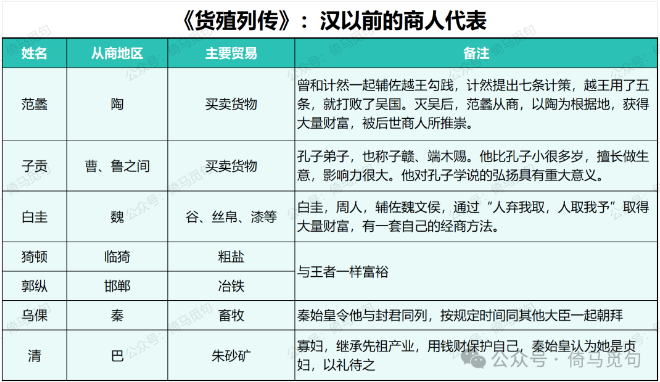
Sima Qian then lists several merchants before the Han: Fan Li, Zigong, Bai Gui, Yi Dun, Guo Zong, Wu Luo, and Ba Qing. Details appear in the table below:
3. Regional Economic Conditions in the Early Han
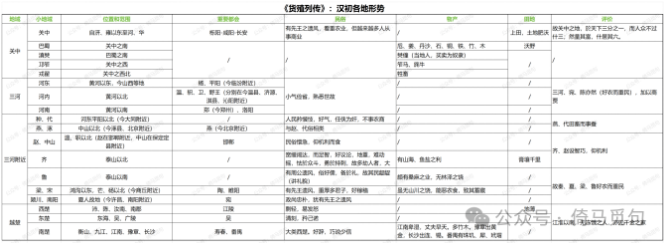
The Han unified the realm, opened checkpoints and major routes, and lifted prohibitions on exploiting mountains and wetlands. Wealthy merchants could therefore travel throughout the empire, all kinds of goods circulated freely, and their desires could be satisfied. The Han government also relocated powerful figures, feudal lords, and wealthy households to the capital.
Sima Qian then introduces conditions in various regions in the early Han. The material is rich, covering geographical divisions, major cities, local customs, and products. I have made a table to provide an overview. His discussion in this section is quite fragmented and difficult to summarize, so the table is for reference only; readers should consult the original text:
4. The Importance of Wealth and Ways to Obtain It
Whether worthy men withdraw from the world or enter public life, they do so for wealth. Brave men charge into battle because substantial rewards drive them. Women adorn themselves, travel great distances, and make no distinction between young and old in their pursuit of wealth. Sons of wealthy households dress elaborately and travel in grand style to display an appearance of riches and status. Others, such as hunters and fishers, gamblers, physicians and practitioners of occult arts, government clerks, and soldiers, likewise hurry to and fro for nothing other than wealth and profit.
There are three kinds of wealth: wealth from primary production, wealth from secondary occupations, and wealth from illicit activities. Of these, the first is best, the second comes next, and the third is lowest. For poor people, however, "Farming is inferior to crafts, crafts are inferior to trade, and embroidering patterns is inferior to leaning at the market gate." He also points out that business yielding less than a 20% return is not worth pursuing.
5. Cases of Obtaining Wealth
After discussing ways to become rich, Sima Qian immediately provides examples, shown in the table below.
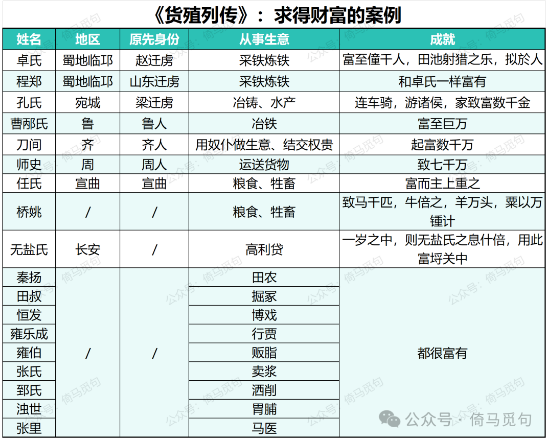
We can see that no particular occupation has a monopoly on riches, nor does wealth have a permanent owner. A household with a thousand pieces of gold rivals the lord of a city, while someone with vast wealth enjoys life as a king does. Such a person is called an "untitled lord."
III. A Discussion of Several Questions
I have a few ideas, some of them admittedly provocative, for everyone's consideration and criticism.
1. Sima Qian's Views on Society and History
I believe Sima Qian's views on society and history are broadly consistent with historical materialism.
The central proposition of historical materialism is that the economic base determines the superstructure. People must first satisfy their needs for food, drink, shelter, and transportation before they have spare time to explore such higher-level subjects as politics, culture, and philosophy.
Sima Qian regards the pursuit of profit as human nature: "The best approach is to follow it; next is to guide it toward advantage; next is to instruct people; next is to regulate them; the worst is to contend with them." Moreover, "When granaries are full, people understand ritual; when food and clothing are sufficient, they understand honor and shame. Ritual arises from abundance and falls away in want." If people cannot fill their stomachs, do not indulge in lofty talk of morality with them.
It is precisely for this reason that Sima Qian could face the commercial activities of his day objectively, recount merchants' stories of making profits, and explore business methods.
Of course, Sima Qian coincides with historical materialism only on this point; the two are not entirely equivalent.
2. Merchants' Main Business in the Qin and Han Periods
From Sima Qian's descriptions of representative merchants, we can see that from the Spring and Autumn period to the early Western Han, merchants' main businesses were trading agricultural products, such as grain and silk; trading cattle and sheep; and extracting, processing, and trading salt and iron. These three businesses sustained the vast majority of great merchants. Grave robbing, gambling, and treating horses were merely unconventional ways of getting started and could not sustain a business in the long run.
This suggests several conjectures for future verification:
① From the Spring and Autumn and Warring States periods to the early Han, China's commodity economy was highly developed, and private commerce may have reached the peak of ancient Chinese history.
② After Emperor Wu of Han introduced state monopolies on salt and iron throughout the country, many great merchants must have gone bankrupt or declined. The monopolies strengthened government finances, and centralization and autocratic rule grew stronger as a result, at the cost of declining private commerce.
③ The ideas and policies of promoting agriculture and suppressing commerce made China's ancient feudal dynasties very stable, but also slowed social development. Otherwise, judging by the trajectory of merchants in the early Western Han, they would soon have needed to hire workers. Perhaps after a few decades or a century, someone would have opened a handicraft workshop.
3. Wealth from Primary Production, Secondary Occupations, and Illicit Activities
"Wealth from primary production" must not simply be understood as "working the fields." It means engaging in agricultural production—in other words, being a landlord.
First, when Sima Qian discusses ways to become rich, he is discussing ways to become an "untitled lord": someone who possesses wealth and status without official rank or an enfeoffed estate. To understand such people, we must compare them with those who have been enfeoffed.
"An enfeoffed lord lives on rents and taxes, averaging two hundred coins per household each year. A lord of a thousand households therefore receives two hundred thousand." What about commoners? "Ordinary people engaged in farming, crafts, and commerce likewise generally earn two thousand a year on ten thousand; a household with a million thus earns two hundred thousand, from which its taxes and levies must be paid."
In other words, an ordinary person with a million coins earns two hundred thousand in annual profit, while a lord with an estate of a thousand households also receives two hundred thousand. In wealth, then, a million-coin household is equivalent to a lord of a thousand households.
What qualifies as a "million-coin household"? Sima Qian gives examples:
Thus it is said: on dry land, horses numbering two hundred hooves, cattle numbering a thousand hooves and horns, or sheep numbering a thousand feet; in wetlands, pigs numbering a thousand feet; by the water, fish ponds yielding a thousand shi; in the mountains, a thousand large timber trees. A thousand jujube trees in Anyi; a thousand chestnut trees in Yan or Qin; a thousand orange trees in Shu, Han, or Jiangling; a thousand catalpa trees north of the Huai, south of Changshan, or between the Yellow and Ji rivers; a thousand mu of lacquer trees in Chen or Xia; a thousand mu of mulberry and hemp in Qi or Lu; a thousand mu of bamboo along the Wei; and, near the walls of a renowned city of ten thousand households, a thousand mu of land each yielding a zhong of grain, or a thousand mu of gardenia and madder, or a thousand beds of ginger and chives: all these owners are the equals of a marquis of a thousand households.
All of these involve owning various natural resources. To put it plainly, they mean being a landlord, because you could not possibly do all this work yourself; the people below you do it. At the time, these workers were mostly "slaves and servants," that is, serfs without personal freedom. In the middle and later periods of feudal society, they were tenant farmers who rented land and paid rent to the landlord.
Wealth from primary production is characterized by "not watching the markets or traveling to other towns, but sitting and awaiting the harvest, maintaining the standing of a retired scholar while obtaining a livelihood." This connects with the earlier statement: "Wise men plan deeply in the halls of government and debate at court; those who keep faith, die for principle, or live in mountain caves establish lofty reputations—where do they ultimately turn? To ample wealth." The "retired scholar" and those who "keep faith, die for principle, or live in mountain caves" are the same kind of people. They are recluses, but more fundamentally they are landlords. Being a recluse merely means not participating in government; they still possess substantial resources. Without financial resources, you cannot even qualify as a recluse!
When Fan Zhongyan says, "Far away among rivers and lakes, one worries for one's ruler," or Zhuge Liang says he "personally tilled the fields," their underlying meaning is really: even if I do not hold office, I can still go home and be a small landlord!
"Therefore wealth from primary production is best, wealth from secondary occupations comes next, and wealth from illicit activities is lowest."
That is precisely why poor people lack the standing and capital to pursue wealth from primary production: "For those seeking wealth from poverty, farming is inferior to crafts, crafts are inferior to commerce, and embroidering patterns is inferior to leaning at the market gate. This refers to secondary occupations, which provide resources for the poor."
Those who are utterly destitute must try all kinds of ways to accumulate their first pot of gold, even unconventional ones, if they want wealth and status.
In addition, the hierarchy of disdain Sima Qian reveals in his discussion closely resembles that of society today. "Enfeoffed lords" correspond to the "tax collectors" I discussed in "The Five Main Sources of Wealth in Modern Society"; those with wealth from primary production are "rent collectors"; and those with wealth from secondary occupations are "profit seekers."
Although agricultural and modern societies differ, the proposition that wealth must always take second place to power has remained consistently true in China.
Comments
No account needed. A nickname is required; email is optional. Successful submissions appear publicly without manual pre-moderation.
Comments and nicknames are public. Optional email addresses are not displayed. The selected Waline backend and its hosting provider process comments, nicknames, optional email, IP and browser information. Comments show IP region, without the full IP address or browser and operating system labels. Hosting: Vercel; database: Neon.