Question:
How should we understand Chapter One, Section Three, “The Form of Value, or Exchange Value”?
Answer:
In the sixth question, we explained that exchange value is the form in which value appears: the quantitative relation or proportion in which one commodity exchanges for another. Why do we say this? A commodity's use value can be expressed through its natural physical form, but its value cannot be seen directly in the commodity itself. It can appear only in the social relation between one commodity and another. Here, form of value and exchange value are synonyms. We can understand them in terms of how commodities enter into social relations with one another and by what means they are exchanged. (In Xu He's An Introduction to Political Economy, “form of value” is rendered as “shape of value”; exchange value is the form in which value appears. Readers can compare the terms.)
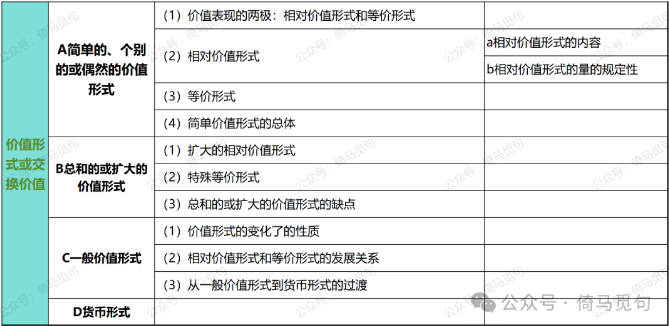
Marx develops his account through four forms of value: A. The simple, individual, or accidental form of value; B. The total or expanded form of value; C. The general form of value; D. The money form. The subsection headings in Section Three are listed below:
Marx says:
“Everyone knows—even if they know nothing else—that commodities have a common form of value that contrasts strikingly with the varied natural forms of their use values: the money form. Here, however, we must do what bourgeois economics has never even attempted: show the origin of this money form; that is, trace how the expression of value contained in the value relation between commodities develops from its simplest, least conspicuous shape into the dazzling money form. In doing so, the riddle of money will also disappear. (62)”
We can see, then, that Marx devotes so much space to these four forms of value in order to overcome the shortcomings of the classical economists and, by analyzing the development of the form of value, arrive at a better understanding of the money form of commodity value.
Comments
No account needed. A nickname is required; email is optional. Successful submissions appear publicly without manual pre-moderation.
Comments and nicknames are public. Optional email addresses are not displayed. The selected Waline backend and its hosting provider process comments, nicknames, optional email, IP and browser information. Comments show IP region, without the full IP address or browser and operating system labels. Hosting: Vercel; database: Neon.