The National Bureau of Statistics defines “employed persons” and the “employment rate” very broadly. Put simply, if you do one hour of casual work in a week, you do not count as unemployed. If you are studying at school, you do not count as unemployed. If your workplace has suspended operations for less than three months, you do not count as unemployed either. If you resign voluntarily, this indicates that you are able to work but unwilling to do so, and you do not count as unemployed in that case either.
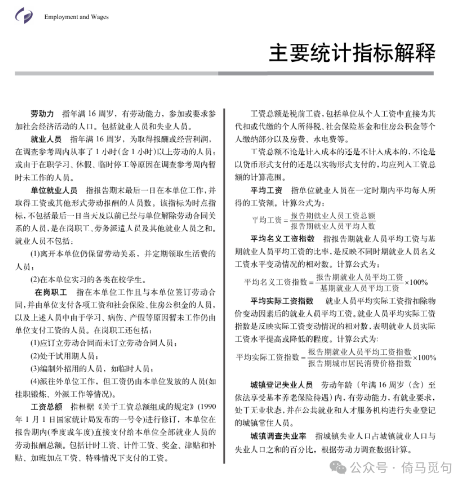
These definitions are said to match those of the International Labour Organization, align with international practice, and permit international comparison.
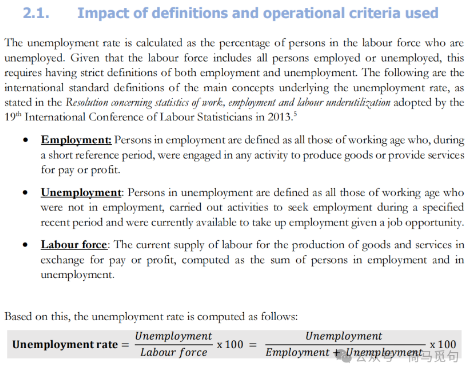
If the definitions are fixed and the statistical methods are consistent, data collected according to the same standards can reflect the current employment situation, or at least its trend.
Let's first look at China's unemployment data over the years. China began regularly publishing the surveyed urban unemployment rate every month in April 2018. In the China Statistical Yearbook published each year thereafter, the “surveyed urban unemployment rate” was actually the rate for December, rather than the annual average. The annual average was not published until the yearbook released in 2024.
Below are the officially published unemployment statistics I have compiled.
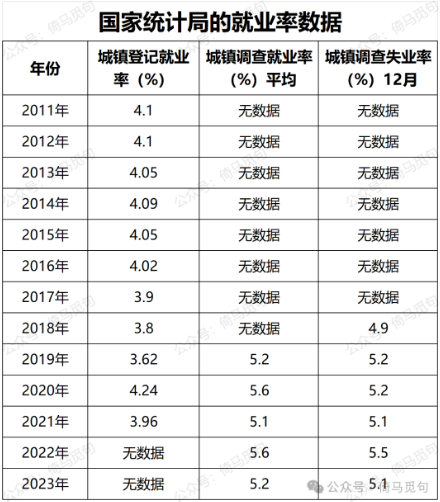
We can see that 2020 and 2022 were the two worst years for employment in China. The overall situation improved in 2023, but remained worse than in 2019 and 2021. Judging by the December figures, 2018 was the best year for employment; comparisons further back are difficult.
I also compiled data from the International Labour Organization to look at unemployment rates in other major countries in 2023:
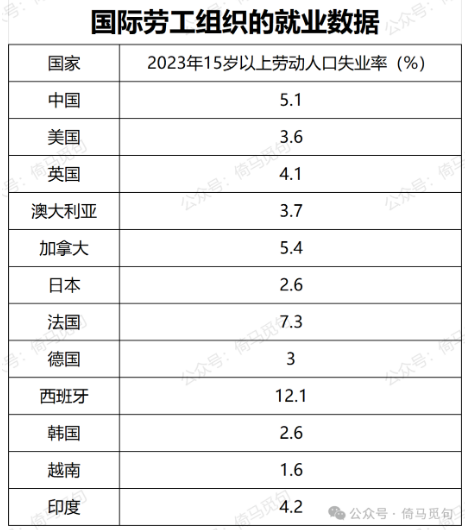
We can see that China's unemployment rate is indeed somewhat high, but remains within a manageable range. And although the statistical standards are the same, countries differ in their statistical methods and procedures, so these figures are for reference only.
What, then, is China's employment situation like this year?
On October 18, the State Council Information Office held a press conference on the performance of the national economy in the first three quarters of 2024.
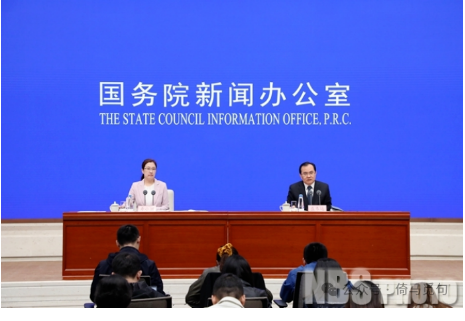
On employment, Sheng Laiyun, deputy director of the National Bureau of Statistics, said:
Although there is pressure on total employment, the overall employment situation is stable. The surveyed urban unemployment rate was 5.1% for the first three quarters: 5.2% in the first quarter, 5.0% in the second, and 5.2% in the third. Overall, it was relatively stable. The third-quarter rate was a little higher than the second-quarter rate, mainly because of the seasonal effect of university graduation in July and August, but the overall situation remained stable. Why is our country's employment situation stable overall? In addition to the great importance that Party committees and governments at all levels attach to employment, and the strong employment policies I just mentioned, there are also the effects of our institutional advantages and economic fundamentals.
Generally speaking, the fourth-quarter unemployment rate is lower than the annual average. Combining this with past data, we can infer that employment this year is the best it has been since 2019. Of course, it is not better by much, and there is still a gap compared with 2018.
From the perspective of economic fundamentals, Sheng Laiyun identified three factors supporting employment stability: ① The economy continues to grow, increasing demand for labor. ② Services account for a growing share of GDP, and most service industries are labor-intensive and have a strong capacity to absorb employment. ③ The population structure is changing: from 2013 to last year, China's labor resources aged 16–59 declined by an average net 5–6 million people annually over those ten or so years, with a net decline of around ten million last year.
In sum, labor market supply is shrinking while demand is increasing, so the future trend is stable employment.
Why emphasize stability? Because in a market economy, an unemployment rate that is too low is also unfavorable to economic development. If unemployment is too low and there is no sufficient “reserve army of labor,” businesses' labor costs rise, putting them under operational pressure.
The biggest problem in China's current employment situation is “pronounced structural imbalances in employment”: young people's employment rate is low, while manufacturers struggle to recruit. Sheng Laiyun said:
Another issue is that structural imbalances in employment are relatively pronounced. On the one hand, young people face considerable employment pressure and their unemployment rate remains somewhat high; on the other, manufacturing has difficulty recruiting workers. In particular, demand for some frontline skilled manufacturing workers still exceeds supply. Structural imbalances are therefore a very important feature of the labor market.
I think this has a great deal to do with higher education in China. Enrollment has expanded too much, leaving too many students in schools doing meaningless coursework. What schools teach does not match market demand, while the public sector cannot accommodate so many researchers. There may therefore be room for improvement here.
For ordinary young people, the lesson these data offer is this: do not simply follow whatever your school does. Develop your skills in a focused way according to the realities of the job market, and build abilities that the market recognizes. Only then can you “sell yourself for a good price” after graduation.
Comments
No account needed. A nickname is required; email is optional. Successful submissions appear publicly without manual pre-moderation.
Comments and nicknames are public. Optional email addresses are not displayed. The selected Waline backend and its hosting provider process comments, nicknames, optional email, IP and browser information. Comments show IP region, without the full IP address or browser and operating system labels. Hosting: Vercel; database: Neon.