Baidu Index is a data analysis platform based on the vast amount of behavioral data generated by Baidu users. It offers a great deal of information. In particular, search volumes and changes for different keywords can reveal the social needs behind them.
What is the employment situation like today? We can consult official statistics and media reports or survey the employment circumstances of people around us. Baidu Index can provide another reference point. A couple of days ago I analyzed the official statistics bureau's unemployment figures. This article examines the current employment situation as reflected by Baidu Index.

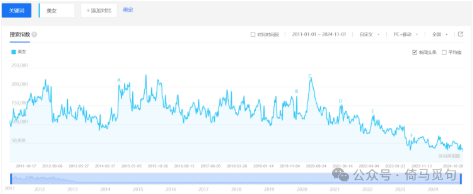
First, to check the consistency of Baidu Index data across years, I used the keyword “beautiful women” and selected data from January 1, 2011, to November 1, 2024. Searches for “beautiful women” declined after 2022 and fell much more sharply after 2023, having been relatively stable before.
Since Chinese men's sexual repression is stable—it has been stable for thousands of years—we can conclude that, overall, Chinese internet users have used Baidu less since 2022, particularly since 2023. Perhaps people have become accustomed to other search engines over the past two years.
Now let us analyze employment.
I chose two keywords: “looking for work” and “part-time jobs.” We will first examine data from January 1, 2011, to January 1, 2019. I selected this period to identify annual and seasonal patterns in people's demand for employment, because it was unaffected by the pandemic.
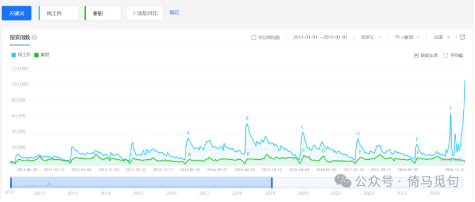
The cyclical patterns are very clear. My analysis is as follows:
1 Searches for “looking for work” peak each February, sometimes early in the month and sometimes late, roughly around the Lunar New Year. A secondary peak occurs in early July, corresponding to graduation season and the start of the summer holidays.
2 Between 2011 and 2018, the employment situation was worst in 2014, 2015, and 2016, because the peaks in these three years were clearly higher than in other months.
3 The overall trend for “part-time jobs” resembles that for “looking for work,” but the Lunar New Year peak is less evident. Its highest point occurs in early July each year, indicating that demand for part-time work is greatest at the start of the summer holidays.
4 Both “looking for work” and “part-time jobs” reach their troughs around February, before the Lunar New Year. Presumably people are preparing to go home for the holiday and have less need to look for work. Once the holiday is over, they get busy job hunting again.
That covers this period.
Now let us select January 1, 2018, to November 8, 2024. This includes the relatively regular patterns of 2018 for comparison with the pandemic and post-pandemic periods. For reference, the outbreak discovered in Wuhan began attracting increasing attention in December 2019. On February 23, 2023, the National Health Commission said that the pandemic was basically over.
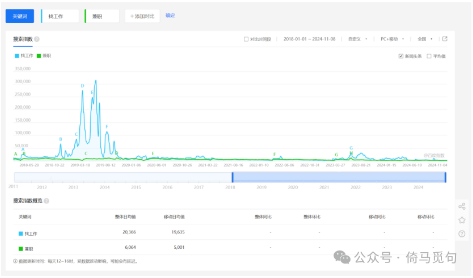
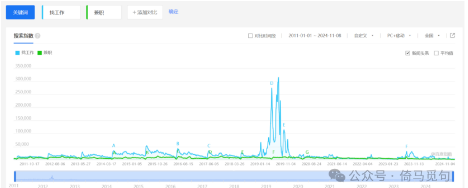
We can see that between September 2018 and September 2019, the overall volume of searches for “looking for work” was extremely high. The increase was so large that the usual annual cycles became comparatively insignificant. But the pandemic had not started yet! Why was this?
In my previous article, I analyzed official unemployment information and concluded:
We can see that 2020 and 2022 were the two worst years for employment in China. The overall situation improved somewhat in 2023, but remained worse than in 2019 and 2021. Judging by the December figures, 2018 was the best year for employment; comparisons further back are difficult.
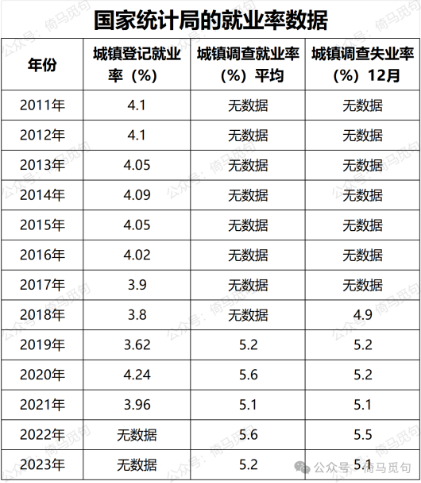
One possibility is that China's unemployment rate was already trending upward from late 2018. By 2019, the employment rate was already very poor. In 2020, during the pandemic, the state stabilized an unemployment situation on the verge of collapse by strengthening pandemic controls.
In other words, we cannot rule out the possibility that China absorbed an economic crisis through the pandemic. Even without the pandemic, an economic crisis and downturn would have arrived. By using the pandemic as an opportunity to strengthen government control over the economy, China prevented us from feeling that crisis.
Of course, these are only conjectures. Further research will be needed to establish what really happened!
Now let us select January 1, 2020, to November 8, 2024. Excluding the peak of 2018–2019 allows us to examine changes in the past few years more closely.
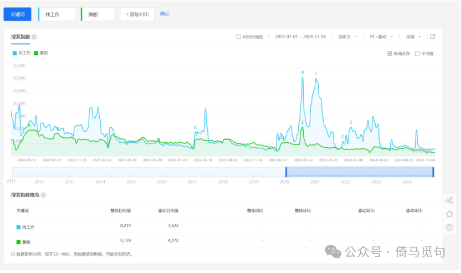
First, although the overall picture is rather irregular, the trough before each Lunar New Year is still fairly clear, except in 2024. This is when people's demand for job hunting is lower.
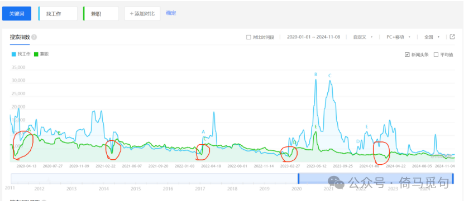
Next, we draw a dividing line at February 23, 2023, separating the chart into periods before and after the pandemic. For context, February 23, 2023, was the fourth day of that Lunar New Year and the date on which the National Health Commission announced that the pandemic was basically over.
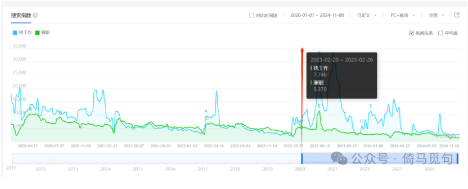
We can see that searches in the pre-pandemic period of 2021 and 2022 followed fairly regular patterns, similar to earlier years, 2011–2017. The instability in 2020 may reflect several waves of unemployment, though it was still far better than September 2018–September 2019. The irregularity of 2023 was probably due to the recent reopening: no longer required to stay home, people began looking for work all at once.
There were two peaks in searches for “looking for work” in early May and early July 2023. This was probably the period of greatest employment pressure after the pandemic.
The Lunar New Year in 2024 fell on February 10, but searches for “looking for work” were high both before and after that date, settling down only at the end of March. Two smaller peaks followed, around May 10 and August 20, after which the data became fairly stable.
Search volume was relatively high from the beginning of this year through the end of March, but nowhere near the levels of 2020 and 2023. After late March this year, searches for “looking for work” became very low. Even allowing for the two small peaks, this can be called the lowest period of the past few years.
That is the detailed analysis. Here is a summary of my findings and inferences:
1 From 2011 to September 2018, searches for “looking for work” followed a clear pattern: ① the lowest point was before the Lunar New Year, the highest was after it, and a secondary peak occurred in early July.
2 Between 2011 and 2018, the worst years for employment were 2014, 2015, and 2016.
3 From September 2018, demand for finding work suddenly increased. This peak lasted until September 2019. It may have resulted from a wave of unemployment and may have foreshadowed an economic crisis.
4 China entered the pandemic era in December 2019. Demand for job hunting was greatest in 2020, while 2021 and 2022 were relatively stable. On February 23, 2023, China essentially ended its pandemic era, and demand for employment remained very high in the year that followed.
5 People in China were very active in looking for work from the beginning of this year through late March. The chart below shows this year's data.
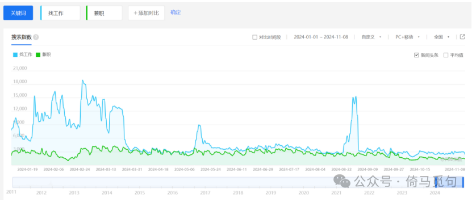
6 Since March this year, searches for “looking for work” have fallen to their lowest average level in recent years. Two small peaks appeared around May 10 and August 20 for unknown reasons, but they do not change the overall picture. The chart below shows data since January 1, 2011.
That concludes the analysis.
I should state that this method is certainly neither scientific nor rigorous. It can provide only a supplementary perspective. Perhaps, however, as we gather more material, we will be able to understand the meaning of these data more accurately.
So far, although Baidu Index differs somewhat from official statistics, the available material at least allows us to infer that the current employment situation remains stable and is continuing to improve. I think this conclusion is at least somewhat more reliable than the claims of unscrupulous media outlets that peddle anxiety.
What do you think? Comments are welcome!
-END-
This is a WeChat public account where you can learn something. Follow me for more interesting articles!
Recommended related articles:
What Is the Current Employment Situation Really Like? Based on National Bureau of Statistics Data
How Is China's Official Unemployment Rate Calculated, and How Useful Is It?
Comments
No account needed. A nickname is required; email is optional. Successful submissions appear publicly without manual pre-moderation.
Comments and nicknames are public. Optional email addresses are not displayed. The selected Waline backend and its hosting provider process comments, nicknames, optional email, IP and browser information. Comments show IP region, without the full IP address or browser and operating system labels. Hosting: Vercel; database: Neon.