I
My WeChat signature reads, “How often has the world grieved for the past? The mountain still rests beside the cold river.” These lines come from Liu Yuxi's “Meditating on the Past at Mount Xisai,” reproduced in full below:
Wang Jun's towered warships sailed down from Yizhou; Jinling's royal aura faded into darkness. A thousand fathoms of iron chain sank to the riverbed; a banner of surrender emerged from Stone City. How often has the world grieved for the past? The mountain still rests beside the cold river. Now the four seas form a single home; autumn reeds rustle around the ruined ramparts.
Liu Yuxi excelled at poems on historical subjects, but I think this may be his finest.
Understanding it, however, requires some background. In particular, the lines beginning “How often has the world” are unremarkable by themselves but a masterstroke within this poem. Let me explain.
II
1. Meditating on the Past at Mount Xisai
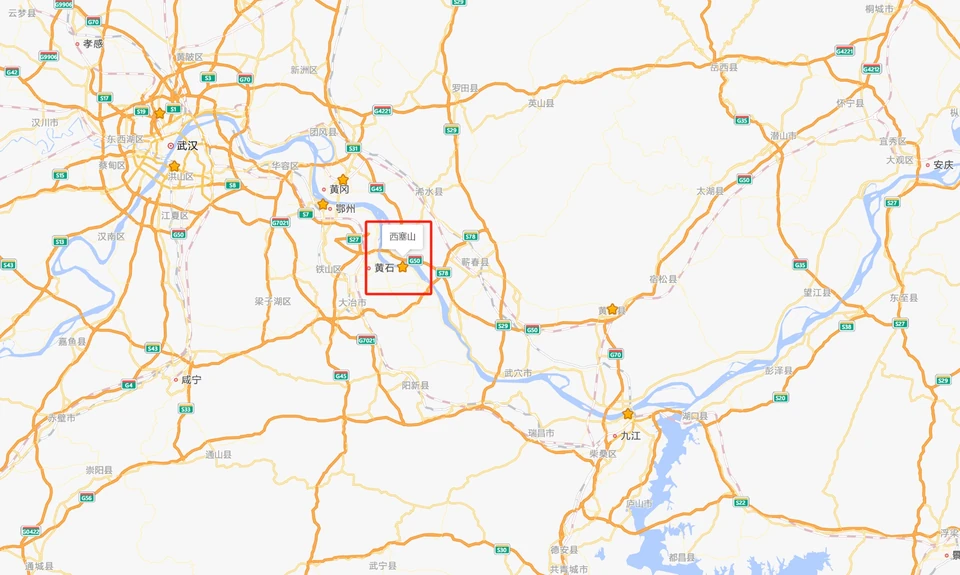
Mount Xisai stands beside the Yangtze east of Huangshi, Hubei. A famous military stronghold during the Six Dynasties, its strategic terrain is said to have witnessed more than a hundred battles.
(Figure: location map of Mount Xisai)
The Tang poet Wei Yingwu described its scenery in “Mount Xisai”:
Its force rushes from a thousand li away, plunging straight into the river, where it breaks.
Mountain mist spans the mighty autumn fortress; the land constricts the surging current to the brim.
Southeastern regimes generally had their political centers in southern Jiangsu and northern Zhejiang, so they needed to gain early control of Jingzhou, upstream from the Wu-Yue region. Because it was distant, they also tended to assign separate generals to oversee it. Mount Xisai lies strategically between Jingzhou and Wu-Yue. For southeastern regimes, its fortress was therefore particularly important when they were being founded or nearing destruction, and less important when they were powerful—rather like the Great Wall under the Qing.
This geographical position makes Mount Xisai especially evocative of dynasties' rise and fall.
In 824, the fifty-two-year-old Liu Yuxi was transferred from prefect of Kuizhou to prefect of Hezhou. Traveling from present-day Chongqing to a place west of present-day Nanjing—He County, Anhui—he naturally went by water. Passing Mount Xisai, he was moved to write this poem.
2. Wang Jun's towered warships sailed down from Yizhou; Jinling's royal aura faded into darkness
Wang Jun, whose given name is pronounced “Jun,” was prefect of Yizhou in the early Western Pu. After taking office, he spent seven years building ships and preparing to destroy Wu. Already seventy and uncertain how much time he had left, he was eager to accomplish something. He therefore stood ready for the campaign against Wu and was determined to succeed.
In November 279 CE, Emperor Wu of Jin, Sima Yan, decided to attack Wu. In the first lunar month of 280, Wang Jun led the main force—or at least the main naval force—of towering warships out of Yizhou, whose administrative seat was present-day Chengdu. In mid-March, he entered Jianye, present-day Nanjing, and accepted the surrender of Wu's ruler Sun Hao. The Three Kingdoms were thus reunited.
In this couplet, the first line shows Wang Jun setting out from Sichuan with his warships, advancing majestically down the Yangtze. In the next, the force has already reached Jinling's walls and a dynasty has fallen. The first line has them “sailing down”; the second has royal power “fading away.” No time is left for us to react, conveying how swiftly the dynasty collapses: the victor sweeps all before him, the defeated crumble completely.
3. A thousand fathoms of iron chain sank to the riverbed; a banner of surrender emerged from Stone City
Within the overall Jin conquest of Wu, these lines add process and detail. In terms of the camera's viewpoint, they portray the war from Wu's side.
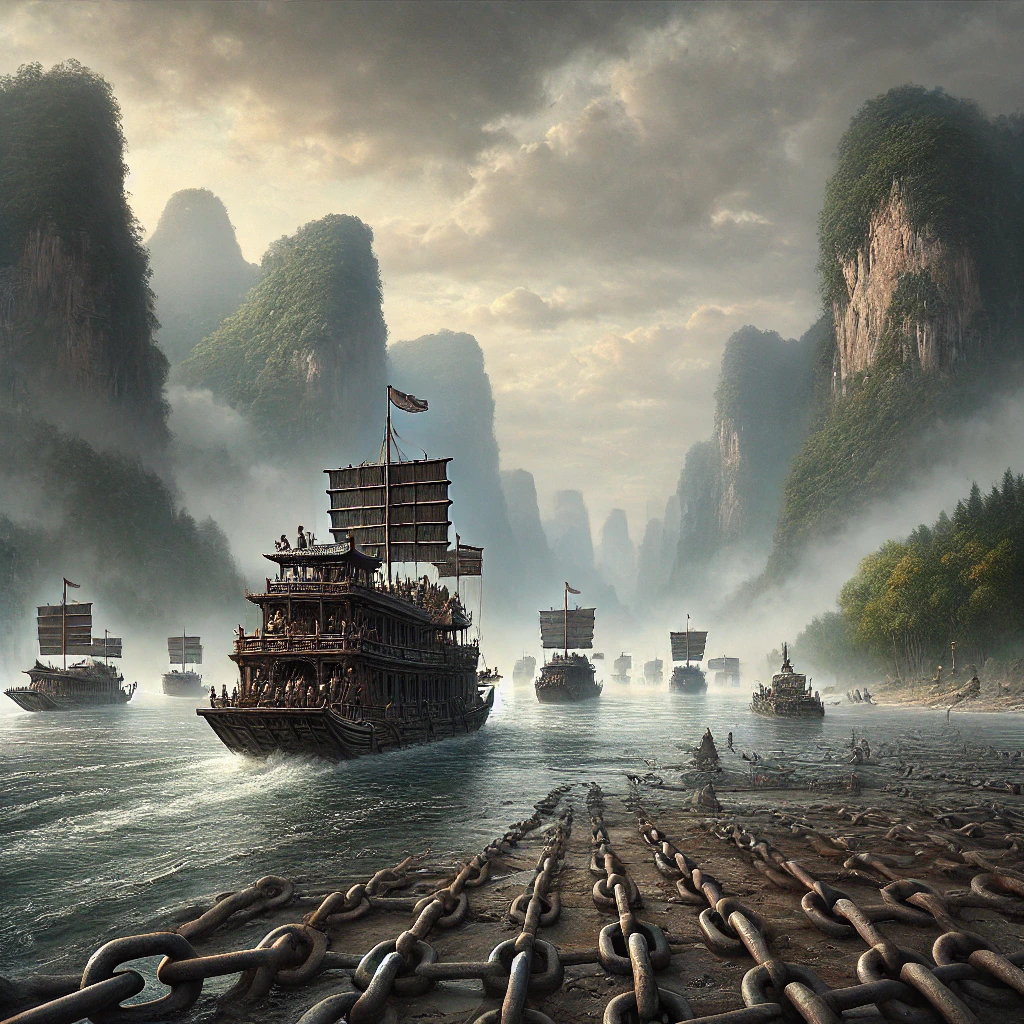
To resist Jin's navy, Wu stretched iron chains across strategic points on the Yangtze and placed iron spikes several zhang long in the water. But what use were they? Wang Jun used wooden rafts to clear the spikes and torches to burn through the chains. His great ships continued unhindered.
Stone City was originally a military stronghold on Stone Mountain in Nanjing and later became another name for the city. Nanjing was called Moling under the Han. Sun Quan renamed it Jianye, and it later also became known as Jinling.
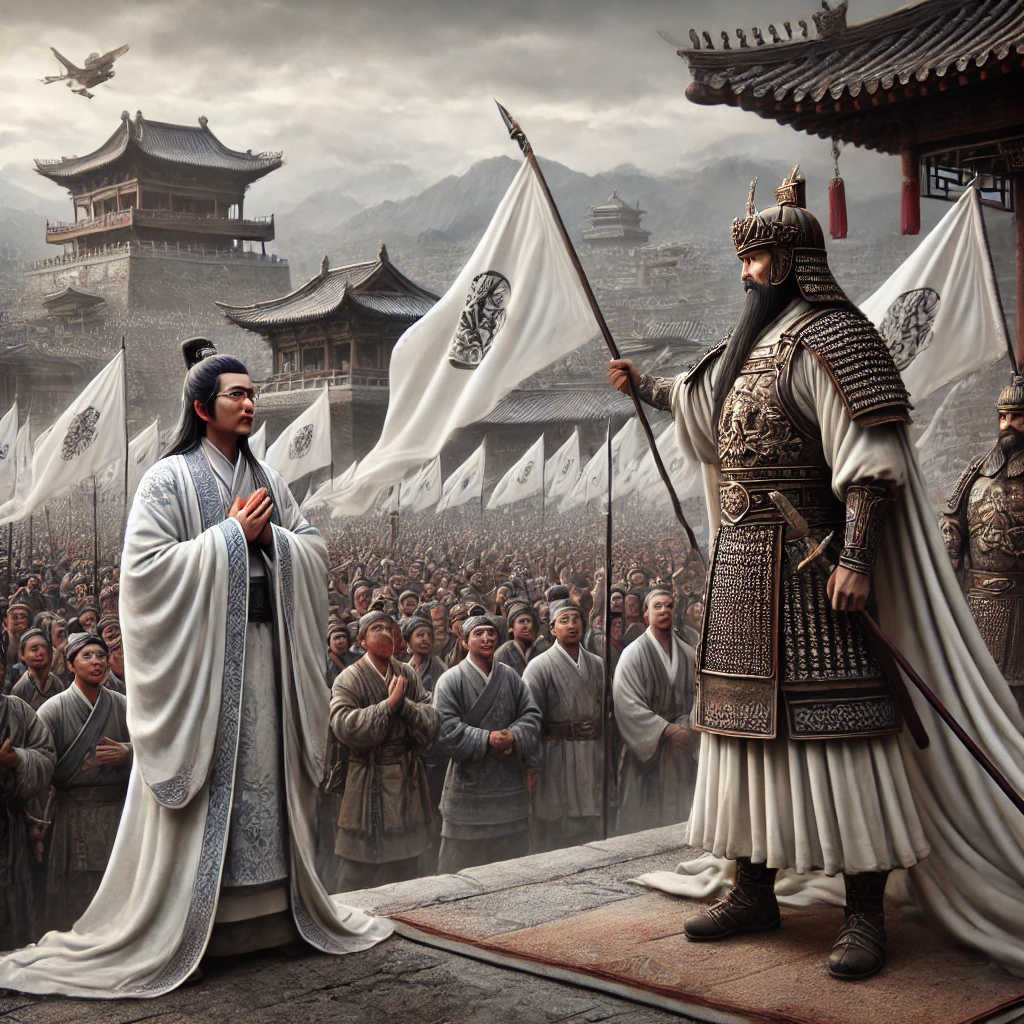
Wu's ruler Sun Hao surrendered to Wang Jun and the others at Stone City. “Fan” means a flag. “Xun” is a unit of length: “eight chi make one xun,” though some say six or seven. In any case, one xun is roughly more than one meter and less than two.
Thus, the first line describes several thousand meters of iron chain sinking to the riverbed, and the second describes Stone City covered in surrender flags. These images are both literal and symbolic: the “iron chains” stand for Eastern Wu's defenses, and the “surrender banners” for its capitulation and defeat. This couplet conveys much the same meaning as the previous one, merely from another angle.
4. How often has the world grieved for the past? The mountain still rests beside the cold river
These two lines seem unexceptional alone, but after the preceding four they are astonishing. We initially think Liu Yuxi is writing only about Eastern Wu, but he is actually reflecting on all of history.
Eastern Wu was the first of the Six Dynasties: Eastern Wu, Eastern Jin, Song, Qi, Liang, and Chen. The preceding lines show Jin's destruction of Wu through four scenes, while this couplet's “How often has the world” makes us think of every dynasty that followed.
It is as if Liu Yuxi screened the beginning of a film in the first two couplets, then “How often has the world grieved for the past” prompts readers to play out the rest in their minds according to the same pattern.
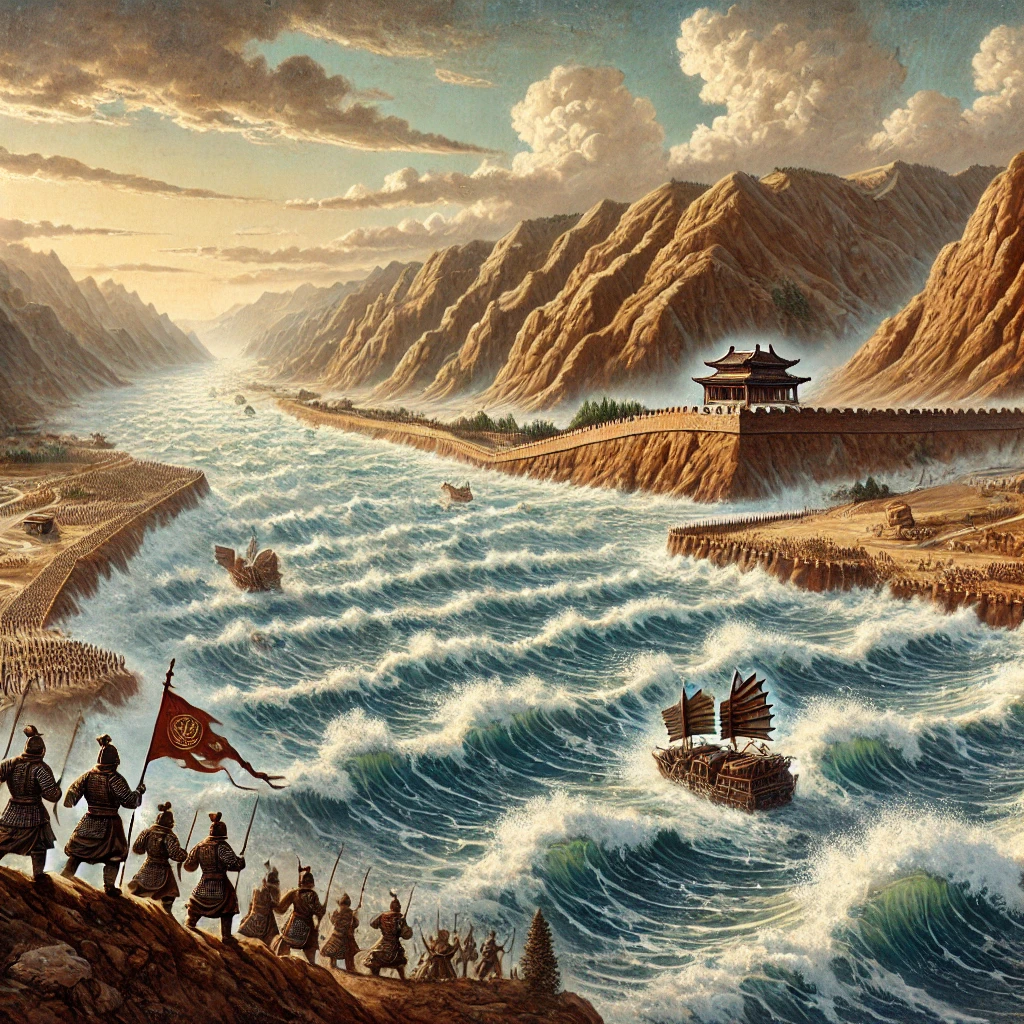
Yet what does it all amount to? However dynasties rise and fall, Mount Xisai still rests beside the Yangtze. The mountain retains its old shape; the water flows on.
This contrast between past and present stirs deep feeling. Poems meditating on the past often move us through precisely this technique, which we will discuss further below.
5. Now the four seas form a single home; autumn reeds rustle around the ruined ramparts
Now the country is united, and Mount Xisai's former fortress and encampments lie abandoned amid reeds in the autumn wind.
The emotions here are complex. Some see the couplet simply continuing the preceding lament over dynastic succession. Others find a philosophical view: all things have periods of glory and decline, suggesting that the Tang too will perish like earlier dynasties. Still others see criticism of the present through the past, warning contemporary rulers to govern diligently or suffer Eastern Wu's fate. Others interpret it as aimed at the Tang's separatist military governors: national unity is history's direction, and those who divide the country will come to no good end.
Different readers in different moods find different meanings. That is one reason this poem rewards repeated reading.
III
Liu Yuxi's historical poems have formulas. One is: “Rise and ruin depend on human affairs; mountains and rivers offer mere terrain.” In other words, “things remain, but people change.” Much happens in the human world, yet mountains and rivers barely change. The contrast deepens our reflections on human affairs.
Take Liu Yuxi's “Stone City” and “Wuyi Lane”:
Mountains still surround the old capital; tides strike the empty city and retreat in loneliness. The old moon east of the Qinhuai River still crosses the battlements late at night.
Wild grass flowers beside Vermilion Bird Bridge; the evening sun slants across the entrance to Wuyi Lane. Swallows once before the halls of Wang and Xie fly into the homes of ordinary people.
Other poets use this technique too, often creating an epic atmosphere.
Yang Shen's “Immortal by the River,” for example, is beautifully suited to opening Romance of the Three Kingdoms and uses the same technique.
Eastward rolls the mighty Yangtze, its waves washing away heroes. Right and wrong, success and failure, turn in an instant to emptiness. The green hills still remain; how many sunsets have glowed red? White-haired fishers and woodcutters on the riverbank are accustomed to autumn moons and spring breezes. Joyfully they meet over a jug of cloudy wine. So many events, ancient and modern, all pass into laughter and conversation.
Another example is Su Shi's “Charm of a Maiden Singer: Meditating on the Past at Red Cliff”:
The great river flows east, its waves sweeping away the outstanding figures of a thousand ages. West of the old ramparts, people say, lies Zhou Yu's Red Cliff of the Three Kingdoms. Jagged rocks pierce the sky, fierce waves strike the shore, rolling up a thousand heaps of snow. The land is like a painting—how many heroes there were in that age!
Examples are countless, so I will list no more.
Yet this technique is really suited only to classical poetry; its applicability is greatly reduced today. Modern society develops too quickly. Changes once described as “seas becoming mulberry fields” might have taken thousands or tens of thousands of years; now they may take only decades. A small city from a dozen years ago may look completely different today. Modern landscapes are also complex. It is hard to capture their characteristics in a few lines; more complex literary forms are needed.
Of course, none of this prevents us from appreciating earlier poetry.
Comments
No account needed. A nickname is required; email is optional. Successful submissions appear publicly without manual pre-moderation.
Comments and nicknames are public. Optional email addresses are not displayed. The selected Waline backend and its hosting provider process comments, nicknames, optional email, IP and browser information. Comments show IP region, without the full IP address or browser and operating system labels. Hosting: Vercel; database: Neon.