I. The Chicken Has Five Virtues
The saying that chickens possess "five virtues" comes from the Outer Commentary on the Han Tradition of the Songs:
Wearing a crest on its head is civility; bearing spurs on its feet is martial prowess; daring to fight an enemy before it is courage; calling to others when it sees food is benevolence; keeping the night watch without missing the hour is trustworthiness.
But the chicken's "five virtues" are not the main point of the original passage. The point comes afterward:
The chicken has these five virtues, yet you cook and eat it daily. Why? Because it comes from close at hand.
The chicken possesses so many virtues, yet instead of treasuring it, you eat it. Why? Because it is too close to you, and you no longer consider it special.
A yellow swan flies a thousand li at a stretch, alights in your garden pond, eats your fish and turtles, and pecks at your grain. It has none of these five virtues, yet you still value it. Why? Because it comes from far away. Therefore I shall leave you: the yellow swan is taking flight.
By contrast, the yellow swan flies a thousand li, stops at your garden pond, eats your fish and turtles, and pecks at your grain. It lacks those five virtues, yet you still treasure it because it comes from far away.
Tian Rao spoke these words when bidding farewell to Duke Ai of Lu. Feeling unappreciated, he compared himself to a chicken to show that the duke did not recognize quality. Tian Rao later went to Yan, where "Yan immediately appointed him minister. After three years, its government was peaceful and well ordered, and the country had no thieves." He fulfilled his ambitions.
II. Chickens and Dogs Ascending to Heaven
In ancient times, chickens were often mentioned alongside dogs, as in the famous idiom, "When one person attains the Way, even his chickens and dogs ascend to Heaven."
The allusion comes from Wang Chong's Discourses Weighed in the Balance. It tells how Liu An, Prince of Huainan, became an immortal after taking an elixir with the help of extraordinary men:
The prince attained the Way, and his whole household ascended to Heaven. All the domestic animals became immortals: dogs barked in the heavens, and chickens crowed among the clouds. This means that elixir remained, and the dogs and chickens ate it and ascended to Heaven along with the prince.
The chickens and dogs ate the leftover elixir, so they could ascend with him.
In fact, Wang Chong did not tell this story because he believed it was true, nor to criticize the phenomenon whereby those connected to a person who gains power also benefit.
On the contrary, this was a legend widely believed by superstitious people at the time. Wang Chong cited it to criticize such superstition. The text immediately continues:
Those who love the Way and study immortality all say it is true. These are empty words. Human beings are creatures. Though they may be as exalted as kings and lords, their nature does not differ from that of other creatures. No creature escapes death, so how can humans become immortal? Birds have feathers and wings and can fly, yet cannot ascend to Heaven. Humans have neither feathers nor wings; by what means could they rise? Even if they had them, they would be no different from birds. Since they lack them, how could they ascend? …
Ancient people were generally superstitious. Both Daoist and Confucian thought in the Han carried strong theological elements. Wang Chong was one of the few materialists who devoted writings specifically to promoting a scientific spirit.
The tale of "chickens and dogs ascending to Heaven" was therefore originally the object of Wang Chong's criticism. He merely preserved these stories by criticizing them.
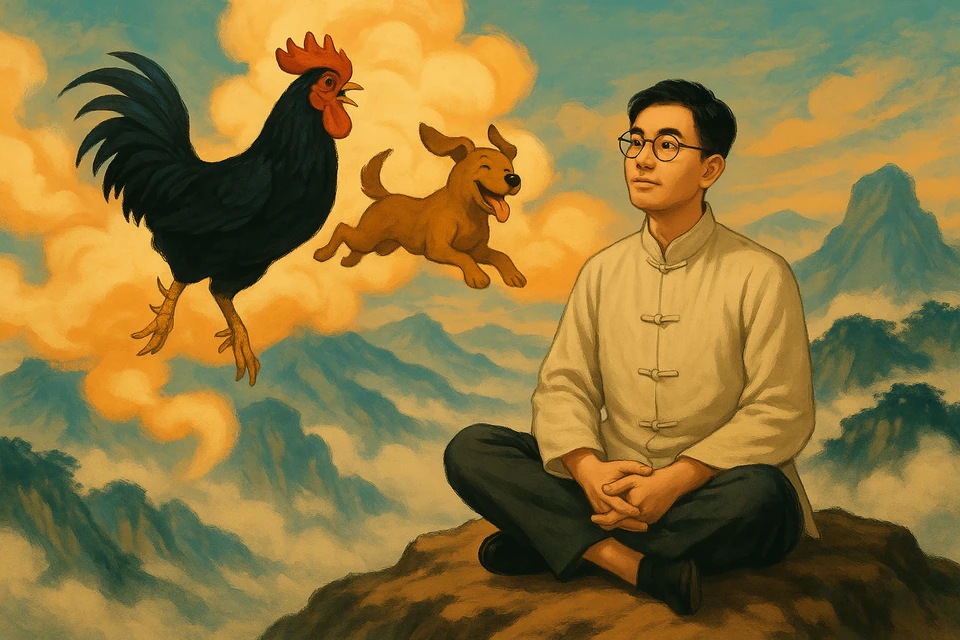
III. Still as a Wooden Chicken
The idiom "still as a wooden chicken" is connected to cockfighting and comes from the Zhuangzi, "Mastering Life":
Ji Shengzi raised a fighting cock for the king. After ten days the king asked, "Is the cock ready?" He replied, "Not yet. It is still vainly proud and relies on its temper." Ten days later the king asked again. "Not yet. It still reacts to sounds and shadows." After another ten days he asked again. "Not yet. It still glares fiercely and bristles with aggression." Ten days later he asked once more. "Nearly ready. Even when other cocks crow, it no longer changes. Look at it: it resembles a wooden chicken. Its power is complete. Other cocks dare not challenge it; they turn and run."
Ji Shengzi raised a fighting cock for the King of Qi, taking forty days to make it ready. What was the standard? It had to resemble a wooden chicken. Why was that good? Because it showed composure: it did not deliberately display its aggression and remained unmoved when other cocks crowed provocatively. When it actually entered the arena, its presence was all the more formidable, intimidating rivals at a glance.
Zhuangzi told this story to say that a true master should be restrained, steady, and unostentatious. Those who flaunt all their sharp edges are instead restless and prone to defeat.
Today, "still as a wooden chicken" means being as dumbstruck as a wooden bird, frozen with fear or astonishment. It has shifted completely from praise to criticism.
IV. Chencang and Baoji
Baoji in Shaanxi was called "Chencang" in ancient times—the Chencang in the saying "openly repair the plank road while secretly crossing through Chencang." It was not renamed "Baoji," or "Precious Chicken," until the Tang dynasty.
Why was it renamed? The Baoji Local Chronicles Office explains:
Baoji was anciently called Chencang, named after Mount Chencang, today's Mount Jifeng. In the second year of the Zhide era of Emperor Suzong of Tang (757), the crowing of a divine chicken was heard on Mount Chencang. Suzong regarded the divine chicken as a national treasure and its crowing as an auspicious omen, and therefore renamed Chencang County Baoji County. The name has continued to this day.
In fact, legends about crowing at Chencang already existed a thousand years earlier, though they did not concern a real chicken.
The "Treatise on the Feng and Shan Sacrifices" in the Records of the Grand Historian records that Duke Wen of Qin, who reigned from 766 to 716 BCE, discovered a stone-like object in Chencang. It arrived at night, shone like a shooting star, resembled a rooster, and sounded like crowing. Duke Wen therefore named it "the Treasure of Chen."
Duke Wen of Qin obtained something said to resemble a stone, and built a shrine to it on the northern slope of Chencang. Its spirit sometimes did not appear for a year and sometimes came several times a year. It usually arrived at night, shining like a shooting star and coming from the southeast to settle within the shrine enclosure. It resembled a rooster, its sound rolled like thunder, and pheasants called at night. It was worshipped with a sacrificial animal and named the Treasure of Chen.
This account is mysterious. Later scholars suggested that the object was simply a meteorite and not so supernatural. In any case, renaming Chencang "Baoji" was not an arbitrary whim; it at least respected an ancient legend.
Indeed, poetry and prose linked Chencang with a precious chicken even before the renaming. For instance, Zhang Heng of the Western Han wrote in "Rhapsody on the Western Capital": "There is the Treasure of Chen, the crowing chicken." Xu Ling of the Southern Dynasties wrote in "Cockfighting": "If news comes from Chencang, seek out the precious chicken and bring it here."
V. Crowing Like a Chicken and Stealing Like a Dog
This story concerns Lord Mengchang, Tian Wen. Representing Qi on a mission to Qin, he won the admiration of King Zhaoxiang, who wanted to make him Qin's minister. The king later changed his mind, imprisoned him, and planned to murder him.
Lord Mengchang sought help from the king's favorite concubine, who wanted the white fox-fur coat he had already presented to the king. But the coat had been sent into the palace and could not be retrieved, leaving all his retainers at a loss. Finally, a guest skilled at imitating a dog's bark stepped forward and used this ability to obtain the coat from a palace storeroom.
After receiving the gift, the concubine pleaded with the king as promised, and the king released Lord Mengchang. Fearing that the king would change his mind, Lord Mengchang fled that night, but could not pass Hangu Pass. Under Qin law, the gates could not open until the cock crowed. None of the assembled retainers had an answer until another guest, skilled at imitating a rooster, stepped forward. His crowing caused the pass to open early.
Lord Mengchang liked maintaining retainers and turned no one away. At first, his other guests disdained the company of men whose talents were crowing like chickens or stealing like dogs. Yet in a moment of real danger, these two saved his life, and only then did everyone accept their worth.
Of course, stories like this in the Records of the Grand Historian can simply be enjoyed as tales, rather like a story collection. I seriously doubt its authenticity; the real situation could not have been so simple.
Wang Anshi was similarly unimpressed. He commented:
Everyone says Lord Mengchang could attract worthy men, who therefore gathered around him, and that he ultimately relied on their strength to escape the tiger-and-leopard state of Qin. Alas! Lord Mengchang was merely a leader of men who crowed like chickens and stole like dogs. How can this be called attracting worthy men? Otherwise, commanding the strength of Qi, had he obtained even one true worthy, he should have been able to face south as a ruler and control Qin. Why would he still have needed such tricks? It was precisely because such men came through his gates that true worthies did not come.
In other words, if Lord Mengchang had truly been good at recognizing and employing talent, he would never have fallen into a position where he needed men who crowed like chickens and stole like dogs. This observation cuts straight to the point.
VI. Chicken and Penis, Cock and Cock
There is a very strange phenomenon: Chinese ji, "chicken," and English "cock" can both mean a chicken and a penis… Why do the two languages coincide in this respect? I thought about it for three days and nights without finding an answer.
Some say the extended use of "cock" is connected to cockfighting. The rooster's image emphasizes masculinity, fighting spirit, and strong reproductive ability, bringing that organ to mind.
Keith Thomas says:
"Just as hunting was valued for mimicking war, cockfighting and dog-and-bear fighting were valued for representing individual combat. The cock symbolized male courage and sexual potency…" (Man and the Nature World)
A popular Chinese saying goes, "Say ji without saying ba, and we can all be civilized," since jiba is a vulgar term for penis. Thus, in the name of civility, Baidu Tieba has forums, or ba, for all twelve zodiac animals except the chicken. Baidu consequently acquired the affectionate feminine nickname "Du Niang," which remains in use.
I cannot readily establish how the Chinese extended meaning "ji*" arose. Apparently not every region uses "ji*": some call it a "bird," others a "sparrow," and others an "ox."
In short, this subject runs too deep for me to understand alone. Readers, please enlighten me.
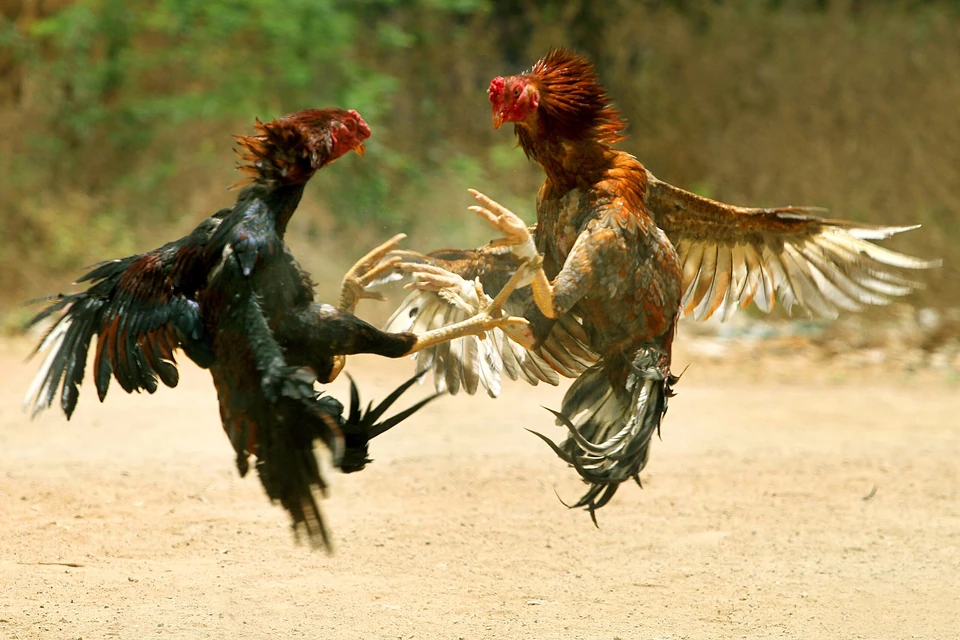
VII. Chickens and Ducks
Another strange phenomenon: when referring to an organ, "chicken" means a male organ; when referring to the person, however, "chicken" means a woman—while a man with the same occupation is called a "duck."
Why is this? There are several explanations.
First: ji, "chicken," sounds the same as ji, "prostitute," hence the usage.
Second: roosters show off and make a racket, resembling sex workers displaying their charms and fitting the noisy, bustling atmosphere of red-light districts.
Third: the expression "calling a chicken" originated during the era of Hong Kong's Shek Tong Tsui pleasure district. Hiring a celebrated courtesan required a floral calling card worth one Hong Kong dollar. This card was called "Kai." Because people pronounced it inaccurately, they mispronounced kai as the word for chicken. The usage spread, and "calling kai" gradually became equivalent to "calling a chicken," meaning hiring a prostitute, before spreading to other Cantonese-speaking areas.
Available material suggests, however, that this use of "chicken" first came from Hong Kong and Taiwan, then spread through Cantonese-speaking areas, and finally became popular nationwide.
Of course, this usage is contemptuous, derogatory, and disrespectful. Readers should use it cautiously.
VIII. Injecting Chicken Blood
That special use of "chicken" came from Hong Kong and Taiwan, but "injecting chicken blood" originated on the mainland.
In the 1950s and 1960s, a treatment became popular among the Chinese public in which blood drawn from live chickens was injected into humans, supposedly to boost immunity and cure every disease.
People did feel temporarily excited after the injections, and some illnesses appeared to improve, so "chicken-blood therapy" enjoyed a brief craze. But it was soon found to do more harm than good, readily causing infection and allergic reactions, and was eventually officially prohibited.
Today, saying someone is "as if injected with chicken blood" means they are excited, impulsive, and blindly enthusiastic, with a touch of irony or at least teasing.
"Chicken-blood parenting" is now another popular expression. Its original meaning was simply to inject the child with chicken blood.
The metaphor is vivid, and a more suitable expression is hard to find at present.
IX. Cocktails and Cocktails
The cocktail is also named after the chicken. It is a mixed drink based on spirits with additions such as juice, syrup, and bitters. The term first appeared in early nineteenth-century American documents, defined then as "a stimulating liquor, composed of spirits of any kind, sugar, water, and bitters."
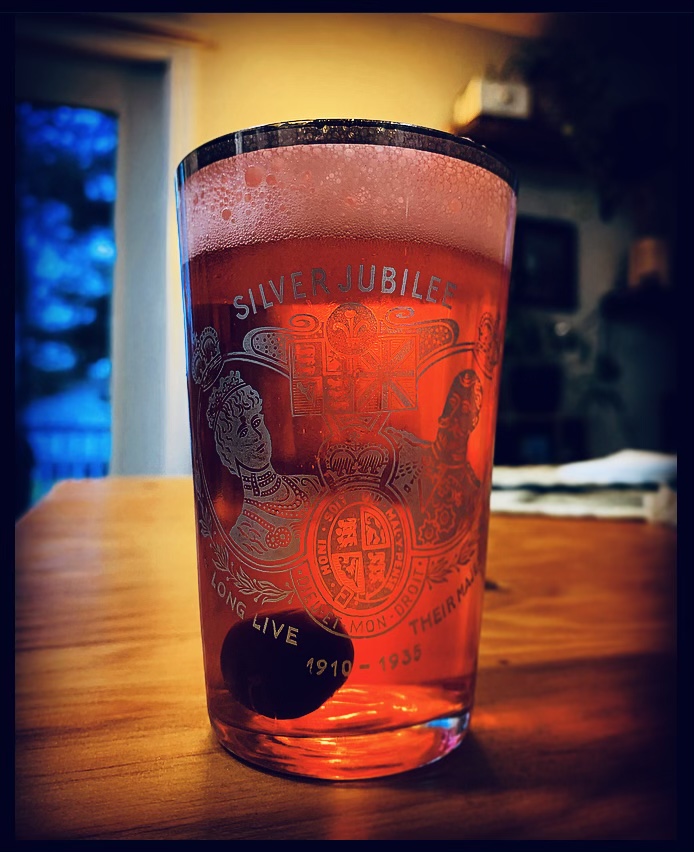
The word's origin remains disputed. Some historians and etymologists believe that cocktails are actually connected to horses.
What connection?
Etymologist Anatoly Liberman says:
There was a custom of docking the tails of horses that were not thoroughbreds. Such horses were called "cocktailed horses," later shortened to "cocktails." By extension, "cocktail" also described a lowborn person pretending to upper-class status, well dressed but lacking genuine breeding. The 1806 definition of the drink specifically mentioned water as an ingredient, showing that a cocktail was fundamentally diluted alcohol: not a "thoroughbred," but a mixture with elevated pretensions. Reusing the slang "cocktail," previously applied to inferior horses and sham gentlemen, was therefore entirely natural.
According to this explanation, pure liquor corresponds to a thoroughbred, while a cocktail corresponds to a mixed-breed horse with a docked tail masquerading as a thoroughbred.
In other words, the etymological development of "cocktail" in English already carried a sense of "mixed." (Though I still cannot understand why mixed-breed horses with docked tails were called "cocktailed horses"…)
In any case, dictionaries give "cocktail" two additional meanings, both connected with mixing. One is a cold dish or appetizer (a dish of small pieces of food, usually served food), as in "fruit cocktail," a cold dish combining different fruits. The other is a mixture (a mixture of different substance, usually ones that do not mix together well), as in "a lethal cocktail of drugs."

X. Roosters and Hens
In ancient times, chickens had four basic uses: meat, eggs, crowing, and fighting. Both roosters and hens provide meat, but only hens lay eggs, while crowing and cockfighting depend on roosters. Their functions and appearances therefore differ greatly, giving rise to various expressions.
In English, a hen is a female chicken. "Henpecked" literally means pecked by a hen and figuratively describes a man who is tightly controlled by his wife, timidly obedient, and without opinions of his own. It means the same as the Chinese expressions "strictly wife-managed" and "soft ears."
"Chick" means a young chicken. "Chicken" can mean chickens in general, a young chicken, or chicken meat, with context determining the intended meaning.
Both "cock" and "rooster" mean a male chicken, the former being British usage and the latter American. Supposedly, Americans so often used "cock" for a certain other thing that when they actually wanted to name the bird, it felt too crude. They therefore began using "rooster" in the eighteenth century. "Roost" means to perch or a place where birds perch.
In Chinese, pin means a female animal, so pinji means a hen. The idiom "the hen announces the dawn" describes a hen taking over the rooster's morning crow and was used in ancient times to compare women to usurpers who disrupt government. It comes from the Book of Documents:
The ancients said: "A hen does not announce the dawn. When a hen announces the dawn, the household will fall." Now Zhou, King of Shang, listens only to the words of a woman and, in his confusion, abandons the sacrifices without attending to them.
Of course, claiming that King Zhou lost his kingdom because he blindly listened to a woman and abandoned sacrifices reflects the prejudices of ancient patriarchal society.
By contrast, in Zhao Benshan's comedy sketch, an "egg-laying rooster" is called "the fighter jet among roosters," a wholly complimentary expression.
- END-
This is a WeChat public account where you can learn something new. Follow me for more interesting articles~
Related article:
One Angry Crow, a Fallen State: Stories of Cockfighting in Chinese History
Comments
No account needed. A nickname is required; email is optional. Successful submissions appear publicly without manual pre-moderation.
Comments and nicknames are public. Optional email addresses are not displayed. The selected Waline backend and its hosting provider process comments, nicknames, optional email, IP and browser information. Comments show IP region, without the full IP address or browser and operating system labels. Hosting: Vercel; database: Neon.