There is a question on Zhihu: “Can AI therapists truly ‘empathize’? What is the fundamental difference between algorithmic comfort and human comfort?”
The question itself is actually leading.
What is “empathy”? And what is “true empathy”?
My guess is that an assumption is hidden behind it: human comfort is nobler than algorithmic comfort, and AI cannot truly empathize.
The answers below it do indeed cater to this assumption.
But is that really the case? Let us examine the question carefully.
1 First, We Must Ask: What Is “Empathy”?
Empathy means putting yourself in another person's shoes, imagining yourself in their circumstances to understand and feel their situation and emotions.
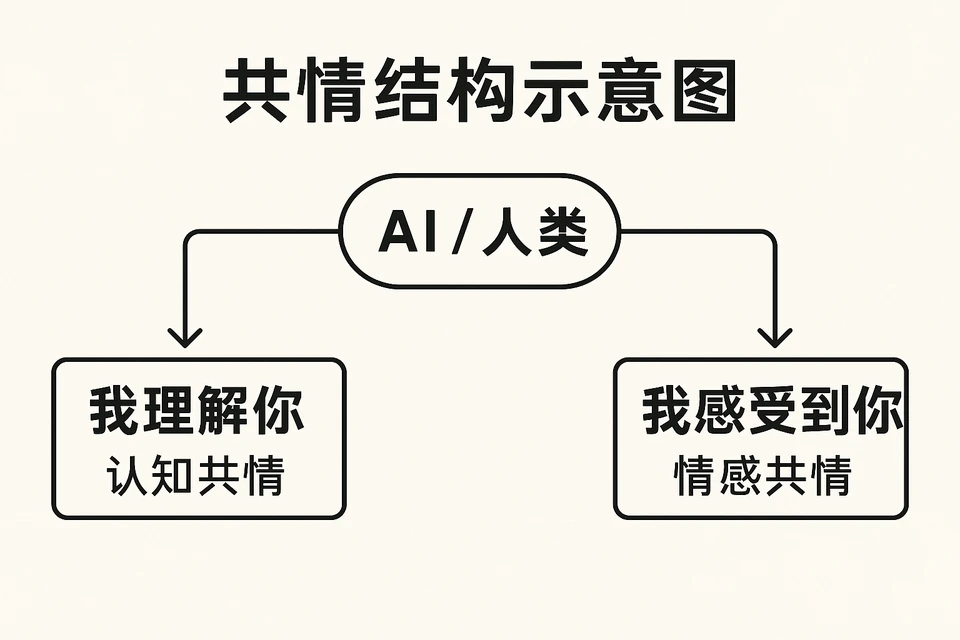
Empathy has two aspects: “knowing what another feels” and “feeling what another feels.”
The first is called Cognitive Empathy: understanding another person's emotions and circumstances. For example, “I know you're very sad.”
The second is called Emotional Empathy: resonating with another person's emotions. For example, “I feel your pain too.”
How, then, does AI comfort work?
Simply put: AI comfort = emotion recognition + pattern matching + response generation.
Emotion recognition: it identifies the user's emotional state through text or image input. If you say, “I'm so tired today; life feels meaningless,” AI may identify “exhaustion + depressive tendencies.”
Pattern matching: based on your emotional state, it matches corresponding comfort templates or conversational frameworks in its database and further determines whether you need encouragement, empathy, advice, or companionship.
Response generation: using a large language model, it generates personalized words of comfort suited to the context. It may refer to earlier conversations and choose the style of expression you prefer. AI also adjusts tone, pacing, and word choice to create a response that feels human.
Some AI systems add a persona, such as “an understanding female listener.” Others add long-term memory and refer back to earlier conversations to make their answers feel familiar.
In short, every part is a non-emotional computational process. There is no “genuine concern,” only “high-quality imitation.”
Strictly speaking, then, AI cannot “know what another feels,” much less “feel what another feels.” An AI therapist cannot truly “empathize.”
That answers the question.
2 But I Want to Ask One More Thing: Do We Really Need “True Empathy”?
Everyone has a psychological need for comfort. Others' empathy can provide reassurance and help us feel better.
But the degree of empathy people demand varies, depending both on the person and on the situation.
For example, when sad and seeking comfort, some people need only to know that the other person understands their sadness. Others want that person to feel sad alongside them, or at least show signs of sadness. In certain situations, some people desperately want the other person to experience their circumstances fully and cry with them; otherwise, they believe the person does not care.
Emperor Qianlong, for example, was very close to Empress Fuca. After her death, he was devastated, wrote many poems in mourning, and held an elaborate funeral.
Qianlong did not merely grieve himself. He harshly demanded empathy from everyone else, severely punishing those who showed “insufficient empathy.” For example:
① In the Hanlin Academy's ceremonial text for the empress, the Manchu translation mistakenly rendered “imperial deceased mother” as “former empress dowager.” Qianlong therefore dismissed every official in the Ministry of Punishments and sentenced Akdun, the minister of punishments overseeing the Hanlin Academy, to death pending review, with execution after autumn.
② Believing the empress's ceremonial book and seal were insufficiently well made and unworthy of her dignity, Qianlong punished the entire senior leadership of the Ministry of Works.
③ Because tables used for the rites were not clean enough, he demoted all the principal officials of the Court of Imperial Entertainments.
④ He punished every official who shaved his head within one hundred days; some were executed, others dismissed.
⑤ When his eldest son Yonghuang and third son Yongzhang did not show enough grief at the empress's funeral, he berated them on the spot and declared that neither prince “could ever inherit the throne.”
Zhang Hongjie writes in The Hungry Age of Prosperity:
Such a vicious tongue-lashing of two children showed that the emperor was in a state of psychological disturbance. He wanted everyone to understand his suffering. He could not understand why, when the sky had fallen, so many people could remain calm and carry on as though nothing had happened.
Exactly: to Qianlong, the sky had fallen. Why were you all unmoved? Why could you not understand his suffering? Idiots! Every last one of you!
The problem is that nobody can completely understand another person, let alone fully feel what another person feels.
Qianlong, you loved the empress because you cried together, laughed together, did xxx together, and shared many experiences. That is why her death caused you infinite sorrow. But others did not share those experiences. Many had never even seen Empress Fuca and had no emotional connection to her. Why should they grieve? Acting along with you already showed plenty of respect.
Some who had lost their own wives might draw on their experience to feel a little of it. But many were still single, and some may have just married and been delighted. How were they supposed to feel it? Many simply were not sad, failed to pretend convincingly, and gave themselves away. Is that not normal human nature? Is forcing others to empathize with you not a form of oppression? Could you, Qianlong, feel the joys, sorrows, meetings, and partings of ordinary people?
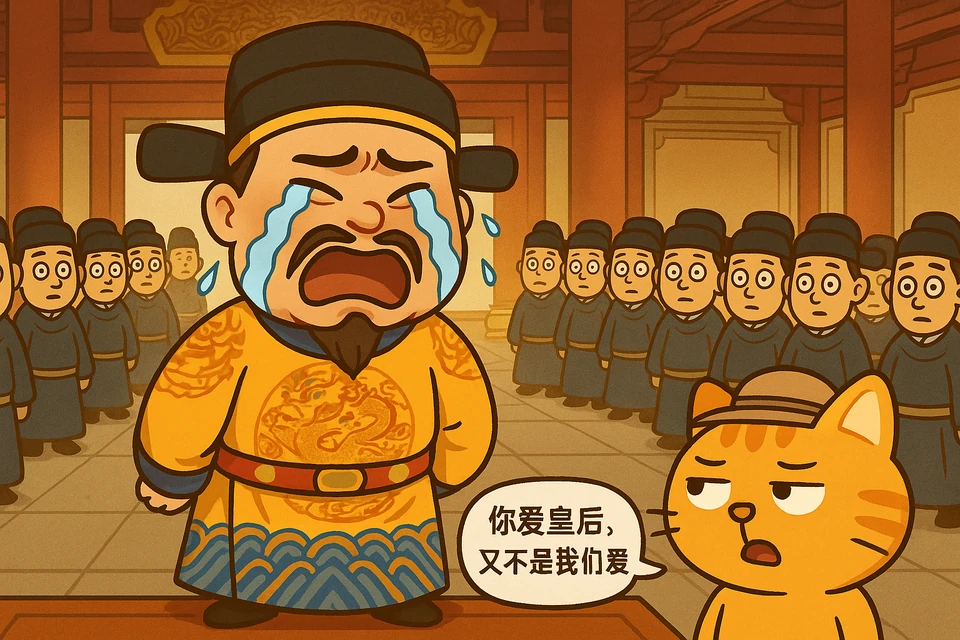
I give this extreme example to make a point: your life is your own. Nobody is obliged to make you the center of their world or fully understand and feel what you feel. “True empathy” is impossible. Pursue it single-mindedly and you will only encounter rotten boyfriends and fake best friends.
“One true confidant in life is enough.” Even a confidant can understand you deeply only in certain respects. Most people do not even have a confidant, yet life must go on. Why insist on true empathy?
I therefore believe that people should not, and cannot, pursue complete empathy. We naturally need psychological comfort, but developing our own character and resilience matters more. With inner strength, simple words of comfort can be enough to reassure us and help us move forward.
3 Algorithmic Comfort Is Enough to Provide Emotional Support
Besides, the human comfort we encounter in everyday life is not always satisfactory.
Some people do not value you, so their comfort is somewhat perfunctory.
Some lack the life experience to understand your feelings, even if they sincerely want to comfort you.
A very few understand you and are willing to listen. But they have their own lives and cannot accompany you indefinitely. Sometimes supporting your emotions drains their own, so human comfort cannot last forever.
What about therapists? Can they fully understand you? They have mainly acquired extensive professional psychological knowledge and seen enough cases. Because they are paid, they are willing and able to suggest solutions from your perspective and offer comfort through various methods.
In other words, human therapists cannot truly “empathize” either. Comforting you is their job. They rely more on psychological knowledge, cases, and experience than on “empathy” with you. In fact, after encountering many patients, many therapists become emotionally numb, replacing feeling with professional composure.
Now consider AI. What fundamental difference is there between the mechanism of AI comfort and that of a wholly rational human therapist? AI's database may even be richer than an individual therapist's experience.
AI is also inexpensive, tireless, and draws on a vast body of human experience. Only AI will make you its complete focus. In theory, if you describe things in enough detail, it can fully place itself in your situation, tailor the words of comfort you most need, and suggest the solutions best suited to you—as long as you have time to train it and feed it information.
Do you still think human comfort is nobler than algorithmic comfort?

Of course, if you really have a soulmate who makes you their entire focus and can remain with you for a long time, that person easily outclasses AI. That would cost them their own agency, but that is another question.
The question is: can you find such a person?
What you seek is not really true empathy. Most of the time, you simply want someone who never tires of replying to your messages. AI is enough for that.
AI indeed cannot empathize, but it provides high-quality emotional imitation. Every time you tell it your troubles, it draws on an emotional database more patient than your mother. AI will not truly understand you, but it will offer the words you most want to hear.
Is that not enough?
Embrace AI! It is a privilege unique to our era!
Whom Would You Rather Confide In?
1. Someone who truly understands you
2. Someone who always replies to your messages
3. Nobody; I would rather bottle it up
4. AI, of course. AI is the best
Comments
No account needed. A nickname is required; email is optional. Successful submissions appear publicly without manual pre-moderation.
Comments and nicknames are public. Optional email addresses are not displayed. The selected Waline backend and its hosting provider process comments, nicknames, optional email, IP and browser information. Comments show IP region, without the full IP address or browser and operating system labels. Hosting: Vercel; database: Neon.