The very existence of this question begins with the administrative boundary changes of 1949–1952.
During the Ming and Qing dynasties, Linzhang and Anyang both belonged to Zhangde Prefecture in Henan Province, whose seat was Anyang.
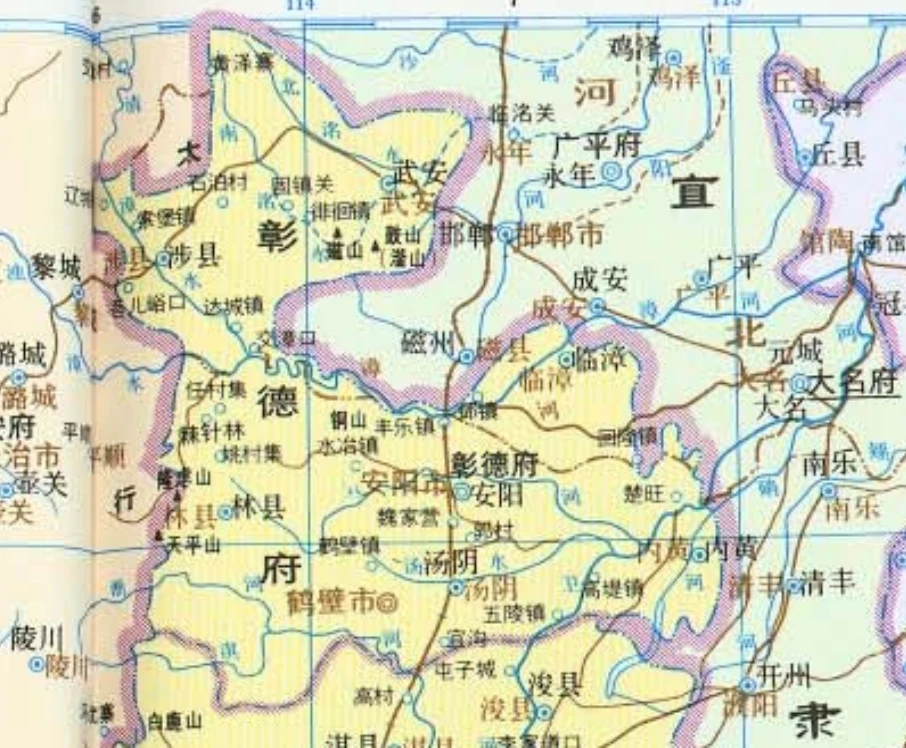
Qing map
This question simply would not have arisen during the Ming or Qing.
Suppose, for example, that Linzhang were now a county under Anyang. Would people still agonize over whether Ye City was in Anyang or Linzhang? Linzhang would be in Anyang—more or less the same thing.
The key is that Linzhang County now belongs to Handan. It is not merely in a different city from Anyang, but in a different province. Hence the dispute.
When, then, was Linzhang assigned to Handan, and why?
From 1949 to 1952, to restore the North China Plain's economy, the People's Republic briefly established Pingyuan Province, encompassing Xinxiang, Puyang, Anyang, Heze, Huxi, Liaocheng, Anyang, and other areas, with its capital in Xinxiang.
At that time, Linzhang County, formerly in Henan, was assigned to Handan Special District, while Anyang City was assigned to Pingyuan Province.
When Pingyuan Province was abolished in 1952, the old boundaries were not entirely restored. Adjustments were made, chiefly to facilitate river management. Puyang and other places formerly in Hebei were assigned to Henan to facilitate Yellow River management; Linzhang and other places formerly in Henan were assigned to Hebei to facilitate management of the Zhang River:
The twenty-nine counties now belonging to Pingyuan Province but formerly under Shandong—Gaotang, Qingping, Boping, Chiping, Liaocheng, Tangyi, Guanxian, Shenxian, Chaocheng, Yanggu, Dong'e, Liangshan, Shouzhang, Fanxian, Guancheng, Puxian, Juancheng, Yuncheng, Nanwang, Jiaxiang, Juye, Heze, Dingtao, Chengwu, Jinxiang, Yutai, Shanxian, Fucheng, and Caoxian—shall all return to Shandong. The twenty-two counties formerly under Henan—Linxian, Anyang, Yexian, Neihuang, Tangyin, Junxian, Huaxian, Qixian, Jixian, Huixian, Xinxiang, Yanjin, Fengqiu, Yuanyang, Huojia, Xiuwu, Wuzhi, Bo'ai, Wenxian, Qinyang, Mengxian, and Jiyuan—along with the cities of Xinxiang and Anyang and the Jiaozuo Industrial and Mining District, shall all return to Henan;
The five counties formerly under Hebei—Nanle, Qingfeng, Puyang, Dongming, and Changyuan—shall likewise be assigned to Henan, rather than returned to Hebei, to facilitate Yellow River management. Wu'an, Shexian, and Linzhang, now in Hebei but formerly under Henan, shall remain unchanged in Hebei to facilitate management of the Zhang River. —“Directive of the CPC Pingyuan Provincial Committee on Correctly Implementing the Central Authorities' Decision to Abolish Pingyuan Province,” November 16, 1952
Linzhang thereafter became firmly part of Handan, Hebei, ending its long history under Henan.
The key to this administrative change was the Zhang River.
The Jiajing-era Gazetteer of Zhangde Prefecture records: “The Zhang River is prone to shifting.” In other words, it frequently flooded and changed course, and the precise locations of towns along its banks frequently changed too.
The present ruins of Ye City comprise northern and southern cities. The northern city was built by Cao Wei and lies mostly north of today's Zhang River, under Linzhang County. The southern city was built by Eastern Wei and lies south of the river, under Anyang.
When Cao Wei built Ye City, however, it was on the Zhang River's southern bank. Only after the river changed course repeatedly did it end up relatively north of the river today.
In fact, Ye City was always a major military town immediately beside the Zhang River's southern bank.
Have you wondered why, during the Warring States period, Handan and Ye City lay only forty kilometers apart yet belonged to different states, Zhao and Wei?
Handan was Zhao's capital, while Ye City was the center of Wei's Henei Commandery. Why were two central cities so close?
Because the Zhang River then carried much more water and ran farther north than today. Handan stood forty li north of it, while Ye City stood on its southern bank. Developing Ye City allowed Wei to defend effectively against Zhao's attacks.
When Ximen Bao governed Ye, he dug irrigation channels, turning the surrounding area into an important grain-producing region.
With convenient water transport, abundant grain, and strategic terrain, Ye City gradually became the center of the entire Hebei region. Yuan Shao, Cao Wei, Later Zhao, Ran Wei, Former Yan, Eastern Wei, and Northern Qi all made it their capital. In 580, Yang Jian burned it down, moving the administrative seats of Xiangzhou, Wei Commandery, and Ye County, along with Ye's residents, to the old city of Anyang. Ye City was abandoned and never revived.
Why, then, could Chang'an and Luoyang recover from repeated destruction, while Ye City never did?
The key again lay in the waterways.
During the Northern Song, the northern region's center was Daming, the dynasty's “Northern Capital” and Hebei's largest city.
Daming stood beside the Zhang River downstream from Ye City, connected to the Grand Canal through the Yongji Canal. To an extent, it replaced Ye City's strategic role.
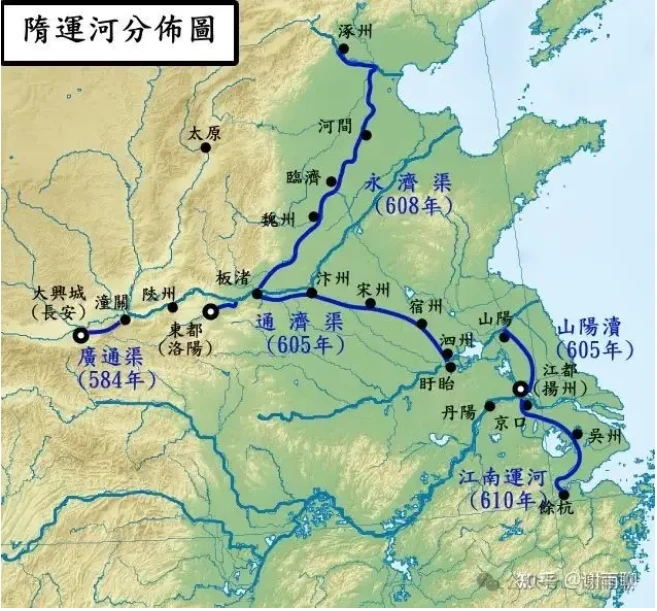
The Sui canals. Daming lies on the Yongji Canal
The Zhang River lacked proper management. Repeated course changes and silting reduced its navigability and military importance. Later canal systems also lay mainly farther east. Compared with Linqing and Liaocheng, its river-transport advantages vanished.
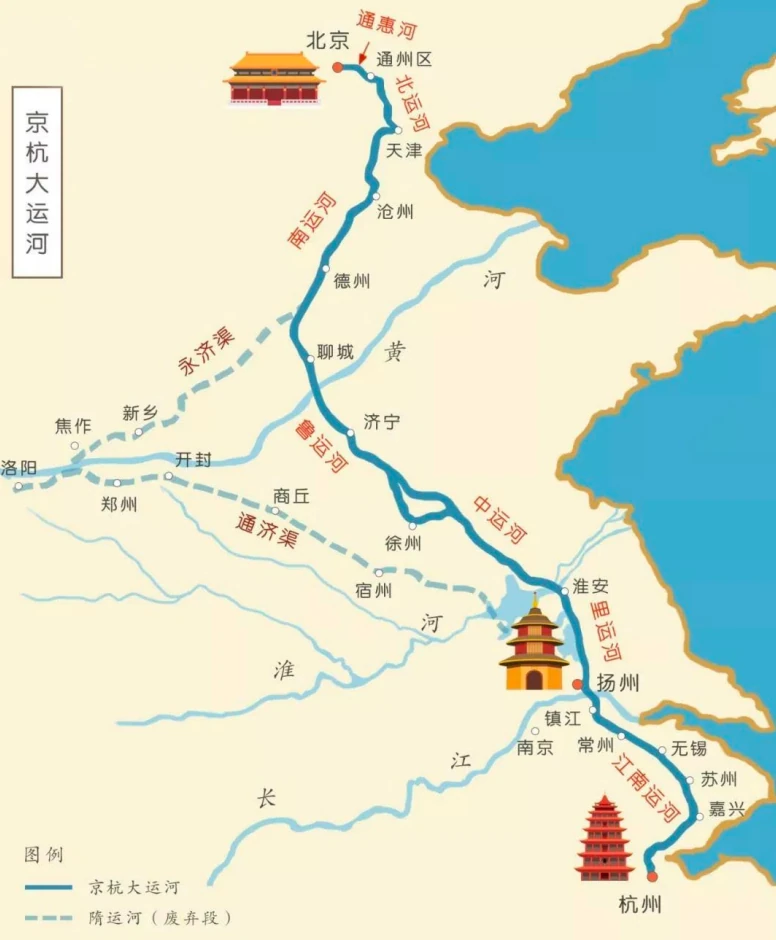
Thus, along the north–south Guangyang–Handan corridor, today's Beijing–Guangzhou route, Handan and Anyang took Ye City's place. On the waterways, Daming and Liaocheng replaced it. Naturally, rebuilding Ye City was no longer necessary.
In modern times, Yellow River floods, the canal's abandonment, and the construction of the Beijing–Guangzhou railway theoretically created a possibility of revival. By then, however, the old site had long become farmland, with Handan to its north and Anyang to its south, while it occupied the awkward boundary between Henan and Hebei…
Now Ye City is a cultural site being put to use by both provinces, one fish served two ways, making what may be its final contribution.
So, returning to the original question: who exactly is Ye City's successor?
Geographically, Linzhang in Hebei inherited the larger part, and Anyang in Henan the smaller.
As a city, Anyang inherited Ye City, since its inhabitants were all moved there.
In strategic position, Anyang inherited a share and Handan half.
But the real Ye City is dead, gone. No one inherited it. Neither Handan nor Anyang can become North China's center, much less a capital. Anyang and Linzhang should strive to create their own history and look forward, rather than fixate on a dead city.
-END-
This is a public account that helps you learn. Follow me to read more interesting articles~
Comments
No account needed. A nickname is required; email is optional. Successful submissions appear publicly without manual pre-moderation.
Comments and nicknames are public. Optional email addresses are not displayed. The selected Waline backend and its hosting provider process comments, nicknames, optional email, IP and browser information. Comments show IP region, without the full IP address or browser and operating system labels. Hosting: Vercel; database: Neon.