The conflicts among political forces within each country are far greater than the conflict between the two countries' rulers, and greater still than any conflict between their peoples.
First, Thailand has two major political forces: the royal family and military on one side, and the elected civilian government on the other, represented by the Shinawatra family. The current prime minister, Paetongtarn, is Thaksin's youngest daughter. The former controls military power and the economy's lifelines; the latter consists of big capitalists. The civilian government is generally friendly toward China, while the military's position is complex, with both pro-China and pro-US figures. Of course, we could also put it this way: there has never really been any “pro-China” or “pro-US”—everyone simply starts from their own interests.

What about Cambodia? It too is a constitutional monarchy, but the king has virtually no power, and the Hun Sen family mainly controls the government. Under Hun Sen's leadership, Cambodia aligned itself fully with China. After his son Hun Manet succeeded him as prime minister on August 22, 2023, Cambodia continued to maintain good relations with China, but placed greater emphasis on multilateral balance and was slightly less friendly toward China than under Hun Sen.
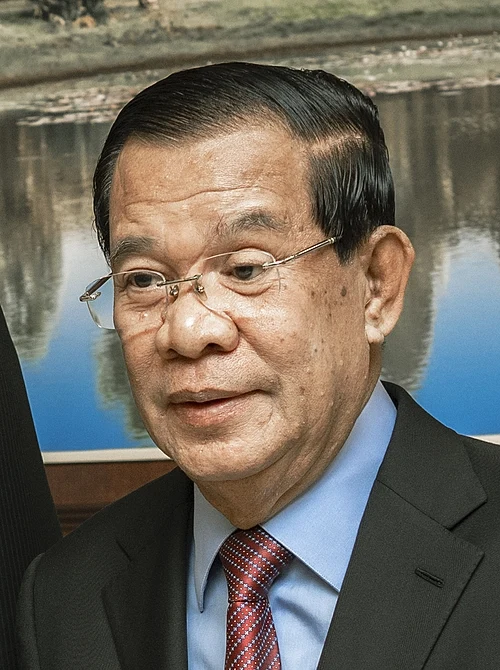
The timeline of this Thai–Cambodian conflict offers some clues:
On May 28, 2025, Thai and Cambodian troops briefly exchanged fire along the border, killing one Cambodian soldier. The location was the Chong Bok pass, part of the Emerald Triangle at the junction of Thailand, Cambodia, and Laos. The boundary is confusingly demarcated, a legacy of history. Like the India–Pakistan situation, it is a dispute deliberately left behind by Western countries before their departure.
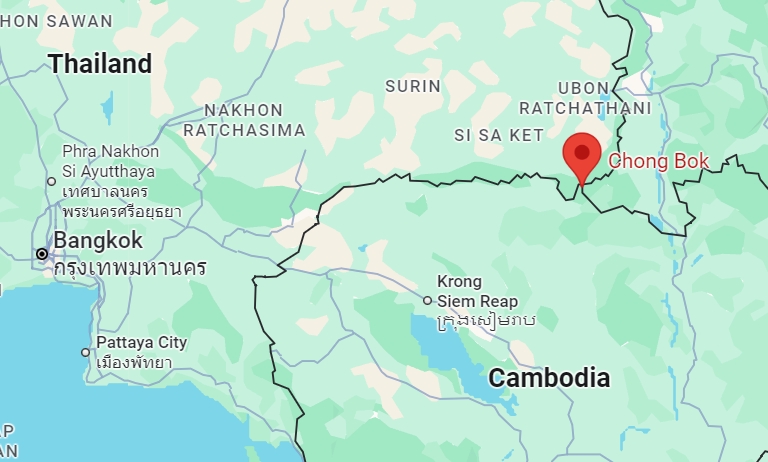
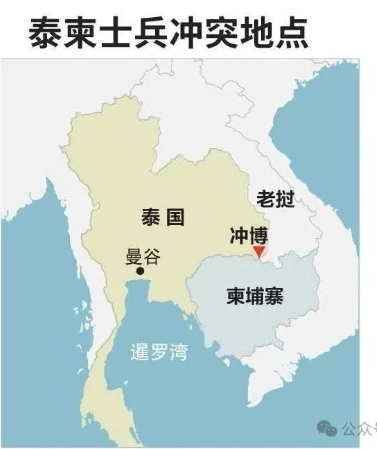
According to Thailand, Thai soldiers found large numbers of Cambodian troops digging trenches in an area considered Thai territory. Fighting broke out after Thai attempts to persuade them failed.
From Cambodia's perspective, the area was not Thai territory. Thai soldiers fired first, the dead soldier was Cambodian, and the clash ended only after Cambodia called Thailand.
In short, each side accused the other of initiating the dispute. Cambodia made a fuss about taking the matter to an international court while reiterating that it did not want conflict with Thailand. Thailand also showed relative restraint and said it wanted to ease tensions. Only some military figures adopted a hard line, while Prime Minister Paetongtarn declared, “We will never give up an inch of our territory, but neither will we enter a war because of misunderstanding.”
On June 15, 2025, Paetongtarn spoke to Hun Sen by telephone in a private capacity. Her tone was gentle. She respectfully addressed him as “uncle,” called herself his “niece,” and criticized certain Thai military figures who had made forceful statements.
June 18, 2025:
A nine-minute recording of a telephone conversation between Paetongtarn and Hun Sen was leaked [55]. Hun Sen acknowledged deliberately recording the audio and forwarding it to around eighty officials [55]. Later, he also posted the full seventeen-minute conversation on his Facebook account to “avoid misunderstanding and misinterpretation [56].” Paetongtarn also confirmed the recording's authenticity [55]. —Excerpt from Wikipedia
This put Paetongtarn on the defensive. Even holding a special press conference to explain herself could not stop opposition and public demonstrations.
On June 20, 2025, Thai Senate President Mongkol Surasajja submitted requests to impeach Prime Minister Paetongtarn to the National Anti-Corruption Commission and the Constitutional Court.
On July 1, 2025, the Constitutional Court announced that it would hear the constitutional case against Paetongtarn, and she was immediately suspended. Deputy prime ministers took turns as acting prime minister. Paetongtarn remained culture minister.
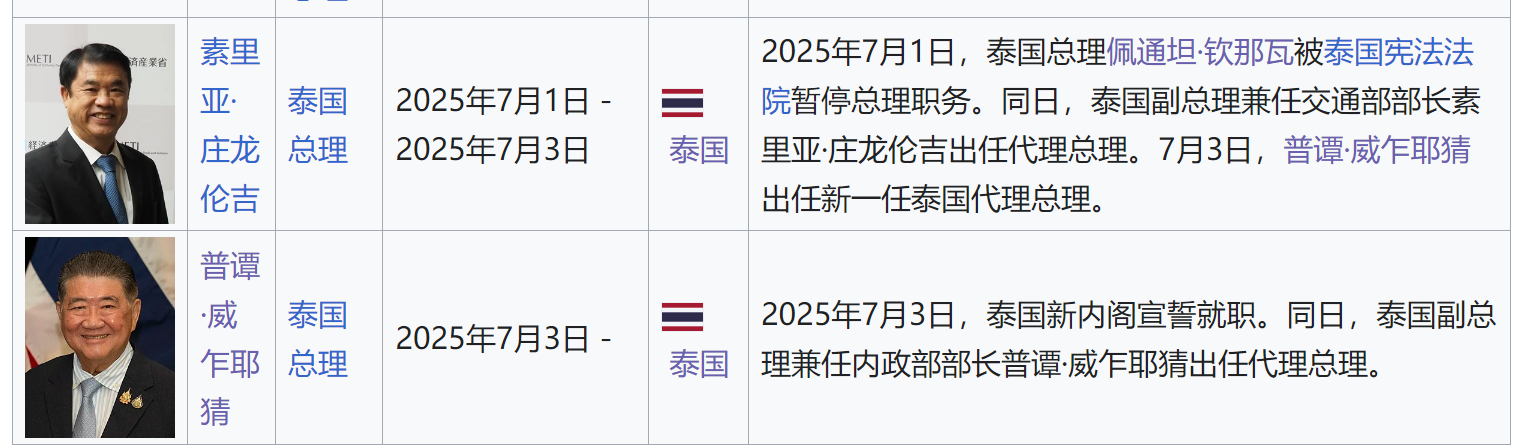
July 16, 2025:
Three Royal Thai Army soldiers were injured after accidentally triggering a landmine while patrolling the Emerald Triangle. Initially it was thought to be a mine left over from the Cold War [17], but subsequent evidence indicated a newer Russian PMN-2 mine [18]. One of the injured soldiers required an amputation [19]. Thailand planned to bring Cambodia's alleged violation of the Ottawa Treaty before the United Nations [20]. —Excerpt from Wikipedia
July 20, 2025:
Cambodia denied laying mines and accused Thai troops of deviating from the patrol routes established by the 2000 Memorandum of Understanding and entering Cambodian territory containing mines left from the war. It questioned Thailand's motives. [21] —Excerpt from Wikipedia
July 23, 2025:
Thailand said another five-man Thai patrol had been injured by a landmine in Nam Yuen district, Ubon Ratchathani province. One soldier was severely injured and had his right leg amputated. Thailand blamed Cambodia. The Royal Thai Armed Forces issued a statement strongly condemning this “inhumane act,” saying it “threatened peace and stability in the border area.” Cambodia denied the accusation and said the explosion occurred in an uninhabited area of Cambodia's Preah Vihear province. [24]
The same day, Thailand decided to downgrade diplomatic relations with Cambodia. It recalled its ambassador in Phnom Penh and expelled Cambodian diplomatic personnel in Bangkok [25]. Cambodia stated that Thailand's landmine allegations were groundless and fabricated, designed to shift responsibility for its improper diplomatic actions onto Cambodia. In response, Cambodia lowered relations to the minimum level of chargé d'affaires, recalled all diplomats and staff from its embassy in Thailand except essential personnel, and ordered Thai diplomats to leave within a specified time [26]. —Excerpt from Wikipedia
On July 24, 2025, the border conflict escalated. That morning, Thailand and Cambodia exchanged fire at at least six locations, and Thai F-16 fighter jets struck targets inside Cambodia. Both sides accused the other of firing first. Multiple casualties have now been reported, with no sign of a ceasefire.
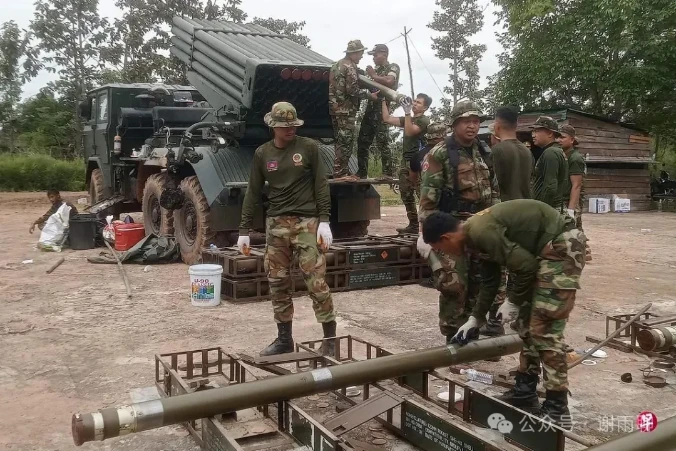
The photograph shows Cambodian soldiers loading a BM-21 multiple rocket launcher in the border area of northern Cambodia's Preah Vihear province, adjoining Thailand. (AFP)
That is the information I have collected so far. There are certainly inaccuracies, but it is broadly correct.
At this point, I offer the following thoughts for reference:
1. Throughout this conflict, the Thai military has held the initiative. Temples, landmines—whatever the issue, I see them all as excuses. As long as the Thai military can fight, it can gain momentum and consolidate power.
2. The Thai military very likely initiated the conflict to strike at the domestic civilian faction and strengthen its own position. At the very least, that has been the objective effect: Paetongtarn was suspended, the conflict escalated, and the military took the lead.
3. Paetongtarn and Hun Sen have a good private relationship and many shared interests. Thailand is strong and Cambodia weak, yet in their call Paetongtarn adopted a very deferential posture, treating Hun Sen as an elder and even criticizing her own country's generals to placate him.
4. There are two possibilities regarding the leak. Hun Sen may have authorized it himself, or Cambodian opposition figures or Thai military spies may have leaked it. If the former, Hun Sen also had motives for guiding the escalation—perhaps to strike at political enemies or divert attention from domestic tensions. If the latter, his control over Cambodia is not so strong. Either way, the leak shows that Cambodia too is full of internal contradictions and problems.
5. Of course, from Cambodia's perspective, it really has no motive to fight Thailand. Cambodia cannot defeat Thailand, and its domestic tensions have not reached the point of requiring a war.
6. China has deep ties and economic cooperation with both countries, and a major conflict between them would not benefit China. From China's position, escalation should therefore be avoided as far as possible. China has indeed acted accordingly.
7. Overall, this conflict will not spiral out of control, because it is against China's interests and China will certainly mediate. Moreover, under international law, the disputed area really is not Thai territory. At most, the Thai military could occupy it in practice, already a considerable risk. Advancing further would have no legal justification at all and leave it with little support for an unjust cause.
These are some admittedly immature thoughts based on the material currently available. Discussion is welcome. Let's keep following the drama together!
Comments
No account needed. A nickname is required; email is optional. Successful submissions appear publicly without manual pre-moderation.
Comments and nicknames are public. Optional email addresses are not displayed. The selected Waline backend and its hosting provider process comments, nicknames, optional email, IP and browser information. Comments show IP region, without the full IP address or browser and operating system labels. Hosting: Vercel; database: Neon.