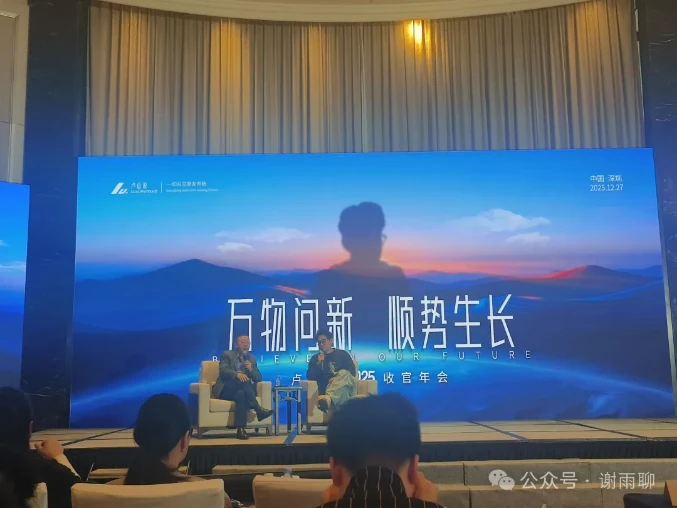
There is an online creator called “Mr. Lu Says.” He is a finance professional with twenty years in the industry and the first Chinese-national FOF manager. His followers and paid community members are mostly financial professionals, business owners from various sectors, and second-generation wealthy people. To broaden my horizons, I ate rice porridge for a month and scraped together more than 2,000 yuan to attend his year-end annual meeting. His speech was titled “All Things Seek Renewal: Growing with the Tide.” To me, however, “Rich People's Troubles” would have been more fitting. As an ordinary person, I found the speech eye-opening and rewarding. Learning about wealthy people's troubles made me feel happier by comparison and, to some extent, cured my inner turmoil.
So what troubles do wealthy people have?
First Come Health Problems and Anxiety About Aging
The first slide of Mr. Lu's presentation read: “My greatest realization in 2025: if your body isn't well, your mind won't be either.” He mentioned more than once that he was already in his forties and sometimes felt anxious about age and feared growing old. He therefore exercises with great determination, and it works: he is visibly muscular. His videos feature squinting and making himself look unattractive. The squinting is real—he really does barely open his eyes when speaking—but he is actually very good-looking by mainstream standards.
Mr. Lu said that a friend, a business owner who joined his small community early on, has an eight-figure net worth and is quite young, around forty. This friend disappeared for a year last year. Only later did people learn that he had been ill and spent an entire year in treatment. Fortunately, he recovered. This shows that health is one of the few major risks wealthy people face.
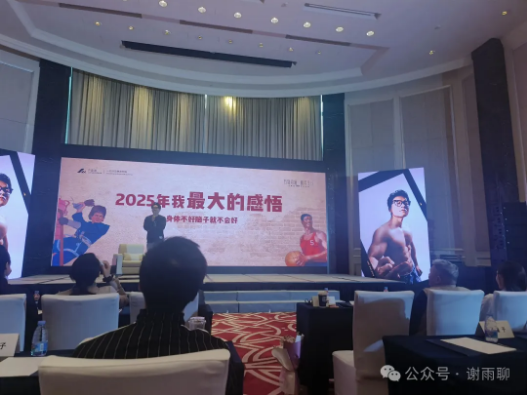
Next Come the Safety of Their Money and the Risk of Bankruptcy
Perhaps because of the broader environment, wealthy people are generally cautious. Mr. Lu repeatedly stressed risk and the safety of funds. “Nobody can keep winning forever,” he said. Beyond your core business, you need fallback options, even if they deliver lower returns. Life is unpredictable. Even an excellent business can stop making money or start losing it when unforeseen risks strike. Reportedly, Li Ka-shing's publicly known wealth is only half his total wealth because he has kept so many fallback options. Even his public assets are sufficiently diversified. This is wealthy people's awareness of risk.
Mr. Lu also said that many rich people's character does not match their position. Unless they reflect on themselves and change past ideas and behavior, their assets will eventually fall back to the level their understanding warrants. He likes singing, he said. He used to sing with property bosses, later internet bosses, and later still cross-border business bosses. The big players onstage come and go, and very few survive for long. “Everything that kills you is something you didn't anticipate.” “The greatest risk is not knowing that you're not good enough.” Business owners who remain wealthy over the long term therefore all possess a sense of humility and respect for what they cannot control.
In general, business owners with relatively little capital can accept high risk. Before entering wealthy circles, they must first accumulate a certain amount of money, which requires high-margin—and therefore risky—businesses. Mr. Lu and his audience, however, already have substantial capital. Risk and uncertainty come first in their thinking.
Only Then Come Investment and Growing Their Wealth
These concern wealthy people too, but even in investment they consider risk first. Overall, Mr. Lu is optimistic about next year's A-share market. Yet instead of buying individual companies' shares, he prefers financial products that let professionals decide which stocks to buy. He also invited Dr. He Hua, founder of Jiuyi Investment, to speak. He Hua advocated global asset allocation: A-shares are worth investing in, US equities are also attractive, and commodity futures such as gold, silver, and copper offer considerable investment value. But he stressed diversification and not putting all your eggs in one basket. This, too, is essentially risk prevention. Even if some investments lose money, others can at least offset those losses, allowing overall assets to appreciate.
Finally Comes Happiness
Most wealthy people are not happy. Mr. Lu said that people like them have had their appetites for food, material things, and sex overfulfilled, raising their thresholds enormously. The ideal state of happiness combines extremely high wealth with an extremely low threshold for satisfaction, which is of course difficult. Wealthy people often feel a sense of emptiness: nothing seems interesting because they have experienced everything.
His friend who had been ill said, “Extreme suffering can reset your threshold.” During his illness he had thought many things through and gained clarity. Sometimes, then, one can deliberately create a sense of scarcity: go hungry for a while, for example, and a bowl of noodles will taste better than lavish delicacies normally do.
Many friends my age are just beginning their careers. For us, a lack of money is arguably our greatest worry, and money could solve most of our problems. Yet after hearing Mr. Lu's speech, I realized that human needs are endless, as is the pursuit of wealth. Continually facing challenges is the normal state of life. Perhaps the best quality is finding joy amid hardship and enjoying the struggle of living. Many sages and exemplary figures in ancient times found contentment in poverty and devotion to the Way: Yan Hui, who had “a basket of rice and a gourd of water in a shabby lane; others could not have borne the hardship, but Hui never lost his joy”; and Song Lian, who wrote that “with enough to delight me within, I did not notice that my food and clothing were inferior to others'.” Perhaps their attitude toward life is what our era most needs to learn.
Comments
No account needed. A nickname is required; email is optional. Successful submissions appear publicly without manual pre-moderation.
Comments and nicknames are public. Optional email addresses are not displayed. The selected Waline backend and its hosting provider process comments, nicknames, optional email, IP and browser information. Comments show IP region, without the full IP address or browser and operating system labels. Hosting: Vercel; database: Neon.