Many talented young Chinese people excel in both humanities and sciences but simply cannot learn English well. Take me: in secondary school, I spent almost 40% of my time studying English and barely managed a score of 131. I devoted far less time to mathematics, relying only on classes and some straightforward investigation and practice, yet scored 143. At university I chose English as my major to challenge my weakness, but the major did not increase my interest in the language. My grades remained poor, and my ability was just enough to graduate.
This April, I came to Malaysia to study and learned more about its society. I found that Malaysian Chinese generally speak at least three languages: Mandarin, English, and Malay. Some also speak Cantonese, Hokkien, or Hakka. The same ethnic group, yet Malaysian Chinese seem universally gifted at languages, while mainland Chinese universally learn mute English. It is truly enviable.
I think this difference is mainly a matter of social environment. Malay is Malaysia's official language, compulsory for all citizens; English is a widely used second language; Mandarin has no legal status but is widely used among Chinese people. After independence, the Malaysian government pursued assimilation-oriented educational policies and attempted to convert Chinese schools. Only through prolonged struggle and community fundraising did Malaysian Chinese preserve the independent Chinese secondary-school tradition. In this environment, they speak Mandarin at home, must use Malay with the government and other ethnic groups, use English with foreigners, and speak all three at school. Independent Chinese secondary schools have Mandarin classes, humanities subjects are mostly taught in Malay, and science and engineering subjects mostly in English. With frequent use, they naturally learn to speak some of each.
Looking back, environment is still the most important factor in language learning. Hearing and using a language often makes it easy to acquire. Malaysia, for instance, has many migrant workers from Indonesia, Myanmar, Vietnam, and Nepal. Apart from Indonesians, whose language is mutually intelligible with Malay, workers from the other countries generally speak neither English nor Malay when they arrive. After working in Malaysia for a while, however, most can speak them. I know a man from Myanmar who is an apprentice at a hotel. Sometimes he does renovation work with his mentor, the hotel's Chinese head chef. This man has little education, yet his Malay is already fluent, his English sufficient for simple conversations with me, and he understands Mandarin related to his own work. When we eat at Chinese restaurants, the Myanmar employees generally know a few common Mandarin phrases.
Compared with these Myanmar workers and Malaysian Chinese, we spend more time, effort, and money learning English, with little result. It is understandable, then, that we sometimes criticize English education in China. In the recent argument between Hu Xijin and Tang Jiafeng over removing English's core-subject status, I emotionally side with Teacher Tang.
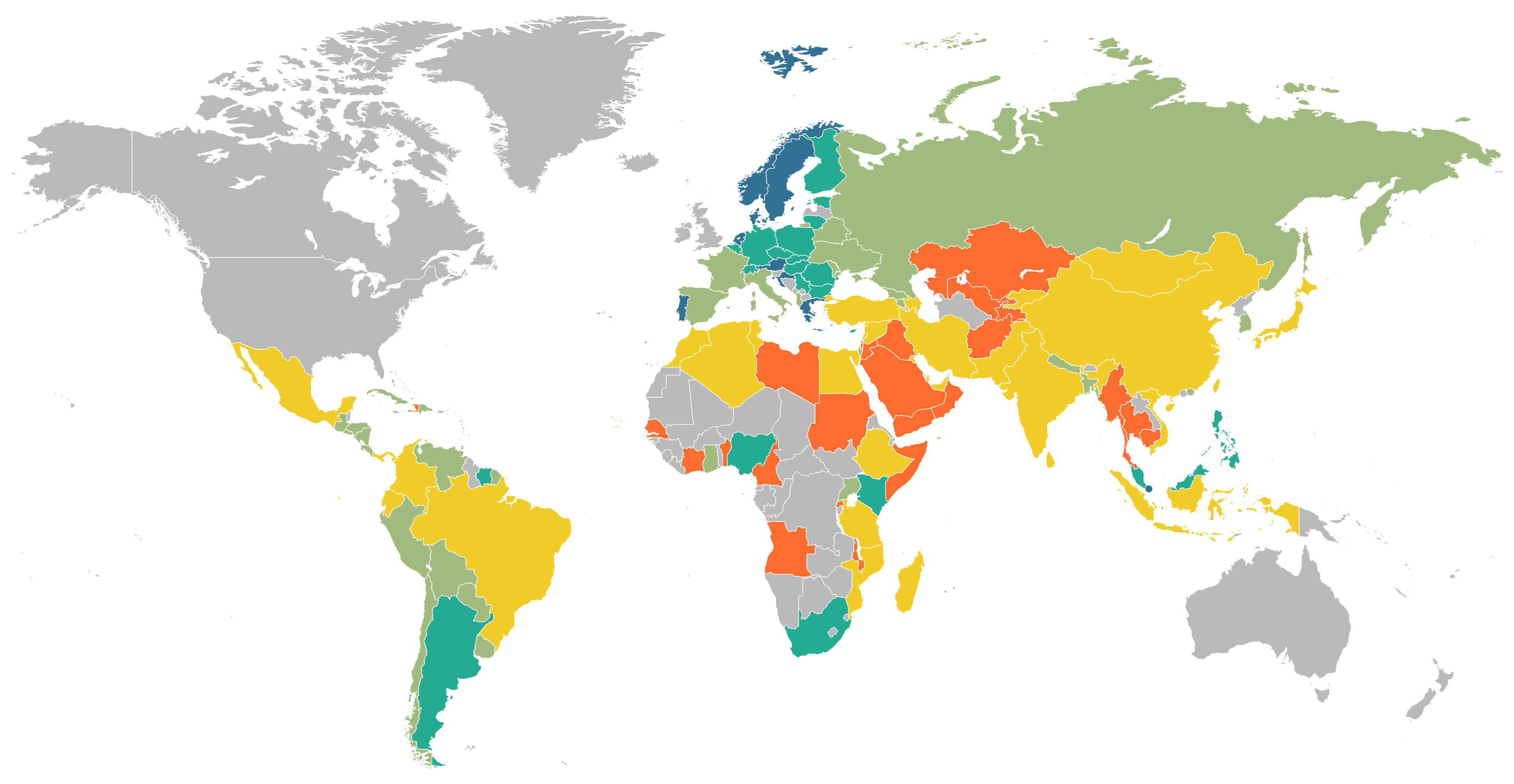
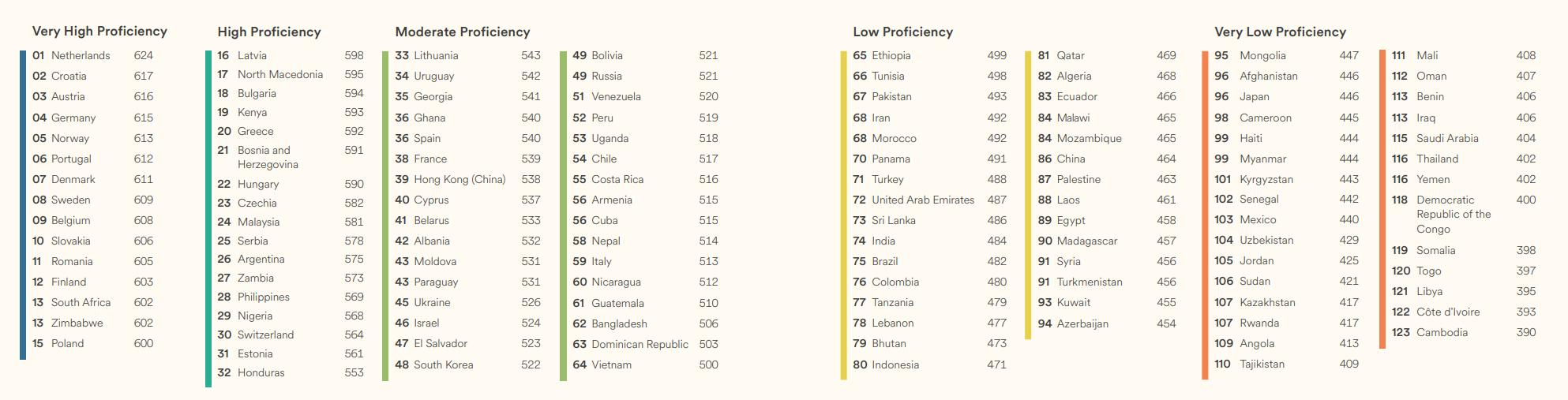
Still, there is no need to feel inferior. Mainland China's overall English level is actually no worse than that of Taiwan, South Korea, or Japan. An index assessing English ability in non-native-speaking countries, EF EPI, is called the EF English Proficiency Index. European countries have led its rankings for years, almost monopolizing the top half. Among Asian countries and regions, Singapore, the Philippines, Malaysia, Hong Kong, and South Korea rank relatively high. South Korea, Taiwan, mainland China, and Japan nevertheless rank fairly close together. South Korea is much better, the mainland and Taiwan are similar, and Japan is worst.
In the latest 2025 rankings, Singapore was classified as an English-native-speaking country and excluded. Malaysia overtook the Philippines to become Asia's top scorer; China's ranking fell sharply; Taiwan was omitted, reportedly because of insufficient data; and Japan remained weak. See the figures below for details.
There is another small consolation. Although Malaysian Chinese speak several languages, some who did not receive a complete Chinese-language education or have been out of school for a long time have relatively limited knowledge of Chinese history and culture. Once I chatted with a Chinese taxi driver who said his grandfather came from Hainan. I mentioned that Hai Rui was from Hainan, but he did not know who Hai Rui was. I then told him about Su Shi's exile there and quoted “Three hundred lychees a day.” Of course, I must point out that the poem was actually written in Huizhou; I was merely broadening the conversation. Su Shi is, after all, very famous. Yet after all my talking, the driver still looked blank. It turned out he could speak Chinese but had little exposure to classical poetry or general Chinese cultural knowledge.
Of course, this may relate to occupation and age. Perhaps younger Malaysian Chinese study more. Malaysia does, after all, have the most complete Chinese-language educational system outside mainland China and Taiwan. Their level is far beyond that of ethnic Chinese in Thailand and Indonesia, who have assimilated into local populations.
By comparison, Chinese-language ability among Singaporean Chinese is an even greater problem. Former prime minister Lee Hsien Loong recently addressed it specifically, saying that over 70% of ethnic Chinese households now use English as their main language, far above 40% twenty years ago. Most ethnic Chinese people today effectively have English as their mother tongue. They can understand Mandarin but cannot speak it fluently, have severely limited vocabulary, and lack writing skills and the ability to communicate in depth.
Considering all this, I do not think removing English's core-subject status would have serious consequences. Compulsory study does not necessarily produce better results, and removing that status would not stop people learning it later themselves. On the contrary, a modest reduction in English's status might relieve young Chinese people's burden, reduce wasted time, and let them study it when it suits them best. Overemphasizing English also does harm China's independent development and research in science and culture. Singapore offers a recent cautionary example.
These views are for reference only. I do not mean to criticize any country, since each has its own circumstances. But I think the passionate discussion itself represents progress. English certainly matters, yet reducing its status should be open to discussion. Some people become agitated at the mere suggestion of removing its core-subject status, which I find baffling.
Comments
No account needed. A nickname is required; email is optional. Successful submissions appear publicly without manual pre-moderation.
Comments and nicknames are public. Optional email addresses are not displayed. The selected Waline backend and its hosting provider process comments, nicknames, optional email, IP and browser information. Comments show IP region, without the full IP address or browser and operating system labels. Hosting: Vercel; database: Neon.