I. An Introduction to the Big Five and My Test Results
The Big Five model is widely recognized in psychology as the most comprehensive, reliable, and effective description of individuals' basic traits currently available. It has distinguished itself in extensive empirical research and is widely used. It divides personality into five dimensions: extraversion, neuroticism, agreeableness, conscientiousness, and openness. The opposite of neuroticism is emotional stability, which many tests prefer to use as the positive pole.
Compared with tests such as the MBTI, astrology, and tarot, the Big Five lacks a social element but is more reliable. Its results can help people understand themselves, build on their strengths and address their weaknesses, and guide their future studies, careers, and relationships.
My results are as follows:
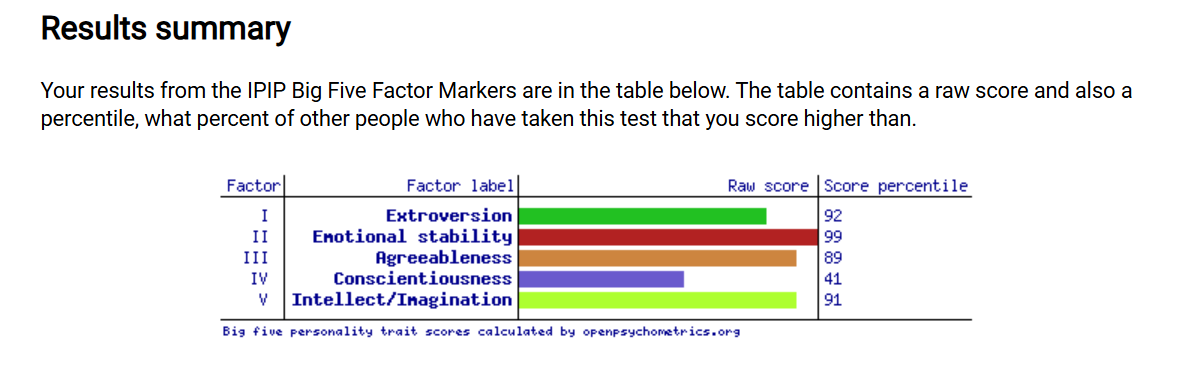
Extraversion: 92
Stability: 99
Agreeableness: 89
Conscientiousness: 41
Openness: 91
My conscientiousness is below average, while my other scores are high. The following analysis is written for myself and offered for others' reference.
II. Extraversion: 92
Despite scoring highly on extraversion, I do not consider myself absorbed in socializing and parties. I prefer thinking through questions alone, enjoy reading and writing, and like single-player games rather than online games. Still, I do not avoid socializing and enjoy joining the fun. With others, I mainly listen; once familiar with them, I become more talkative. I like discussing far-ranging subjects such as scientific questions, historical stories, and unusual theories, but seldom concrete current affairs. Thanks to my outstanding abilities and extensive reading, I am confident and cheerful most of the time. Only when I encounter an attractive woman and entertain improper thoughts does my performance suffer, making me reserved and introverted.
With experience in hosting, public speaking, and organization and management on campus and in companies, I never get stage fright. However unfamiliar the surroundings, I can quickly calm down and fit in. When someone pushes me to center stage, I will certainly not disappoint. These are also signs of high extraversion.
My extraversion has probably increased further since coming to Malaysia. On the one hand, the social atmosphere abroad is less oppressive than at home, and I meet many optimistic, outgoing strangers. On the other, I face much less social pressure: nobody knows me here, so even making a fool of myself will not affect my image back in China.
III. Stability: 99
My nervous system is indeed extremely insensitive to negative external stimuli. In a crisis, I quickly skip emotional release and move into rational analysis. Even without testing, I know my baseline serotonin is relatively high and my cortisol secretion under stress relatively low. I therefore do not wear myself down mentally, become depressed, or feel discouraged by setbacks.
In relationships, I am almost never offended, much less enraged, so even many people with low emotional intelligence like being my friends. I also have the virtue of “welcoming news of my faults.” When others criticize me, I gladly accept it if it makes sense. Even criticism demanding perfection makes me grateful to hear the truth.
There are two drawbacks. First, I lack a sufficient sense of danger in everyday life, easily overlooking procedural and paperwork issues or failing to take problems seriously enough, which holds things up. Second, being so thick-skinned makes it easy to overlook others' mental health. I may consider something utterly trivial that someone else minds, so my unthinking remarks can easily hurt people's feelings.
IV. Agreeableness: 89
High agreeableness means I am considerate, thoughtful, and compassionate. I often help others and enjoy doing so, prefer to think well of people, get along with others, experience more positive emotions, and have greater life satisfaction.
However, some research suggests that high agreeableness is not conducive to career development. First, such people are not especially attached to conventional success. Second, they often expend their energy on others' affairs and neglect their own development. Their average salaries therefore tend to be lower than those of less agreeable people.
V. Conscientiousness: 41
My conscientiousness is in the moderately low range, suggesting that I am generally rather easygoing and undisciplined, less inclined to self-discipline and conscientious duty—though not beyond redemption. One important sign is my difficulty strictly following my own plans, along with an easily disrupted daily routine that I do not find shameful. High conscientiousness is the best predictor of modern professional success. Unfortunately, I lack this quality, meaning that career success will be harder for me to achieve.
Research also finds a significant positive correlation between high conscientiousness and longevity. Improving mine would therefore mean better health and possibly a longer life.
Moderately low conscientiousness has benefits too. I adapt to circumstances, embrace changes in life, and lack the psychological burden of “perfectionism,” making me less prone to anxiety.
Overall, however, I hope to raise my conscientiousness slightly, to around 55%–60%. This could lengthen my life somewhat and help me achieve more professionally. Personality is, of course, a relatively stable aspect of human psychology, so change will be slow.
VI. Openness: 91
High openness means I am willing to try new things and enthusiastic about acquiring knowledge and experiences. Research suggests that these qualities help delay intellectual decline in old age.
I am also very tolerant of political and religious views. Although I do not support conservatism myself, I appreciate conservatives' passion. I am not religious, but eagerly study religion.
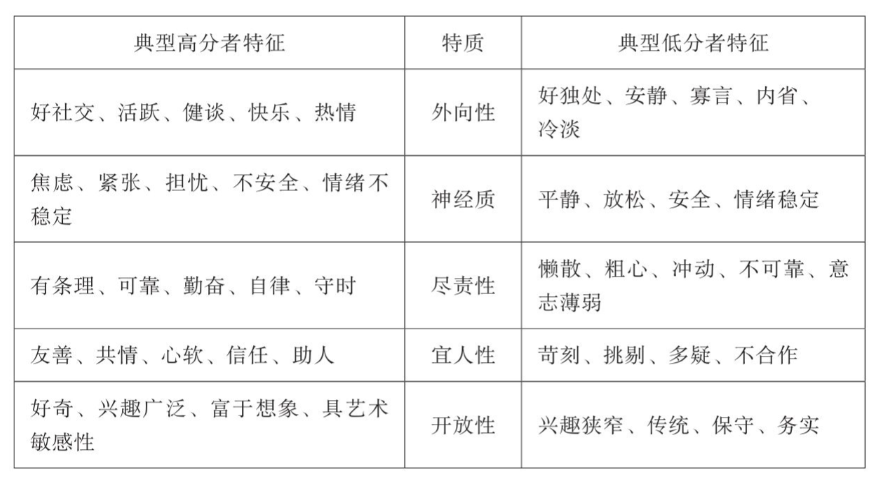
(Image source: Wang Fang, Why We Differ: Forty Lectures on Personality Psychology.)
VII. Work That Suits Me
With my unusual combination of “high stability + high openness + high extraversion + high agreeableness + moderately low conscientiousness,” I am better suited to guiding a vision, developing strategies, and connecting resources than maintaining things at the micro level:
1. Strategic Breakthroughs and Broad Planning
Pattern: finding order in chaos or new developments, formulating broad strategies, and drawing roadmaps, without responsibility for detailed, day-to-day implementation.
Business analysis and strategic development
Corporate strategy consultant
Think-tank or policy researcher
Startup CEO or co-founder
2. Resource Integration and High-Level Matchmaking
Relying on strong interpersonal warmth, empathy, and persuasive communication to build trust, mobilize resources from multiple parties, reach consensus, or handle complex clients.
Venture capital investment manager
Project initiator at a multinational NGO or international organization
Senior negotiator
Director of public relations and media communications
3. Communicating Ideas and Leading Through Inspiration
Turning complex concepts or theories into compelling language to educate, inspire, lead, or influence others.
University lecturer or academic
Documentary director or think-tank podcaster
Executive coach or organizational psychology consultant
Leader of an educational innovation project
VIII. A Partner Who Suits Me
A requirement: high conscientiousness. Only with someone to supervise and remind me can we complement each other. With a less conscientious partner, we would both be undisciplined and could easily give up together, making a mess of life.
Optional qualities: high openness and agreeableness, for greater compatibility, easier conversation, and a less dull life. Lower levels are fine too, since I am very tolerant.
Moderately high emotional stability is enough, but I should avoid someone overly emotionally sensitive. Different levels of sensitivity to events could easily cause the other person mental distress.
Introversion and extraversion each have their merits. I have no preference.
IX. Health Issues to Watch
-
Moderately low conscientiousness makes my schedule and diet irregular, placing extra burdens on my liver and gut microbiota. Poor adherence can mean missing regular checkups, not strictly following medical advice, forgetting medication, or stopping treatment before completing the course.
-
High emotional stability means I pay little attention to minor physical symptoms, potentially letting small problems develop into serious illnesses.
-
High openness and extraversion mean more social activity. Although I do not smoke and rarely drink, when I am happy and the atmosphere is right, a few occasions each year inevitably end with me coming home very drunk, which is extremely harmful to health.
X. References
Goldberg, L. R. (1992). The development of markers for the Big Five factor structure. Psychological Assessment, 4(1), 26–42. (Basis for the International Personality Item Pool, IPIP-BFFM scale calculations.)
Wang Fang. (2023). Why We Differ: Forty Lectures on Personality Psychology. Beijing: Beijing Daily Press. ISBN: 9787547746219.
Wikipedia entry. “Big Five personality traits.” Retrieved from: https://zh.wikipedia.org/wiki/五大性格特质
Gemini (Google AI). Interpretation of Big Five Percentile Data and Cross-Analysis with Neuropsychology. (2026).
Test link: https://openpsychometrics.org/
Comments
No account needed. A nickname is required; email is optional. Successful submissions appear publicly without manual pre-moderation.
Comments and nicknames are public. Optional email addresses are not displayed. The selected Waline backend and its hosting provider process comments, nicknames, optional email, IP and browser information. Comments show IP region, without the full IP address or browser and operating system labels. Hosting: Vercel; database: Neon.