I just read a paper titled “Room Temperature and Productivity in Office Work,” examining the relationship between indoor temperature and office-work efficiency. Its conclusion is that people work most efficiently indoors at temperatures between 21 and 24 degrees.
Here is the paper's abstract:
Indoor temperature is one of the central characteristics of the indoor environment. Depending on the building and its heating, ventilation, and air-conditioning (HVAC) system, it can be controlled with varying precision. Indoor temperature affects several human physiological and psychological responses, including thermal comfort, perceived air quality, sick building syndrome (SBS) symptoms, and work performance.
In this study, we focus on temperature's effects on office-work performance. We include studies using objective performance measures relevant to office-type work, such as text processing, simple calculations (addition and multiplication), telephone customer-service call duration, and the total time call-center employees spend handling each customer. We exclude data on industrial production performance. We calculate the percentage change in performance per 1°C temperature increase across all studies and statistically analyze measured work performance against temperature.
The results show that work performance increases with temperature up to 21–22°C; above 23–24°C, performance decreases as temperature rises. Maximum productivity occurs at around 22°C. At 30°C, for example, performance is only 91.1% of the maximum, a decline of 8.9%.
The authors also point out that the quantitative relationship between temperature and productivity may vary with other building characteristics, occupants' characteristics, and the type of work. Telephone customer-service work, for example, is more affected than laboratory subjects' performance. In experiments, ventilation rates are held constant, but in real life low ventilation often coincides with high temperatures, readily causing sick building syndrome and other negative effects.
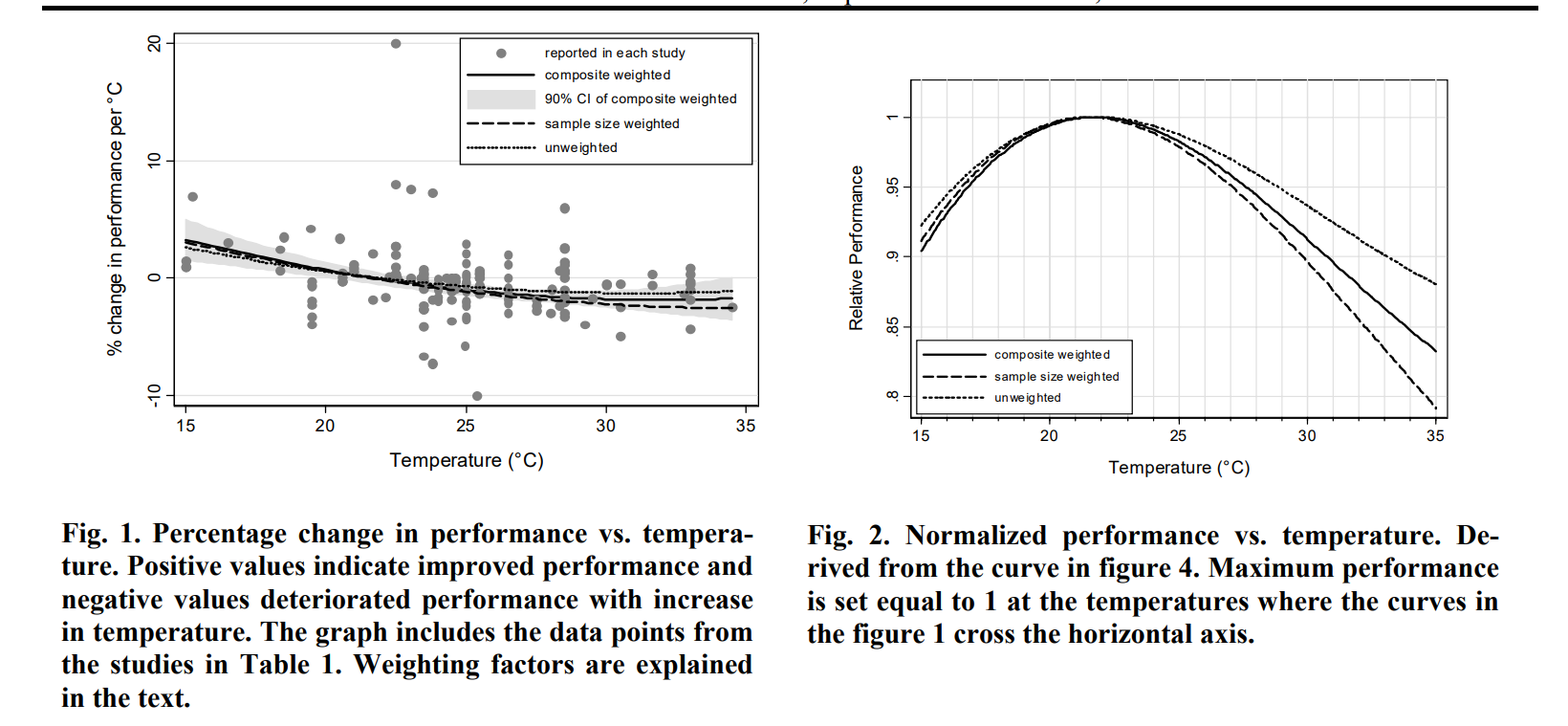
This reminded me of junior high school. Conditions at our county-town school were not particularly good, and many classrooms had no air conditioning, although summer temperatures sometimes approached 40 degrees. Final-year senior-high students had practically no summer holiday, so many classes used class funds to install air conditioners. Looking back, this was a wise decision: according to this paper's findings, at an indoor temperature of 35 degrees, work efficiency has already fallen below 80% of its maximum. Installing air conditioning offers excellent value.
The international building-environment standard ISO 7730 generally recommends office temperatures of 23–26 degrees in summer and 20–24 in winter. In everyday life, indoor temperatures of 20–26 degrees need not cause much concern. Most offices, coworking spaces, and cafés are, in fact, within this comfortable range. When working or studying at home, excessive cold or heat warrants considering air conditioning or going out to find somewhere else to work. These costs are worth paying for greater efficiency.
References:
Seppänen, O., Fisk, W. J., & Lei, Q. H. (2006). Room Temperature and Productivity in Office Work. Lawrence Berkeley National Laboratory. LBNL-60952.
Comments
No account needed. A nickname is required; email is optional. Successful submissions appear publicly without manual pre-moderation.
Comments and nicknames are public. Optional email addresses are not displayed. The selected Waline backend and its hosting provider process comments, nicknames, optional email, IP and browser information. Comments show IP region, without the full IP address or browser and operating system labels. Hosting: Vercel; database: Neon.