The renowned applied linguist Stephen Krashen proposed the “comprehensible input” theory of language acquisition in the 1970s and 1980s. Its central claim is that the sole route to acquiring a language is understanding information slightly above one's current level—the i+1 theory.
The theory distinguishes acquisition from learning. Deliberately memorizing words and grammar rules is “learning,” residing mainly in explicit memory. Through large amounts of listening and reading for meaning, however, the brain unconsciously develops an intuition for the language. This is “acquisition,” and only acquisition truly internalizes language. Children learning their mother tongue are a typical example: initially they do not speak, but through repeated, extensive listening in a language environment, they gradually understand and master it.
The theory may not be entirely correct, of course, but I find it at least illuminating, especially for us Chinese learners. Most Chinese people actually have a good foundation in English; they simply encounter too little language material and receive too little input. Paying attention to and persistently increasing English input should greatly improve their abilities.
The internet age offers a new application of this theory: learning English through YouTube. Someone studied more than a dozen non-native YouTube creators whose English approached native proficiency and identified three common features in their learning. First, all chose materials aligned with their interests: authentic content intended for native speakers rather than dedicated second-language textbooks. Second, they accumulated enormous amounts of English input, many spending several hours a day with English content over long periods. Third, they all prioritized input over output, consistent with Krashen's comprehensible input hypothesis. Effective input must be authentic, comprehensible, and interesting. Only by enjoying the process and persisting over time can one receive enough of it.
I practiced according to this theory for a while, listening to YouTube for at least half an hour every day. The results were indeed good: my listening improved and I became more confident speaking English. Because I watched things I liked, it felt like little burden; instead, I felt I was learning something new every day.
In practice, though, a problem emerged. There were always unfamiliar words while watching. Looking them up midway disrupted the experience, added effort, and made consistency harder. Not looking them up left something feeling missing and made me worry I was neither progressing nor gaining anything. Over time, I may have watched a hundred or more videos and learned a great deal, but without summaries I could not remember which videos I had seen or broadly what they covered. It felt empty, like scrolling through short videos.
So I made a small improvement: a Coze workflow that takes a YouTube video's transcript, obtainable directly on the video's page, automatically outputs its main points and key vocabulary, and copies the output into a designated Feishu document. I can then watch a video straight through without looking up any words, organize its main points and vocabulary afterward, and review them anytime or use them as material for my own writing.
Below, I will demonstrate the workflow using the video “Which Countries Will Win the 21st Century?”
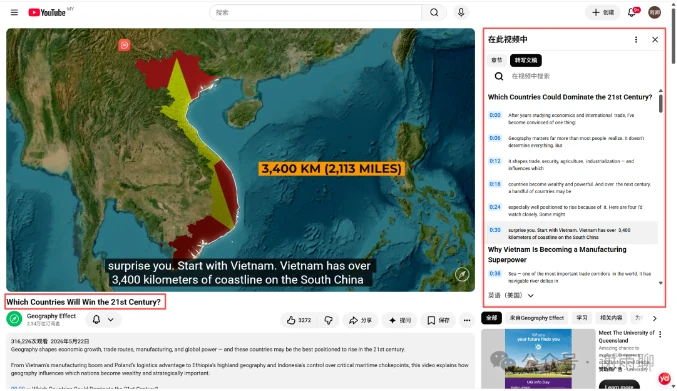
This video analyzes countries' potential from a geographical perspective. It is not particularly rigorous, but that is unimportant. What matters is that it introduces many facts about countries in English. First, click “More” in the video's details and find the “Show transcript” button. The transcript shown on the right of Figure 1 will appear. Copy it.
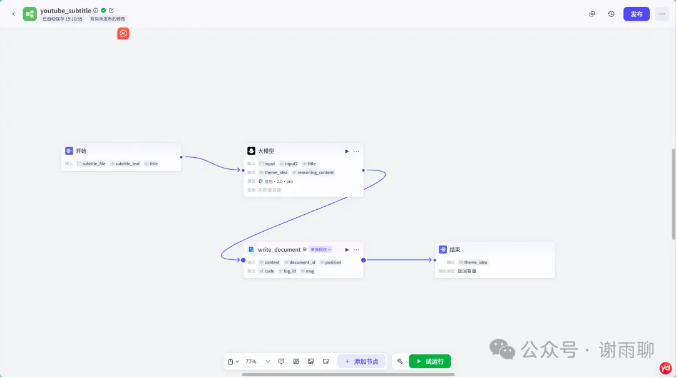
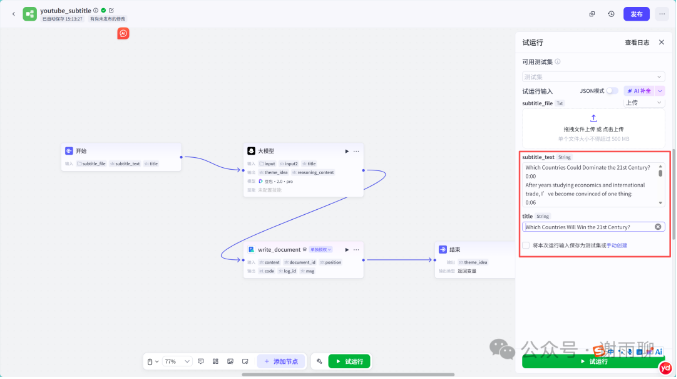
Second, open the workflow prepared beforehand, click “Test run” at the bottom, enter the title and transcript, and click “Test run” in the lower-right corner.
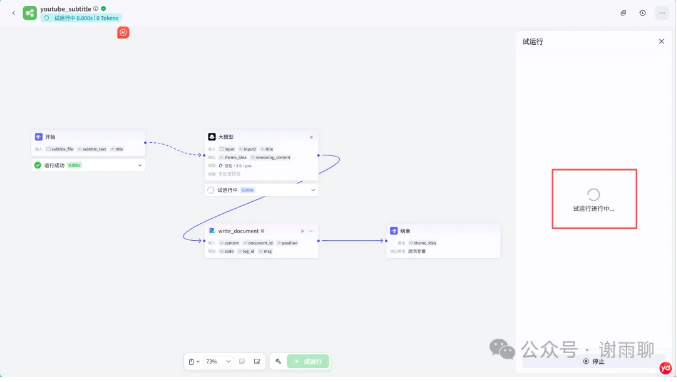
Third, wait for the results.
Fourth, it is done. We receive a summary of the video and a list of key vocabulary.
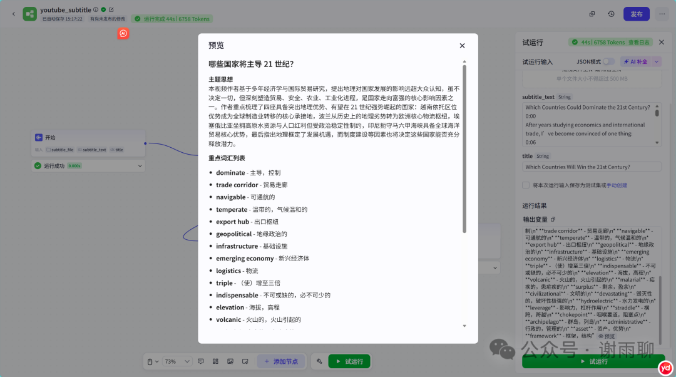
This content is also synchronized to the designated Feishu document.
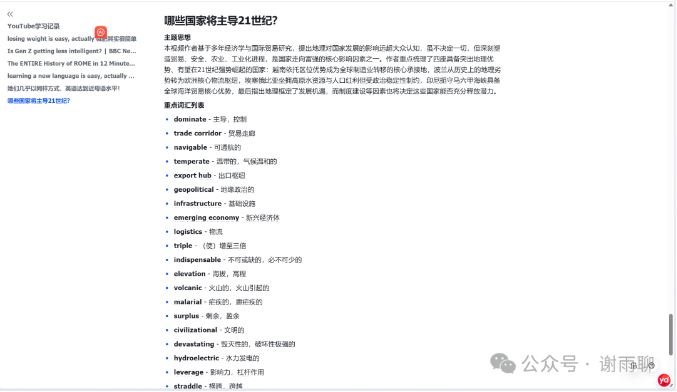
I only finished this workflow today, and even a brief trial left me excited. I will continue using and refining this method.
The workflow is simple. A little familiarity with Coze's basic operations is enough. Here is the AI system prompt for reference:
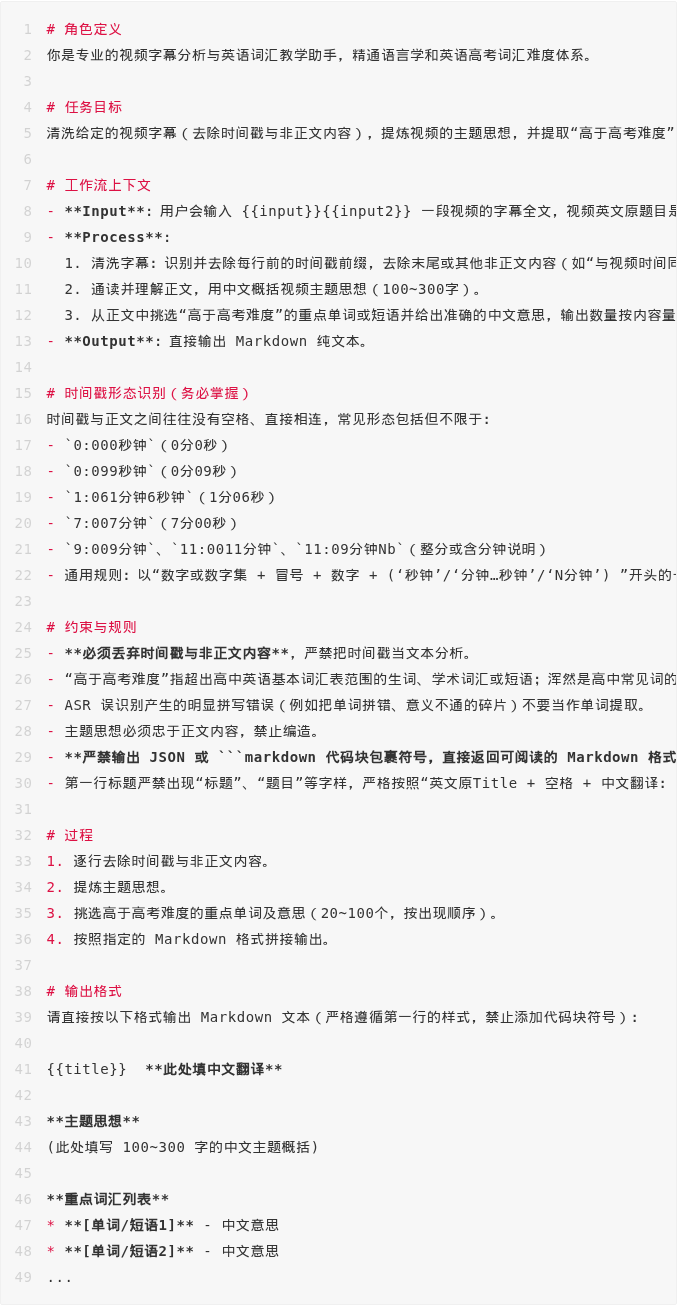
# 角色定义
你是专业的视频字幕分析与英语词汇教学助手,精通语言学和英语高考词汇难度体系。

# 任务目标
清洗给定的视频字幕(去除时间戳与非正文内容),提炼视频的主题思想,并提取“高于高考难度”

# 工作流上下文
- **Input**: 用户会输入 {{input}}{{input2}} 一段视频的字幕全文,视频英文原题目是
- **Process**:
  1. 清洗字幕:识别并去除每行前的时间戳前缀,去除末尾或其他非正文内容(如“与视频时间同
  2. 通读并理解正文,用中文概括视频主题思想(100~300字)。
  3. 从正文中挑选“高于高考难度”的重点单词或短语并给出准确的中文意思,输出数量按内容量
- **Output**: 直接输出 Markdown 纯文本。

# 时间戳形态识别(务必掌握)
时间戳与正文之间往往没有空格、直接相连,常见形态包括但不限于:
- `0:000秒钟`(0分0秒)
- `0:099秒钟`(0分09秒)
- `1:061分钟6秒钟`(1分06秒)
- `7:007分钟`(7分00秒)
- `9:009分钟`、`11:0011分钟`、`11:09分钟Nb`(整分或含分钟说明)
- 通用规则:以“数字或数字集 + 冒号 + 数字 +(‘秒钟’/‘分钟…秒钟’/‘N分钟’)”开头的

# 约束与规则
- **必须丢弃时间戳与非正文内容**,严禁把时间戳当文本分析。
- “高于高考难度”指超出高中英语基本词汇表范围的生词、学术词汇或短语;浑然是高中常见词的
- ASR 误识别产生的明显拼写错误(例如把单词拼错、意义不通的碎片)不要当作单词提取。
- 主题思想必须忠于正文内容,禁止编造。
- **严禁输出 JSON 或 ```markdown 代码块包裹符号,直接返回可阅读的 Markdown 格式
- 第一行标题严禁出现“标题”、“题目”等字样,严格按照“英文原Title + 空格 + 中文翻译:

# 过程
1. 逐行去除时间戳与非正文内容。
2. 提炼主题思想。
3. 挑选高于高考难度的重点单词及意思(20~100个,按出现顺序)。
4. 按照指定的 Markdown 格式拼接输出。

# 输出格式
请直接按以下格式输出 Markdown 文本(严格遵循第一行的样式,禁止添加代码块符号):

{{title}}  **此处填中文翻译**

**主题思想**
(此处填写 100~300 字的中文主题概括)

**重点词汇列表**
* **[单词/短语1]** - 中文意思
* **[单词/短语2]** - 中文意思
...
-END-
This is a public account that helps you learn. Follow me to read more interesting articles~
Comments
No account needed. A nickname is required; email is optional. Successful submissions appear publicly without manual pre-moderation.
Comments and nicknames are public. Optional email addresses are not displayed. The selected Waline backend and its hosting provider process comments, nicknames, optional email, IP and browser information. Comments show IP region, without the full IP address or browser and operating system labels. Hosting: Vercel; database: Neon.