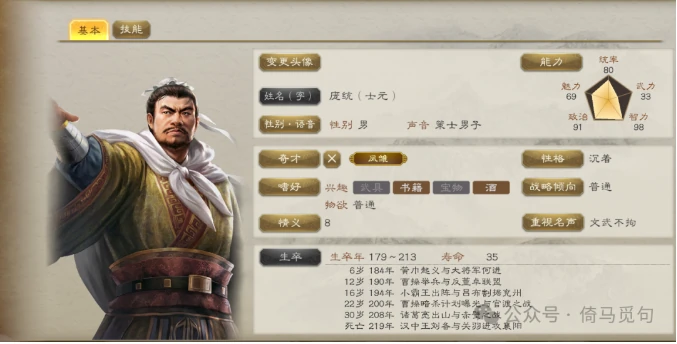
Known as the “Fledgling Phoenix,” Pang Tong was as famous as Zhuge Liang, the “Sleeping Dragon.” He helped Liu Bei seize Yizhou and died during the assault on Luo County. Various novels and games have made his name familiar, but few people know that he also possessed considerable emotional intelligence. This was evident chiefly in the following five ways.
1 Encourage Others and Speak Well of Them
Pang Tong… enjoyed assessing people and worked diligently to nurture talent. His praise often exceeded the abilities of those he commended. Puzzled, people asked him why. Tong replied: “The realm is now in great turmoil, the proper Way is declining, and good people are few while bad people are many. If we wish to revive our customs and advance moral cultivation, without generous praise people's reputations will not be admired or aspired to. Without such admiration and aspiration, fewer people will do good. If I select ten and misjudge five, I still gain half, and can thereby elevate moral teaching and encourage people of ambition to strive. Is that not worthwhile?” —Records of the Three Kingdoms, Book of Shu, “Biography of Pang Tong”
The passage means that Pang Tong liked to assess people and diligently cultivated talent. His praise often went beyond a person's actual abilities and virtues. When people questioned this, he answered: “The realm is in chaos, the proper Way is declining, and good people are outnumbered by bad ones. To revive our customs and promote moral endeavor, we must praise people generously; otherwise their reputations will not inspire admiration or aspiration. If nobody admires or aspires to them, even fewer will do good. I would rather mistakenly praise five out of ten people and still gain five with genuine ability and virtue. This can improve society's moral climate and inspire ambitious people to work harder. Is that not a good thing?”
Put yourself in their shoes. Imagine being young, unknown, and without any achievements. One day you happen to meet a highly accomplished celebrity and ask him to assess you. You have strengths and weaknesses, yet he praises you highly and shares that praise on his social media feed, telling his friends about you. Would you not be deeply moved and inspired to try harder?
2 Find People's Strengths and Vary Your Compliments
When Zhou Yu died, Tong escorted his coffin to Wu, where many people had heard his name. As he prepared to return west, people gathered at Chang Gate, including Lu Ji, Gu Shao, and Quan Cong. Tong said: “Master Lu may be called an ordinary horse with the power of a swift steed; Master Gu may be called an ordinary ox able to carry heavy loads over great distances.” To Quan Cong he said: “You are generous and aspire to renown, rather like Fan Zizhao of Runan. Though not abundantly endowed with intellect, you are still an outstanding man of our time.” Lu Ji and Gu Shao said to Tong: “Were the realm at peace, we would wish to assess the talents of the whole land with you.” They formed a close friendship with Tong before returning. —Records of the Three Kingdoms, Book of Shu, “Biography of Pang Tong”
After Zhou Yu died, Pang Tong escorted his coffin to Wu, where most people had heard of Pang Tong's reputation. Before returning to Jingzhou, he met local notables at Chang Gate. Lu Ji, Gu Shao, and Quan Cong all came to see him off. Pang Tong commented: “Master Lu is like an unremarkable horse with the strength to run swiftly; Master Gu is like an ox that, though not nimble, can carry heavy loads over long distances.” He then told Quan Cong: “You give generously and long for a good reputation, rather like Fan Zizhao of Runan. Though not exceptionally clever, you are still one of the outstanding people of our age.” Lu Ji and Gu Shao said: “If the realm were at peace, we would truly hope to join you in selecting talent from across the land.” They became close friends with Pang Tong and then went their separate ways.
When Pang Shiyuan went to Wu, the people of Wu all befriended him. On meeting Lu Ji, Gu Shao, and Quan Cong, he characterized them thus: “Master Lu is what one might call an ordinary horse with the usefulness of a swift steed; Master Gu is what one might call an ordinary ox capable of carrying heavy loads over long distances.” Someone asked: “From your descriptions, is Lu the better man?” He replied: “Though an ordinary horse may be swift, it carries only one person. An ordinary ox travels a hundred li a day; does it carry only one person's load?” The people of Wu could offer no objection. “Master Quan loves renown, like Fan Zizhao of Runan.” —A New Account of Tales of the World
When Pang Tong arrived in Wu, people there all sought his friendship. He met Lu Ji, Gu Shao, and Quan Cong and offered these judgments: “Master Lu is like an unremarkable horse with the strength to run swiftly; Master Gu is like an ox that, though not agile, can carry heavy loads a long way.” Someone asked: “By that assessment, is Lu Ji superior?” Pang Tong replied: “An ordinary horse may be fast, but it can carry only one person. An ordinary ox can travel a hundred li in a day, carrying far more than one person's load.” The people of Wu had no answer. He also said: “Master Quan aspires to renown, like Fan Zizhao of Runan.”
Gu Shao once talked through the night with Pang Shiyuan and asked: “I hear you are renowned for judging people. Which of us is better?” Pang replied: “In shaping social customs and adapting to the times, I am inferior to you. In discussing strategies for kingship and hegemony and grasping the crucial points on which they depend, I seem to have a slight advantage.” Gu Shao readily accepted these words. —A New Account of Tales of the World
Gu Shao once spent the night talking with Pang Tong and asked: “I hear that you are good at judging people. Which of us do you think is better?” Pang Tong answered: “In cultivating social customs and moving with the times, I am no match for you. But in discussing the strategy of imperial and hegemonic undertakings and grasping the essentials, I seem to have a slight edge.” Gu Shao accepted this assessment with equanimity.
To recap, after Zhou Yu's death in 210, Pang Tong traveled more than a thousand kilometers from Jiangling in Jingzhou, near today's Jingzhou city, to Wu, today's Suzhou. Local notables had long heard his name and all came to meet and associate with him. He assessed three men—Lu Ji, Gu Shao, and Quan Cong—saying that Lu Ji had “the strength of a swift steed,” Gu Shao could “carry heavy loads over long distances,” and Quan Cong was “an outstanding man of our time.”
Look at how their careers subsequently developed. Lu Ji was later posted away as administrator of Yulin and died in 219, aged only 32. Gu Shao entered government service in the same year, became administrator of Yuzhang, and died of illness in 214, aged only 31. Quan Cong later became a celebrated Eastern Wu general, participated in the great victory at Shiting, and rose to Grand Marshal of the Right and Military Adviser of the Left. He died in 249.
All three men Pang Tong assessed were highly capable, though the early deaths of Lu Ji and Gu Shao limited their achievements. To be fair, however, Pang Tong's comments were quite general and could have fitted almost anyone: he was simply finding different ways to say nice things.
3 Be Sincere and Candid
The Account of the Lands Beyond the River states: The Former Lord was dining and talking at leisure with Tong when he asked: “You served as Zhou Gongjin's merit officer. When I went to Wu, I heard that he secretly advised Zhongmou to detain me. Was that true? Each man serves his own lord; do not conceal anything.” Tong replied: “It was.” Bei sighed: “I was in danger then and needed help, so I had no choice but to go. I nearly failed to escape Zhou Yu's hands! The wise strategists of the realm see things much the same way. Kongming urged me not to go, and was particularly insistent, for he too feared this. I believed Zhongmou's defensive concern lay in the north and that he needed me as an ally, so I decided without hesitation. It truly was a perilous course, rather than a wholly secure plan.” —Records of the Three Kingdoms, Book of Shu, “Biography of Pang Tong,” Pei Songzhi's commentary
The Account of the Lands Beyond the River records that while Liu Bei and Pang Tong were casually dining and talking, Liu Bei asked: “You once served as Zhou Yu's merit officer. When I went to Wu, I heard that he secretly submitted a proposal urging Sun Quan to keep me there. Was that true? You each served your own lord then, so you need hide nothing.” Pang Tong replied: “It was true.” Liu Bei sighed: “I was in a desperate situation and needed help, so I had no choice but to go to Wu. I nearly failed to escape Zhou Yu's clutches! It seems the realm's wise strategists think much alike. Zhuge Liang also urged me not to go, strongly opposing the trip for exactly this reason. I thought Sun Quan's main defensive concern lay to the north and that he was counting on my support, so I made up my mind without hesitation. Looking back, it really was a risk, far from a foolproof plan.”
Historical accounts have their particular emphases. Here, Pang Tong says only two Chinese characters, “It was,” yet they prompt a lengthy reflection from Liu Bei. This shows that Pang Tong was very candid, and that his candor made Liu Bei trust him more.
4 Say What the Other Person Wants to Say
The Annals of the Nine Provinces states: Tong advised Bei: “Jingzhou is devastated and depleted of people and talent. With Sun's Wu to the east and the Cao family to the north, a three-sided balance offers little scope to realize your ambitions. Yizhou is now rich and strong, with a million households. It can provide everything needed for troops and horses in all quarters, and its wealth requires nothing from outside. You can temporarily borrow it to accomplish your great undertaking.” Bei said: “The man utterly opposed to me is Cao Cao. Where he is harsh, I am lenient; where he is violent, I am humane; where he is deceitful, I am loyal. Only by opposing Cao in every respect can I succeed. To lose the trust and righteousness of the realm over a minor advantage is something I will not do.” Tong said: “In times that demand expediency, no single course can settle everything. Absorbing the weak and attacking the benighted were deeds of the Five Hegemons. Take it against the proper order, govern it in accordance with that order, and repay them with righteousness. Once the undertaking is settled, grant them a great domain. How would that betray good faith? If you do not take it today, it will merely benefit someone else in the end.” Bei then proceeded. —Records of the Three Kingdoms, Book of Shu, “Biography of Pang Tong,” Pei Songzhi's commentary
The Annals of the Nine Provinces records Pang Tong advising Liu Bei: “Jingzhou is desolate and ruined, its manpower exhausted. With Sun's Wu in the east and the Cao family in the north, it is hard to achieve much in this three-sided situation. Yizhou, by contrast, is rich and strong, with a population exceeding a million. Its troops and horses are ready for use, and its plentiful resources do not depend on outside supplies. You can temporarily borrow this territory to accomplish your great undertaking.” Liu Bei answered: “The person irreconcilably opposed to me is Cao Cao. He is impatient, while I am accommodating; he is cruel, while I am benevolent; he is deceitful, while I am loyal. Only by acting opposite to Cao Cao in every respect can I succeed. I cannot accept sacrificing the world's trust for a small gain.” Pang Tong said: “Adapting at a critical moment cannot be accomplished by adhering to a single rule. Using the weak to attack the benighted was a strategy of the Five Hegemons. Take it by an improper means, then govern it properly and repay them with good faith. Once the undertaking succeeds, grant them a great domain. How would that violate good faith? If you do nothing now, you will only hand the advantage to others.” Liu Bei accepted this advice and decided to act.
The Longzhong Plan was Liu Bei's group's program of action. Yizhou would have to be taken sooner or later; Liu Bei had accepted this long before. Yet he insisted on being coy, declaring that “to lose the trust and righteousness of the realm over a minor advantage is something I will not do.” In reality, he feared having no legitimate pretext and being criticized. Pang Tong used the principle of “taking improperly but governing properly” and dangled the promise of “granting them a great domain once the undertaking is settled.” By saying what Liu Bei wanted to say, he relieved him of his moral burden and allowed him to concentrate on the established policy.
5 Create and Resolve Conflict to Produce a Win for Both Sides
At a great gathering in Fu, they served wine and music. The Former Lord said to Tong: “Today's gathering is truly joyous.” Tong said: “To attack another's state and delight in it is not the warfare of a benevolent man.” Drunk, the Former Lord angrily replied: “When King Wu attacked Zhou, there was singing in front and dancing behind. Was he not benevolent? Your words are inappropriate; rise and leave at once!” Tong slowly withdrew. The Former Lord soon regretted it and asked him back. Tong resumed his seat, neither turning to apologize nor changing his manner, and ate and drank as before. The Former Lord asked: “In that exchange just now, who was at fault?” Tong answered: “Both lord and minister.” The Former Lord laughed heartily, and the feast was as joyous as before. —Records of the Three Kingdoms, Book of Shu, “Biography of Pang Tong”
After executing Liu Zhang's celebrated generals Yang Huai and Gao Pei, Liu Bei advanced toward Chengdu and took many cities. At Fu he held a grand celebration with a banquet and music, telling Pang Tong: “What a joyful gathering this is today.” Pang Tong answered: “Attacking someone else's state and taking joy in it is not the conduct of a benevolent man.” Liu Bei, who was drunk, angrily said: “When King Wu of Zhou attacked the tyrant Zhou, there was singing in front and dancing behind. Was he not benevolent? Your words are improper. Leave at once!” Pang Tong slowly rose and withdrew. Liu Bei soon regretted this and invited him back. Pang Tong resumed his seat, paid no attention to the apology, and ate and drank as calmly as before. Liu Bei asked: “Who was wrong in what we said just now?” Pang Tong replied: “Both lord and minister were wrong.” Liu Bei laughed, and the banquet returned to its former cheer.
Attacking Yizhou was the agreed policy. With progress finally being made, everyone was naturally happy. But Liu Bei was clearly getting carried away, so Pang Tong reminded him directly.
From Liu Bei's perspective, they were holding a victory feast when Pang Tong suddenly started lecturing about benevolence and righteousness. What a spoilsport! You were the one who firmly supported attacking Yizhou and devised the specific strategy, and now you call us unbenevolent? Have you lost your mind? Get out!
Both Liu Bei and Pang Tong must have felt emotional at the time, but they were both emotionally intelligent and quickly brought their feelings under control. Liu Bei invited Pang Tong back to his seat, apologized, and asked who had been wrong. Pang Tong accepted the offered way out, saying that both lord and minister were at fault. Liu Bei laughed, and cheer filled the air once more.
It appeared to be a conflict, but what did it achieve? It demonstrated Pang Tong's candor and willingness to speak frankly, showed Liu Bei's magnanimity and tolerance, and reminded the assembled generals: we have good reasons for attacking Yizhou, so stop agonizing over it.
To achieve this effect, however, the other person must also be generous-minded and emotionally intelligent, and the two of you must have a very good relationship.
These lessons from Pang Tong can often be applied in everyday life. Remember the following:
1 Praise people more, in different ways. Talent needs care and protection; it does not grow from being crushed.
2 Be candid, care about what the other person really thinks, and give those thoughts a reasonable justification.
3 Friendship sometimes begins with a clash. When a disagreement arises, it may flare up, yet once the conflict is resolved, the relationship can become stronger.
Emotional intelligence is the ability to recognize, understand, and control emotions. When someone keenly notices changes in another person's feelings and promptly adjusts their behavior to evoke positive feelings, or avoid negative ones, and bring the two closer together, we call that person emotionally intelligent.
People always long to be understood and feel grateful to those who take their feelings into account. Emotionally intelligent people can attend to everyone's emotions and feelings, making it easier to earn their trust.
Of course, you need not exercise such emotional intelligence with everyone. But you must understand the point: at the very least, do not hurt those who treat you well.
Comments
No account needed. A nickname is required; email is optional. Successful submissions appear publicly without manual pre-moderation.
Comments and nicknames are public. Optional email addresses are not displayed. The selected Waline backend and its hosting provider process comments, nicknames, optional email, IP and browser information. Comments show IP region, without the full IP address or browser and operating system labels. Hosting: Vercel; database: Neon.