I
My major was English Language and Literature, and our university had some of the best teachers in British and American literature. In my first year, my adviser gave me a reading list that included many books on literature. Yet after four years of study, I had achieved nothing in the field and had decided not to pursue literary research any further.
There were two reasons for this.
First, my foreign-language ability was too weak, and I had read too few literary works, so I lacked a foundation for literary research.
Second, I could not understand Western literary theories such as structuralism, reception aesthetics, phenomenology, and hermeneutics. The more recent the theory, the harder I found it to understand. If I could not even understand the theory, how could I do research?
Yet both reasons had a common cause: my interests lay elsewhere.
I spent at least half my university years doing three things: 1. reading Marxist-Leninist works; 2. reading widely in other disciplines; and 3. conducting investigations and research. The cost was that I had no time to read literature or study English, and I struggled with the courses in my own major.
As for Western literary theory, it would be more accurate to say that I did not know how to criticize it than that I did not understand it. Having read Marx and Engels, I compared the two and felt that these Western literary theories were wrong. Since they were wrong, there was naturally no need to spend too much effort studying them.
What about Marxist literary theory in China? Tong Qingbing’s A Course in Literary Theory seemed to be the best option. At the time, however, I only read through it roughly without thinking deeply about it. After all, an English major’s literature dissertation using domestic literary theory would probably have little chance of passing. I had to make sure I could graduate first.

At the beginning of last year, I started planning my graduation dissertation. I read a great deal of material on Western literary theory and wrote the following:
II
Marx, Engels, Lenin, Stalin, and Mao did little research on “literariness,” “beauty,” or literature considered as art. In fact, investigating the laws of beauty is itself a scientific question, not particularly a matter of ideology. Many methods developed by Western literary theorists can be used, including formalism, structuralism, reception aesthetics, psychoanalytic theory, phenomenology, and hermeneutics. As methods, they can all be shared. Different methods offer different research perspectives, and each may reveal truth to some extent. Many Western Marxist theorists of literature and art have, in fact, incorporated different research methods into an overarching Marxist theory.
But how sentences are arranged, how images are combined, and how they give people a sense of pleasure are all matters of detail. Besides, literary studies completely divorced from society can hardly be called complete literary studies, and all literature throughout history has carried an ideological coloring.
What Western Marxist literary theorists have done relatively well is to study “literary production,” treating literature as a special form of artistic production. The leading synthesizer of this approach is the British theorist Eagleton—a very good man, and still alive. Eagleton proposes studying the “text” through the complex relationships between the “general mode of production, literary mode of production, general ideology, authorial ideology, and aesthetic ideology.” Yet Eagleton does not understand the general mode of production at all, and his discussion of the literary mode of production is also very limited. His focus and ultimate aim are to emphasize the importance of literary criticism. His final conclusion amounts to little more than this: literary criticism subverts ideology and is therefore very important. That is all. Western Marxists work very hard, but their theory has lost its social foundation. Western Europe lacks a real workers’ movement and socialist movement. Particularly since the 1980s, Western Marxist theorists have spent their days shut away in their studies, working diligently. Their effort is moving, and they have achieved something, but their impact is very limited.
I have always thought that studying the general mode of production—that is, the capitalist mode of production, the mode of production in feudal society, and so on—is more important. Research on the literary mode of production cannot be separated from research on the general mode of production. For instance, studying the capitalist literary mode of production cannot be divorced from examining the capitalist mode of production itself. Circumstances forced my hand, however. As an English major, to graduate smoothly I had to settle for the next best thing and study literature. Of course, that is not a bad thing.
When we study the general mode of production—the term “general mode of production” is used in contrast to the “literary mode of production”; in a broad sense, modes of production certainly include literary production, and literary creation is certainly part of social production—the most important questions are how individuals make a living and how society operates. When studying the literary mode of production, we should likewise begin by considering how writers obtain their livelihoods. This often reveals the character of a particular literary activity. Some write with government funding; some write to make money, through bestsellers or online fiction, for example; some write for political agitation; and some are not full-time writers at all, writing simply to express their feelings. Understanding how writers make a living is very important.
A livelihood is a prerequisite for writing and an important condition of it. Conditions are the various factors that constrain a thing’s existence, development, and change. If the conditions for literary creation are not met, literary creative activity will neither occur nor develop. Literary creation has many other conditions too, such as time to write, literacy, an accumulation of material, writing tools, and the impulse to create. All are closely connected with society itself, and all are important. The class character and ideology of literature can be studied from this starting point. In Eagleton’s model of literary criticism, studying the conditions of literary production means studying the relationship between the general and literary modes of production. Although it examines only part of that relationship, it is a very important part.
I intuitively believe this is a very important research topic that deserves serious study. But first-rate Marxist theorists often lack the energy for such subsidiary work, while specialist literary researchers often fail to understand the essence of Marxism. History has therefore placed this task in my hands, and I am determined to fulfill this historical mission. To carry out an academic project well, I must uphold scientific principles of research as well as political principles, while accommodating existing academic conventions as much as possible. This too will be a test for me. (April 27, 2023) [This work may perhaps shift the focus of Western Marxism back from literature and art to political economy. If so, I would be deeply honored.]

III
I therefore tentatively titled my dissertation “On the Conditions of Literary Production” and completed an outline. After writing it, however, I realized that the dissertation would require too much material and would be far too long to explain adequately in an undergraduate dissertation of just a few thousand words.
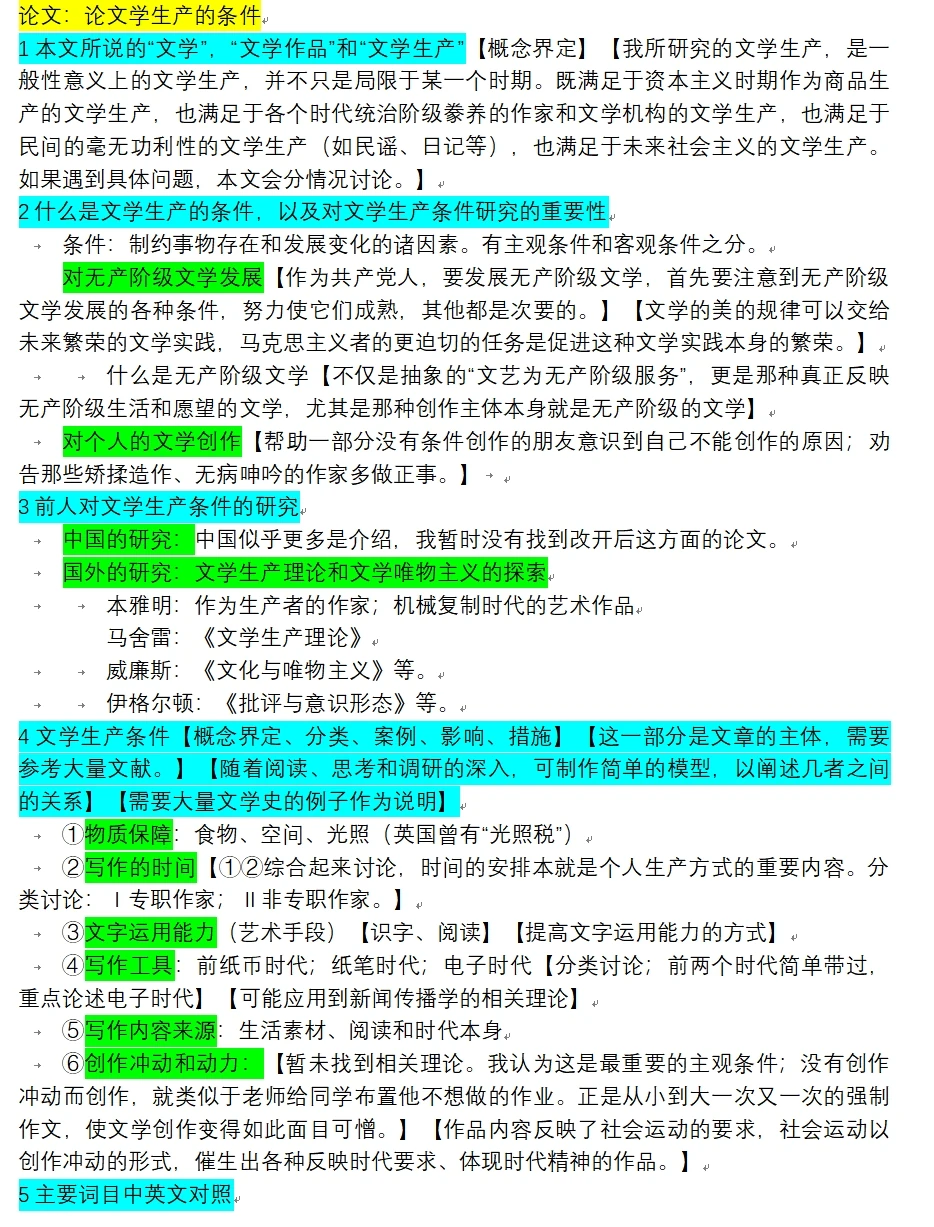
Moreover, very few people had paid attention to the perspective I was taking, so whether scholars would accept it remained an open question—even though I still believe today that my approach is consistent with Marxism.
Of course, the most important point was that I did not yet have the ability to complete this work. As I said earlier, “Research on the literary mode of production cannot be separated from research on the general mode of production. For instance, studying the capitalist literary mode of production cannot be divorced from examining the capitalist mode of production itself.”
For example, in literary creation during the feudal era, writers’ livelihoods, cultural attainment, writing materials, working environments, and readers’ needs all differed from those in the capitalist era. This is why literary genres and literary language changed over time.
To connect the literary mode of production with the general mode of production, one must understand the general mode of production itself sufficiently well. I said that Eagleton did not understand it at all—his book Why Marx Was Right was intended to defend people who misinterpret Marx, but the book itself is a misinterpretation of Marx. In fact, I too have not studied the general mode of production deeply enough, so for the time being I cannot write this work well either.
I abandoned that dissertation and ultimately chose “Strategies for Achieving Phonetic Beauty in Xu Yuanchong’s English Translations of Classical Chinese Poetry: A Comprehensive Analysis of 25 Poems” as my topic, barely passing the defense.
Of course, people keep growing. Perhaps, as I gain knowledge and have more time and energy to spare, I will be able to write the work I have in mind.
If an interested reader later comes across this essay, finds inspiration in my discussion and outline, and completes such a work, that would be wonderful too.

Comments
No account needed. A nickname is required; email is optional. Successful submissions appear publicly without manual pre-moderation.
Comments and nicknames are public. Optional email addresses are not displayed. The selected Waline backend and its hosting provider process comments, nicknames, optional email, IP and browser information. Comments show IP region, without the full IP address or browser and operating system labels. Hosting: Vercel; database: Neon.