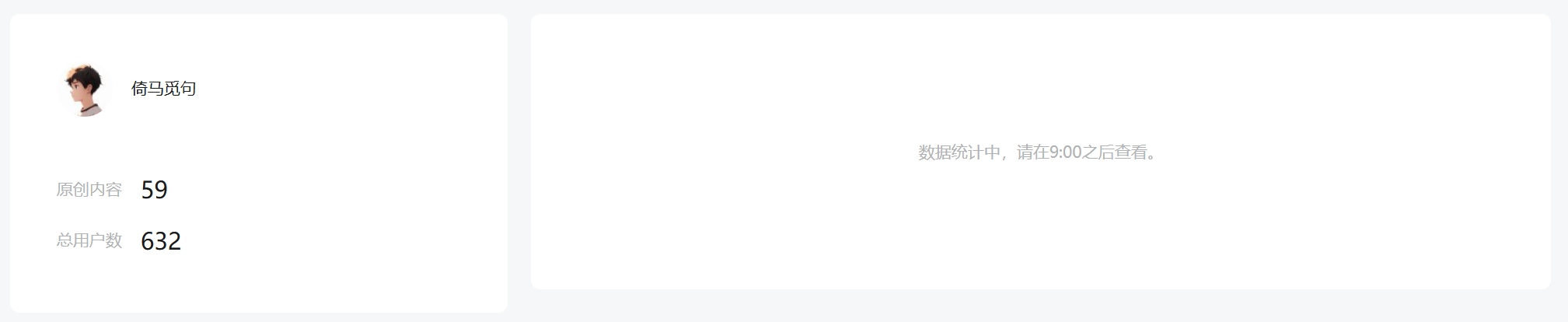
It has been 105 days since I published my first article on this WeChat public account on September 13 this year, "Fan Zhongyan Never Saw Yueyang Tower, and Li Bai Never Visited Mount Tianmu Either". I have published sixty original articles and gained 632 followers. Honestly, it has been quite a failure and calls for reflection. Here is my writing report. I can hardly call it wisdom gained from experience; it is all lessons learned the hard way.
1. An Account Name That Only I Appreciated
When I came up with the name "Yima Miju," or "Leaning on a Horse, Seeking Lines," I felt like a genius. It implied, "Though I lack the talent to finish a piece while leaning on a horse, I devote myself to seeking fine lines behind closed doors." "Ready while leaning on a horse" draws on a historical allusion to writing so quickly that a piece can be finished and put to use almost immediately. "Seeking lines behind closed doors" suggests diligent, grounded, well-supported writing of high quality. "Leaning on Ma" also hints that this account is guided by Marxism, since I have read many Marxist classics.
These four characters were rich in subtle meaning, at once modest and showing off.
Looking back, however, the name was a complete failure. Few people have time to think through these meanings. Many see the name, fail to understand it, look at the description—which seems to be a poem—puzzle over it for two seconds, and leave without knowing what the account is about.
However clever a name may be, if nobody else understands it, it is merely self-admiration.
It looks like I will have to change it.
2. Mutual Follows Are Bloody Useless, and Metrics Anxiety Needs Treatment
Anyone who has created independent online content probably experiences metrics anxiety. After working hard on something and publishing it, hoping many people will read it is only human. You may laugh, but I often sit on the management page after publishing, constantly refreshing it and hoping for new notifications. Most of the time, though, things fail to meet my expectations and hardly anyone reads it.
I also joined mutual-follow groups, where a few account owners followed one another, and spent several days fussing over this. It later turned out that followers gained this way were bloody useless. They did not read anything I posted and gradually unfollowed me.
Fortunately, metrics anxiety is not too hard to treat. The main approach is to lower expectations and enjoy creation itself. If you seek what you value and obtain it, what is there to complain about? Do not be too calculating about writing.

3. A WeChat Public Account Is a Service Platform, Not an Academic One
I originally started the account to push myself to research things, so much of the content took a very long time.
There was nothing particularly wrong with these articles themselves; the main problem was how discouraging they were for me. Take the two reading reports on Once Upon a Time in Bianshui and I Am Not a Good-for-Nothing. One book has 110,000 Chinese characters and the other 200,000. Each took most of a day to read, followed by half a day of rest and then several more hours of writing. The eventual result was only ten or twenty views.
Or take the Capital Q&A series. For rigor, I consulted five books for each part: Marx's Capital, Xu He's An Introduction to Political Economy, and Yu Bin's Forty-Five Ten-Minute Lessons, Introductory Reading, and Justice. Yet after I wrote them, nobody was interested.
Another example is "An Investigation: Is the US Literacy Rate Really Only 79%?". I consulted many sources for that piece too. Worried that readers would challenge it, I kept all the images and pasted them in one by one, trying to document every claim with visual evidence. It still received only a few dozen views on publication.
Of course, these articles gradually gained readership later. The US literacy article also took off on Zhihu, receiving more than eight hundred likes from twenty thousand views—a very high like rate. This shows that the article's quality was excellent; the problem was its promotion.
My most-read article was "How Should We View JD Customer Service Swearing at People?". It was unremarkable, practically a pile of shit compared with my other work. Yet it reached seventeen thousand views and earned me more than seventy yuan.
It took off because it caught a trending topic, promptly provided some news, and gave people a place to discuss it.
This taught me that WeChat articles should strive to meet readers' needs. Substantial, demanding articles can certainly do that, but mine cover too many unrelated topics, lack a focused niche, and require effort to read, making it hard to deliver them precisely to readers who need them. Creating only articles like these would be fine over the long term. The problem is that you cannot last until the long term, because it is too demoralizing.
So my articles must meet the needs of more people. Put simply, I want people to learn through my account things others do not know, or learn them sooner. In short, my account's present positioning is to help people show off.
4. Stop Turning Everything into a Long Essay; Shorter Articles Are Fine Too
I always seem to write more than I intended. Looking back, this is not necessarily good.
Take "Su Shi Studied Buddhism Yet Ate Meat: How Did He Avoid Inner Conflict?". I originally just wanted to introduce a few amusing reasons Su Shi gave for eating meat. But I kept feeling something was missing, so I also introduced the development of Buddhism in the Northern Song and Buddhist rules concerning abstention from meat. These are really three topics. Readers clicked for the title, only to find me tirelessly discussing other subjects, and soon lost patience.
Looking back, there would have been nothing wrong with publishing it as two or three articles.
"The Question of the Mode of Production Is the Central Question of Social Science" also contains a great deal, but its title hardly tempts people to click. Perhaps in the future I can pull out some specific questions and write separate pieces on them.
This is really a matter of attitude. I used to think writing meant unleashing a special move: I had to hold it in and produce one enormous lump. Now I have the right attitude: writing supplies nourishment to everyone, so regularly producing small pieces is perfectly fine.
5. Running a WeChat Account Still Requires Reading Professional Books
People like us who have read a few damn books tend to be a little aloof. We think we know a lot and write well, and firmly refuse to learn from marketing accounts.
This attitude is actually wrong.
WeChat account management has long since developed into a systematic field, and many relevant books are available. Learning their operating methods does no harm and does not conflict with creating good content yourself.
Management and promotion really matter. For example, I publish many articles on both WeChat and Zhihu. Sometimes something that takes off on WeChat receives little response on Zhihu; sometimes something popular on Zhihu receives little response on WeChat. This suggests that it has relatively little to do with article quality itself, and depends instead on triggering a platform's recommendation system and encouraging readers to like, share, and comment.
Good management can amplify the value of content and keep motivating authors to create more, forming a virtuous cycle. Management is a matter of vital importance to independent media, the ground of life and death, the way of survival or extinction; it must be examined carefully.
There is plenty of advice online that is worth reading, but I still think professional books are necessary because they are more specific and systematic and draw together many people's wisdom. I read one last night and found it enormously enlightening. I realized how many things I had been doing wrong. No wonder I had so little traffic.

Based on this, I have identified several improvements to keep in mind:
1 Keep studying and researching WeChat account management, and improve the account's name and operating methods.
2 Publish anything useful to readers without imposing limits on myself. My slogan is to improve everyone's level of "posture"—a playful way of saying knowledge. History, political economy, literature, current affairs, short stories, and more are all welcome, but they must offer insight and new information so readers gain something.
3 Publish substantial articles, but also more short ones. This makes things easier for readers and the author alike. Most importantly, it reduces the psychological burden and can start a virtuous cycle.
Of course, these are only my personal impressions and are certainly incomplete. If you have suggestions, please leave them in the comments.
Many thanks!
Comments
No account needed. A nickname is required; email is optional. Successful submissions appear publicly without manual pre-moderation.
Comments and nicknames are public. Optional email addresses are not displayed. The selected Waline backend and its hosting provider process comments, nicknames, optional email, IP and browser information. Comments show IP region, without the full IP address or browser and operating system labels. Hosting: Vercel; database: Neon.