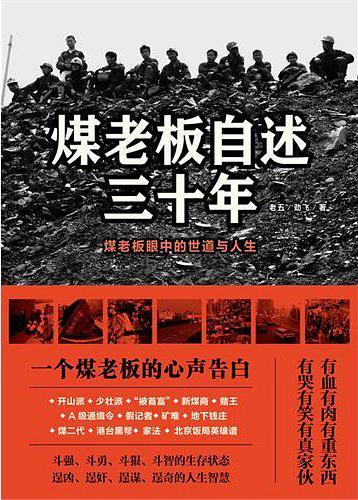
Half a month ago, I finished reading A Coal Boss's Thirty-Year Memoir. I have wanted to introduce the book ever since, but it is so dense with information that it seems better to discuss it in several installments.
Where should I begin? Let's start with their private lives.
I have organized the book's material about coal bosses' private lives into the following eight sections for readers to examine and critique.
1. What Kind of People Are Coal Bosses' First Wives?
Generally speaking, their first wives are ordinary rural women.
Coal bosses can be divided into two generations: the old guard and the younger generation. The coal business began in the early 1980s.
Whether old guard or younger generation, however, most already had families before becoming wealthy from coal. And because the mining business initially had poor prospects—it was dangerous and unstable—many who entered it struggled. Their first wives were naturally not wealthy young ladies.
For example, the author “Lao Wu's” father, “Hao Ertie,” was born in 1926 and was already fifty-eight when he opened a coal-processing plant in 1984. His wife was a mute woman from the village. Hao Ertie's sons were also no longer young at the time; they could not wait to become rich before establishing families, so they too could only marry ordinary people.
Others were worse off and had no first wife at all. For example, “Er Dan,” once the richest man in Shanxi, was a young hoodlum in the early 1980s when a widow who ran a restaurant took a liking to him. They lived together for two years, but he ultimately could not bring himself to marry a widow.
Er Dan did not begin hauling coal and gradually becoming wealthy until he was thirty. Before becoming rich at thirty, he was a bachelor. We can therefore consider him to have had no first wife.
Online stories about “a coal boss marrying off his daughter in high style” show that the younger generation's children generally marry celebrities or children of wealthy families. But they are no longer called “coal bosses”; they are called the “second coal generation” and fall outside this article's scope.
2. Is Keeping a Mistress Common Among Coal Bosses?
The old guard are somewhat better in this respect, but it is indeed very common among the younger generation. Their divorce rate is low, however, and they treat their first wives reasonably well.
The author observes:
Keeping second wives and mistresses is indeed fairly common among the younger generation of coal bosses. Interestingly, although they play around outside the home, their divorce rate is low, and their official wives are mostly the women who shared their early hardships. In this respect, coal bosses seem somewhat more decent than people in show business or the second generation of the rich.
3. How Do Coal Bosses Hire Sex Workers?
As I see it, coal bosses engage in two kinds of extramarital affairs: hiring sex workers and keeping mistresses.
First, hiring sex workers. The author himself did so, although he mentions it only once. In 2001, at a casino hotel in Kuala Lumpur, he called for a sex worker named “Xiao Guo.” She receives special mention because he liked her so much that he brought her to Beijing to sell villas. She performed very well, eventually starting her own company and turning her life around.
There are many venues for hiring sex workers, chiefly entertainment establishments, including “bathhouses,” and hotels. A famous one was Beijing's “Tianshang Renjian,” or “Heaven on Earth.” Another is “Huacheng,” which the author specifically mentions. Huacheng frequently changed its lineup of women and had strict requirements for their physiques. The author says:
For a while, Huacheng introduced a group of women all over 1.85 meters tall, selected from models and retired athletes. As they walked the runway, the short customers below looked like potbellied children. The sight was both absurd and idiotic.
According to the book, compared with other arrangements, hiring sex workers has two distinctive features: payment in cash and the use of condoms.

4. How Do Coal Bosses Find Mistresses?
A mistress is a long-term sexual partner outside marriage, sometimes called a “paramour,” colloquially a “third party,” and sometimes treated as a “concubine.” If she becomes pregnant, she may be promoted to a “second household” or “second wife.”
In the early 1990s, bosses were quite casual about finding mistresses. As long as a woman was attractive and unmarried, they would happily take her. The prevailing idea was that a mistress meant not having to use condoms, and that one did not inquire into a concubine's origins. Many sex workers consequently became coal bosses' second wives.
As time passed, coal bosses grew richer, their tastes developed, and their requirements rose:
After the turn of the century, bosses became much choosier about mistresses. They no longer wanted the flashy, seductive type: they had grown tired of them, and they were bad for one's health. They did not want incapable women either: with so much socializing and pressure these days, a mere ornament offered poor value. They would not accept an excessively high down payment or excessively high monthly installments. However rich a boss is, his money is finite. It is not worth going that far for a woman.
Finding a mistress is easier than hiring a sex worker, because there are few big bosses but many women who meet their requirements and are willing to become mistresses. Supply vastly exceeds demand. Moreover, hiring a sex worker requires paying upfront, whereas finding a mistress sometimes requires only revealing one's status.
Many coal bosses have more than one wife, and the women do not even quarrel with one another. The author's second elder brother, for instance, has at least three wives.
5. What Troubles Do Mistresses Have?
Mistresses have two main troubles: loneliness and children.
They are lonely because coal bosses are no longer as sexually hungry as before. When sexual desire has been amply satisfied, it greatly diminishes, so they develop many other interests. How could a mistress without company not be lonely?
Then there is the question of children. As a big boss's mistress, bearing a child can mean an inheritance of hundreds of millions; without a child, she risks abandonment. Mistresses therefore try every means to become pregnant. Some secretly administer aphrodisiacs, while others take the risk of secretly becoming pregnant by someone else and claiming the child is the coal boss's.

6. Coal Bosses, Actresses, and Female Stars
As everyone knows, many coal bosses invested in television dramas back then, and one of their aims was often intimate contact with actresses. Yet judging by the author's account, coal bosses were far from the only people with dirty hands:
When casting actresses, I was astonished by how many there were—seemingly more than the miners in my province. Numbers create competition, and competition creates unspoken rules. This really is not the actresses' fault; that is simply how the world works. While choosing the first through third female leads, everyone from Young Master Hua and veteran directors to assistant directors picked a new “bride” every night, sleeping around without even having to pay. Does this fucking count as an industry perk? Some vulnerable actresses have it worse than miners. Miners sell their lives; vulnerable actresses sell everything except their lives. A few actresses may have played the unspoken-rules game so long that they have gone right into the deep sea and become completely uninhibited. One day Lei Si visited the set. After an actress learned he was a coal boss, she had not even finished half a small bottle of red wine before dragging him into a hotel room for a furious fuck. No need to cultivate feelings—she wanted him right away. Lei Si was left with the unpleasant feeling of having been raped.
The author also mentions that through connections with casinos and gangs, coal bosses could “arrange dinner with A-list female stars or sleep with second- and third-tier female stars... all of it could be done.”
7. Sexually Transmitted Diseases
Here are the author's own words:
As someone who has been through it, I urge everyone to stay away from sexual entertainment venues. Some diseases cannot be kept out by a condom. Two friends of mine are now long-term sufferers from severe sexually transmitted diseases and are in great agony. Their doctors say they did not catch them from sex workers, but that they arose from within their own bodies. Truly, the poison of lust has attacked their hearts. Another friend contracted AIDS. He had always been careful and always carried the most expensive condoms. What good did that do? He caught it anyway.
8. The Author's Attitude Toward Keeping Mistresses
The preceding material also shows the author's attitudes toward mistresses:
a. Acknowledging reality. He does not deny that coal bosses hire sex workers and keep second wives, nor that he and his family have the same failing.
b. Understanding and respect. He hires sex workers himself, and people in his circle commonly keep mistresses. Naturally, he understands the behavior and does not oppose keeping mistresses as such.
c. “Keeping a mistress still comes down to character; of course, it is better if you can give it up.” These are his own words, although how many coal bosses can manage it is another question.
Marx said:
I by no means portray the capitalist and the landlord in rosy colors. But the individuals dealt with here are only personifications of economic categories, bearers of particular class relations and interests. My standpoint understands the development of society's economic formation as a process of natural history. However much an individual may subjectively rise above these relations, socially they remain their product. Less than any other standpoint can mine hold the individual responsible for these relations. (Collected Works of Marx and Engels, Vol. 5, p. 10)
The above consists of social facts summarized from the book, although their complete truthfulness is not guaranteed. What really interests us is what causes these social facts and what social laws lie behind them.
I hope to see deeper analysis in the future.
Reference: Lao Wu and Jin Fei. A Coal Boss's Thirty-Year Memoir: The World and Life Through a Coal Boss's Eyes [M]. Beijing: Culture and Art Publishing House, 2011.
Comments
No account needed. A nickname is required; email is optional. Successful submissions appear publicly without manual pre-moderation.
Comments and nicknames are public. Optional email addresses are not displayed. The selected Waline backend and its hosting provider process comments, nicknames, optional email, IP and browser information. Comments show IP region, without the full IP address or browser and operating system labels. Hosting: Vercel; database: Neon.