In China, if a family has two sons, they will not be treated very differently. In Japan, however, their treatment can be completely different. When a second son is born into a Japanese family, he is destined for a harder life.
In Feminism from Scratch, Ms. Ueno tells Ms. Tabusa:
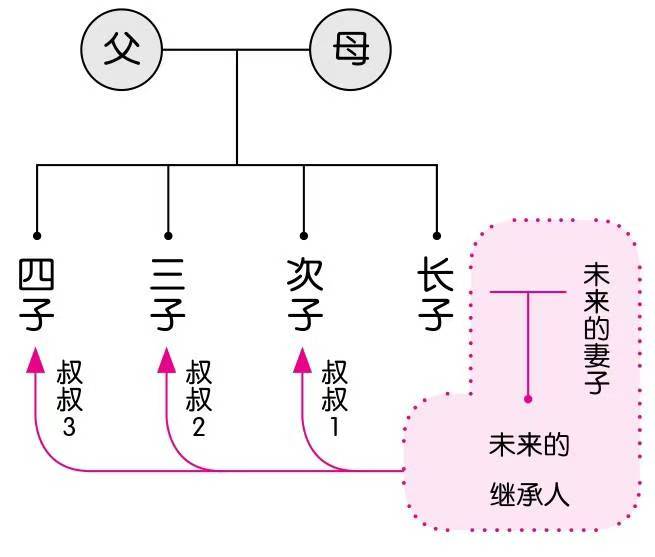
You grew up in Tokyo, so you may not know this. Japan is actually quite large, with many, many rural areas outside the cities. In the northeast, sons born after the eldest are called “Jinmu” (jinmu). It sounds impressive, doesn't it? It comes from Emperor Jinmu. In the local dialect it is pronounced “zunmu,” and some people also call them “uncles.” For example: “An uncle has been born to the Tabusa family.” But he is a baby! You might wonder: “Why call a baby an uncle?” Because the eldest son will certainly have his own male heir one day. To that future heir, isn't this newborn baby an uncle? The name therefore means that their only future is to become uncles.
Unless they marry into another family, second and third sons are generally unable to marry. They remain at home all their lives, working for the eldest son's household. Dividing fields is called “田分け” (tawake) in Japanese, the origin of “fool” (tawakemono). Because the eldest son inherits all the land, there are figures such as Uncle 1, Uncle 2, and Uncle 3. These uncles all live in one room and never marry. Frankly, they are like the eldest son's household servants. That is the position of sons other than the eldest. Only when Japan entered its period of rapid economic growth did they have opportunities to move to big cities and establish families and careers.
Zhang Hongjie's A Concise History of Japan also mentions this:
In the film The Ballad of Narayama, the second son Risuke is thirty-five and still unmarried. Because he has body odor, he has never experienced a woman and can only have sex with a dog. This is not an invention of the screenwriter, but has a basis in historical fact: in some parts of traditional Japan, other sons had no right to marry at all. “In the rural northeast of Japan in the past, social acceptance of inequality between eldest and other sons sometimes reached extremes. In some villages, for example, only eldest sons were permitted to marry.”
The miserable position of second sons in the northeastern region mentioned above was an extreme case; things were somewhat better elsewhere in Japan. Still, it is a fact that second and third sons long served as backups for the eldest and endured humiliation and discrimination. This was all a consequence of the household headship inheritance system of Japan's feudal era.
In ancient Japan, the ie, or “house,” was an economic community aimed at perpetuating the family enterprise, and the katoku was its headship. To ensure the enterprise's long-term continuity, Japanese society generally practiced eldest-son inheritance. On the previous head's death or retirement, the eldest son inherited all his social standing and family property. In some cases, the designated successor alone even inherited the family head's surname. The other sons could not inherit their father's surname and had to change theirs.
The core of eldest-son inheritance, however, was not the eldest son but a single successor: keeping the household undivided. If the family head considered the eldest son insufficiently capable, he could designate another son or even adopt a successor. Japanese people cared little about generational rank, or even the perpetuation of their own bloodline. They cared more about their family enterprise.
Actually, Yamamoto might not even care that his ancestors were…
Although Japan is no longer feudal, household headship inheritance has deeply influenced contemporary Japanese culture and values. It also played an important role in Japan's social transformation. Its effects include the following:
1 Household Headship Inheritance Promotes Family Stability and Capital Accumulation
China has a saying that neither poverty nor wealth lasts beyond three generations. One important reason is the Chinese practice of dividing households, which prevents family property from passing intact between generations. Every division weakens the main branch of a wealthy family. With even a minor mishap, the family can decline.
Japan is different. Eldest sons receive meticulous training from childhood, so the family head's skills and business are passed on comprehensively. Not a portion of the property is divided away. Families are therefore more resilient to risk and more likely to endure. This also explains why many occupations in ancient Japan were hereditary, some continuing for more than a hundred years.
In modern Japan, the idea of household headship inheritance also promoted the growth of family firms. Deng Huijuan writes in Japan's Household Headship Inheritance System:
Businessmen with political connections after the Meiji Restoration, and the later zaibatsu, likewise held capital as family property. To avoid the adverse consequences of its division, the household headship successor inherited all or most of it. Japan's long-established zaibatsu maintained family management from the Tokugawa period onward. The continuous expansion of Mitsui, for example, was closely related to strict household headship inheritance across more than ten generations of successors. Konoike was similar: its family rules stipulated that the successor inherit most property, leaving only 10%–20% to second sons and others, preserving the integrity of the family firm's assets. New zaibatsu formed after the Meiji Restoration, such as Mitsubishi and Sumitomo, displayed the same pronounced family-management characteristics in their core organizational structures as the older zaibatsu.
We therefore have to acknowledge that Emperor Wu of Han's “Edict of Expanding Grace” was indeed the best way to restrain great families and maintain the stability of feudal society. Dividing households constantly created new smallholders, and even large landlords could grow only so large. In an era of a developed commodity economy and permissive commercial policies, large landlords could easily accumulate capital and develop a capitalist economy.
We can say that household division, combined with policies favoring agriculture and restricting commerce, made China's feudal society exceptionally stable, allowing it to last a thousand years.
2 Household Headship Inheritance Helps Create an Industrial Reserve Army
During the Tokugawa shogunate, many “rōnin” appeared. They were second and third sons excluded from the family enterprise who were unwilling to take up other trades, so they relied on their martial skills and caused trouble wherever they went.
Household headship inheritance separated second and third sons from the means of production, forcing them to find other livelihoods. Many became unemployed wanderers. Feudal society could not accommodate them, but during capitalist development they became an industrial reserve army and wage workers, promoting capitalism's growth. This resembles the enclosure movement in the West.
Of course, this has little to do with China's difficulty in entering capitalist society. Ancient China had no shortage of displaced people. Had a capitalist economy existed, they could easily have become wage laborers; no additional enclosure movement or household headship inheritance system was needed. What ancient China's feudal society lacked was commerce and great merchants.
3 Household Headship Inheritance Promotes Personal Development
Under this system, the eldest son, as heir, received unstinting and meticulous training from childhood. As Japan's Household Headship Inheritance System puts it:
The training of eldest sons under household headship inheritance also played a vital role in developing talent. As mentioned earlier, Japanese houses attached great importance to cultivating their successors' abilities. Sony founder Akio Morita, for example, attended the company's New Year celebrations with his father from the age of six. At ten he was required to attend board meetings and confidential meetings at home between Kyusaku Kōmon and company managers. In secondary school he helped verify and count inventories and learned the techniques of sake production, among other tasks. Traditional Japanese families clearly spared no effort and attended to every detail in training successors. If the Morita family still did this in the early twentieth century, it is easy to imagine the situation in the Meiji period, when household headship inheritance was widespread throughout the population. Nearly half of those credited with the Meiji Restoration, for example, were eldest sons.
Second sons, having abandoned any hope of inheriting the family enterprise from childhood, also had to make their own way. Their choices were broad: they could try any trade or become adopted sons of other families to change their status. Many turned the unequal treatment they had experienced at home into motivation to strive, eventually achieving success.
This shows that social institutions are difficult to judge simply as “good” or “bad.” It is more useful to ask whether they are appropriate. Japan's household headship inheritance system made life difficult and miserable for many second and third sons, but benefited Japanese society as a whole.
In fact, during the Kamakura shogunate, 1185–1333, Japan's economy was based on manorial lordship. Although succession followed legitimate eldest-son primogeniture, property was inherited according to the principle of equal division. This led collateral branches of great lords' families to resist control and refuse their obligations. It also repeatedly divided warriors' property, forcing them to seek the protection of powerful local figures. The eventual results were the rise of regional daimyo and social unrest.
It was against this economic background and historical experience that Japan chose a compatible system of household headship inheritance. This also corroborates Marxism's materialist conception of history.
I will offer a tentative conclusion: eldest-son inheritance of property benefits large landlords and large capital; equal division of inheritance benefits smallholder and small-proprietor economies, and also helps form a “middle-class society”; communist society will gradually abolish property inheritance. The details are of course more complicated. These are only preliminary conclusions.
I do not know whether they are correct. Please judge for yourselves.
References:
Deng Huijuan. Japan's Household Headship Inheritance System [D]. Southwest University of Political Science and Law, 2011.
Zhang Hongjie. A Concise History of Japan [M]. Changsha: Yuelu Academy, 2021.
Ueno Chizuko and Tabusa Eiko. Feminism from Scratch [M]. Translated by Lü Lingzhi. Beijing: Beijing United Publishing Company, 2021.
-END-
This is a WeChat public account where you can learn something. Follow me for more interesting articles!
Comments
No account needed. A nickname is required; email is optional. Successful submissions appear publicly without manual pre-moderation.
Comments and nicknames are public. Optional email addresses are not displayed. The selected Waline backend and its hosting provider process comments, nicknames, optional email, IP and browser information. Comments show IP region, without the full IP address or browser and operating system labels. Hosting: Vercel; database: Neon.