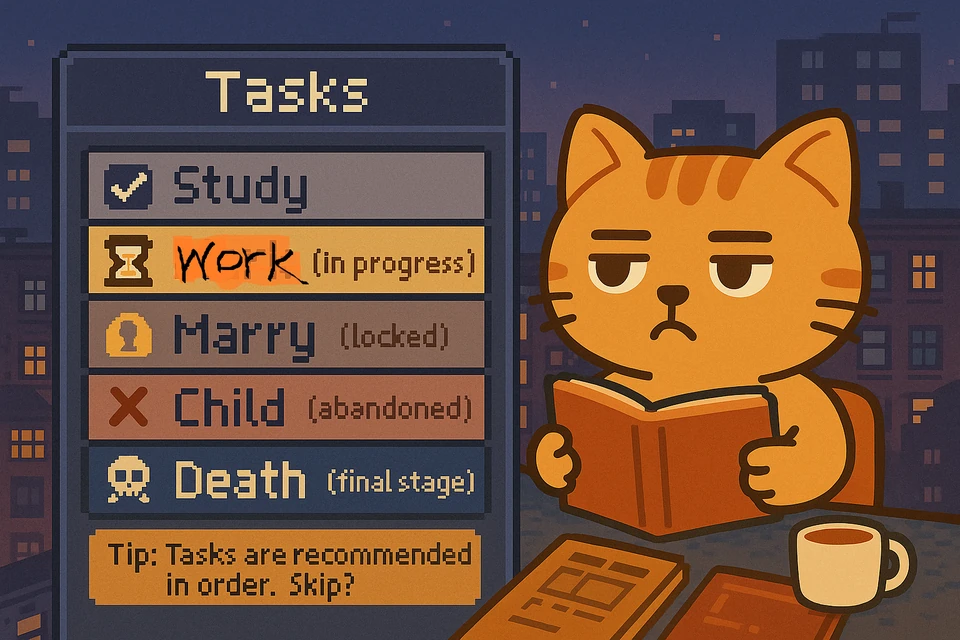
Most Chinese people receive a linear education about life: study, work, marry, have children, raise them, care for aging parents, grow old, and die. One reason for teaching everyone this pattern is that, in our time, it really does suit most people. Following it is unlikely to lead you badly astray and can ensure a basic standard of living. Another reason is that it benefits the country and society: everyone follows the process, society remains stable, and everybody is happy.
I am not here to criticize this pattern. I simply want to suggest that we compare life to a game. This pattern would then be the “main quest” set by the system. As the game’s time advances, everyone is forced to pass through these stages. Of course, their lengths differ from one player to another: some people spend more than thirty years studying, while others have no access to schooling and start working very young. Some players skip certain stages altogether; many, for example, never marry or have children. But that does not matter. At least we all go through the final stage: death. When a person dies, the game ends and counts as cleared.
What, then, is our objective? To finish as quickly as possible?
No. I believe we have only one objective: to experience as much enjoyment from the game as possible. By playing, we can fully appreciate the charm of its world, explore its underlying setting, discover different ways to play, unlock achievements, and interact with other players. Nobody but you can define victory or defeat in this game. As long as we gain happiness from it, playing is worthwhile.
How should we play this game well? Here are my thoughts.
1. Understand Your Character’s Starting Setup
The era you live in, your nationality, ethnicity, class, gender, family, personal characteristics—your genes—and so on determine your playing environment and difficulty level. In other words, everyone has a different storyline.
The saddest thing is to take the strategy for someone else’s storyline, apply it to your own, and fail. For example: chasing vanity in a poor person’s storyline, trying to marry up in an unattractive person’s storyline, refusing marriage and children in a feudal storyline, or trying to become a king or emperor in a democratic storyline. All these deliberately increase your difficulty. Raising the difficulty a little can make the game more enjoyable, but if it becomes too high, you may end the game early and have nothing left to play.
When understanding your starting setup, pay particular attention to the game version. For our parents’ generation, marrying and having children greatly reduced the difficulty and improved the experience. That is not necessarily true in our version. Remaining unmarried and childless has become a reasonable choice for many people, and that choice is not necessarily bad. Similarly, male players in our parents’ generation faced fewer taboos when pursuing women. In our version, male players must be careful about what they say and do, repeatedly confirming the woman’s own wishes. Otherwise, the consequences may range from a feminist warning to imprisonment.
Society’s morals, experience, recommendations, and so on resemble a rules-based horror story: some rules bring punishment if you break them, while others bring punishment if you follow them. Think independently about every rule in light of your own circumstances. Through observation and tentative experimentation, find the right answer. You have to make these judgments yourself.
This first step seems simple, but many players still have not understood it by the time their game ends.
2. Play the Main Quests Well
Many people look down on the main quests. But for most players, they serve as the tutorial. Following them can at least guarantee a basic playing experience.
Main quests: study, work, marry, have children, raise them, care for aging parents, grow old, and die.
For example, early in the game, if you follow the main quest and study properly, you do not have to worry about the responsibilities of making a living. The best choice at that point is to use the time to study seriously and work hard, because even if you do not study, the time will pass anyway. If you leave school early, your family will probably make you go out to work. You will have increased the difficulty of the “work” stage while losing the experience of the “study” stage.
Work, for example, can provide income and some social interaction, gradually bringing you into contact with society and deepening your understanding of the game. If studying is like reading the game’s encyclopedia, manual, and strategy guides, working is actual gameplay. Sometimes you can truly understand the manual only after playing. Some manuals are simply false, and unless you try things yourself, you may never find out and remain deceived for your entire life.
Marriage, having children, raising them, and caring for aging parents are all playing experiences too. You can choose to experience them early, late, never, several times, secretly after publicly rejecting them, or merely watch others experience them. In short, there are many choices and ways to play. Putting these activities in the main quest reminds players that this is an important section of the game and a part its designers are particularly proud of. I think anyone whose circumstances allow it can give it a try.
Overall, I suggest taking the main quests seriously. Complete them well, and your playing experience is unlikely to be bad. Of course, if they do not go well, you can improve your experience in other ways, such as by taking on side quests.
3. Explore and Develop Side Quests
Life is richer and more complicated than any role-playing game currently available, and its side quests are almost limitless. I will suggest a few categories to get the discussion started.
A: Study the game’s code. That means doing scientific research to understand how the world and society operate. The game is so enormous that understanding even part of its code is already a remarkable achievement.
B: Check in around the map. Visit different places in the game, such as foreign lands, popular attractions, and historical sites.
C: Develop hobbies. Singing, dancing, martial arts, football, and other activities let you experience different kinds of fun and interact with other players through them.
D: Change the game version. If you are unhappy with the current version, you can do more than put up with it: you can change it. One way is to leave—for another country, for example, where people may be playing a different version. Another is to change the version directly, through social movements, parliamentary legislation, revolution, or rebellion. Changing the game version can greatly improve the experience, and the process itself can be very enjoyable. Sometimes, however, the risks are high, so I suggest preparing thoroughly before trying.
E: Convert to a religion. Religious faith has a substantial influence, affecting not just your ideas but your life too. For example, if you convert to Islam, you have to do more than study the Quran: importantly, you must follow the teaching against eating pork. One benefit is entering a new social circle. You might even have a chance to marry a Hui woman, with your descendants benefiting from bonus-point policies in the college entrance examination.
In short, there are many ways to play. I am sure everyone has experience of this, so I will not presume to teach the experts.
4. Adopt the Right Mindset
When I was a child, I watched an animated series called The Adventures of Luoluo. It tells the story of a child named Luoluo who enters the world of a game he used to play often, set against a war between the vehicle tribe and the beast tribe.
When Luoluo first enters that world, he asks, “Aren’t you game characters?” Pilihuo of the vehicle tribe replies, “Life itself is a game, but this game is different from ordinary games. You have to play whether you want to or not.”

I think there is nothing wrong with that statement. The biggest difference between the game of life and the video games within it is that playing is compulsory and you cannot restart.
Every player therefore needs the right mindset. Some are dealt a bad storyline, but there is no way around it: they have to keep playing, even through tears. If you wallow in self-pity, your game will only get worse. If you play actively, however, even a terrible storyline may improve.
We can even look at it another way: being given a good storyline is not necessarily a good thing, because it deprives you of the character-building experience of growing from weak to strong.
For example, when playing Romance of the Three Kingdoms XIII, creating an officer with all six attributes set to 100 is not necessarily much fun. You will find that nobody can challenge you, and many mechanics the designers carefully created will seem pointless. Many people instead like making a “Six Ones Recluse”: an officer with all six attributes set to 1. They then enjoy developing that character and defying the odds to change his fate. This can be a better playing experience.
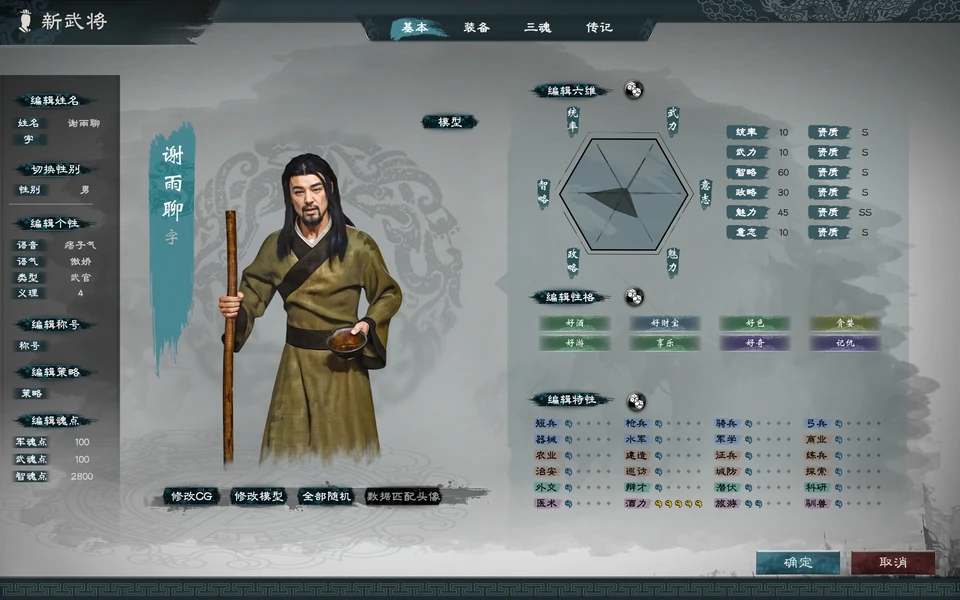
Everyone, then, has a unique storyline, and every storyline can develop in countless directions, making every experience unique. Although we inevitably envy other people’s storylines, it is more important to play our own well and experience the pleasures unique to it.
We make all kinds of decisions within our own storylines. They bring many advantages and many disadvantages. But all of it is your life.
What kind of approach to life’s gameplay do you prefer?
- Steady progress along the main quest: studying, working, and starting a family
- Rich side quests are where the fun is: travel, creativity, and research
- Hidden quests: defying fate and breaking through limits
- I have no idea what I am playing…
What do you think of the life storyline you have been given? A hellish start, or a lucky player’s script?
What stage of the game are you at now? The beginner village, or stuck in a particular dungeon?
You are welcome to discuss.
Comments
No account needed. A nickname is required; email is optional. Successful submissions appear publicly without manual pre-moderation.
Comments and nicknames are public. Optional email addresses are not displayed. The selected Waline backend and its hosting provider process comments, nicknames, optional email, IP and browser information. Comments show IP region, without the full IP address or browser and operating system labels. Hosting: Vercel; database: Neon.