In 2017, Beijing released a new city master plan for 2016–2035, laying out a blueprint for the capital's development over the next twenty years.
In the blink of an eye, it is 2025. Only ten years remain until the final vision described in that plan. Much of the original blueprint has already become reality, while other parts are being implemented. Everything is changing, slowly but thoroughly.
This article introduces the state's overall plan for Beijing at the time and the basic roles of its districts. Comparing it with today's reality will, I believe, give readers much to reflect on.
I believe this plan will continue to reveal its value over time.
I. Beijing's Future Urban Framework: One Core, One Main Area, One Sub-Center, Two Axes, Multiple Nodes, and One Zone
Remember these six key phrases and consult this map of the city's spatial structure, and Beijing's planning logic and urban framework become easy to grasp.
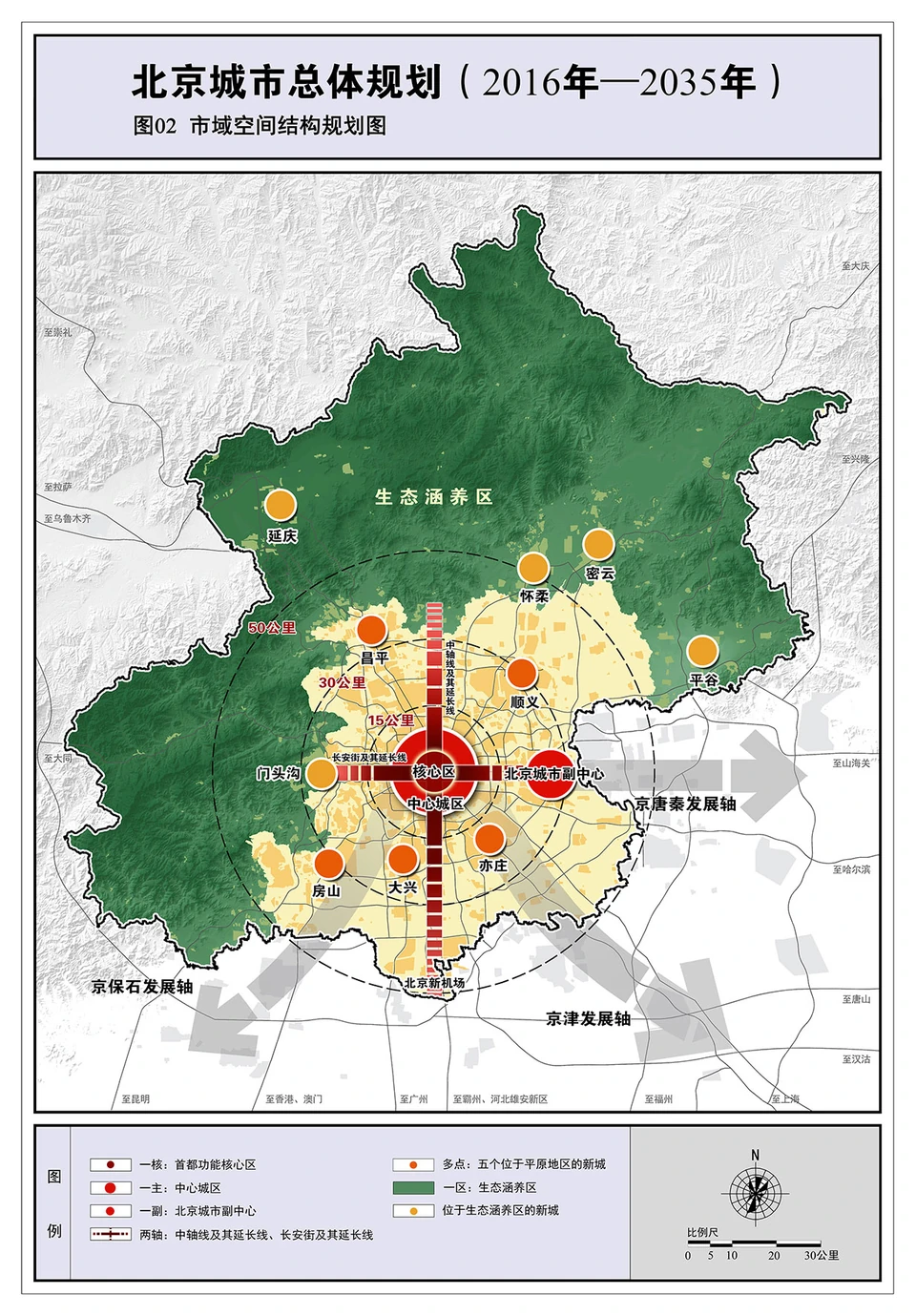
One core: the core area of capital functions, Dongcheng and Xicheng
One main area: the central urban area, Chaoyang, Haidian, Fengtai, and Shijingshan
One sub-center: Beijing's municipal sub-center, Tongzhou
Two axes: the Central Axis, and Chang'an Avenue and its extensions
Multiple nodes: five new towns on the plain, Shunyi, Changping, Fangshan, Daxing, and Yizhuang
One zone: the ecological conservation zone, including Mentougou, Pinggu, Huairou, Miyun, Yanqing, and the mountainous areas of Changping and Fangshan
II. Are “the Capital” and “Beijing” Actually Different Things?
One simple way to understand it is this: inside the Fifth Ring Road is the capital; outside it is Beijing. Dongcheng and Xicheng are the country's political center; Tongzhou is Beijing's municipal administrative center.
Of course, this is merely a convenient explanation. Beijing is the capital and the capital is Beijing, but different areas do indeed have different functions. The roles of “one main area, one core, and one sub-center” make this clear.
1. The Core Area of Capital Functions: Dongcheng and Xicheng
Keywords: politics, culture, core
This is the core area supporting the national political and cultural centers and the international exchange center, a key area for protecting the historic city, and an important window displaying the national capital's image.
This is China's true “heart,” where population and development intensity will be strictly controlled. Functions unrelated to the capital must move away, the ancient capital's character must be preserved, and political security must take priority.
2. The Central Urban Area: Chaoyang, Haidian, Fengtai, and Shijingshan
Keywords: the concentrated location of the four centers
The central urban area concentrates the functions of the national political center, cultural center, international exchange center, and science and technology innovation center. It is crucial to building a world-class harmonious and livable capital, and is the main area from which non-capital functions will be relocated.
It is the main arena for scientific and technological innovation, cultural creativity, and international exchange. In the future, it will reduce density, free up space, improve the living environment, and build a higher-quality urban core.
3. The Municipal Sub-Center: Tongzhou
Keywords: one of the capital's “two wings,” absorbing population and functions from the main urban area
Beijing's municipal sub-center is one of its two new wings, the other being Xiong'an New Area. Its planning and construction should adopt a global outlook, international standards, Chinese characteristics, and ambitious positioning, with the spirit of creating history and pursuing art. Using the most advanced concepts, highest standards, and best quality, it should become a model for a world-class harmonious and livable capital, new urbanization, and coordinated regional development in Beijing–Tianjin–Hebei.
Most Beijing municipal government agencies have now moved to Tongzhou. The sub-center will build a new administrative, business, cultural, and tourism core. It is expected to absorb 400,000–500,000 people from the central urban area by 2035 and, together with Xiong'an, form new growth poles for Beijing–Tianjin–Hebei.
III. The Five New Towns: What Are Their Roles?
Next, let us examine the official roles assigned to the five new towns of Shunyi, Daxing, Yizhuang, Changping, and Fangshan. The order alone, to begin with, tells us something about their relative importance…
1. Shunyi:
A core international aviation center integrating airport and city; a pioneering area for upgrading the regional economy through innovation; and a model of harmonious, livable urban–rural coordination in the capital.
2. Daxing:
A demonstration area for coordinated development across Beijing–Tianjin–Hebei; a leader in scientific and technological innovation; a new gateway for the capital's international exchanges; and a pioneering area for deepening urban–rural development reforms.
3. Yizhuang:
A globally influential innovative industrial cluster and technology service center; a collaborative innovation and development area in the capital's southeast; a base for strategic emerging industries and a model for manufacturing transformation and upgrading; and a green urban district suited to living and working.
4. Changping:
A key ecological conservation and regional ecological governance collaboration area in the capital's northwest; an important part of a globally influential national science and technology innovation center, and a world-class new science and education district; a distinctive historical, cultural, tourism, and ecological leisure area; and a pioneering demonstration area for comprehensive urban–rural governance and coordinated development.
5. Fangshan:
A key ecological conservation and regional ecological governance collaboration area in the capital's southwest; an important node on the Beijing–Baoding–Shijiazhuang development axis within Beijing–Tianjin–Hebei; a demonstration area for innovative transformation in technology and finance; and an international tourism and leisure area combining historical culture with geological heritage.
IV. The Ecological Conservation Zone: Beijing's “Back Garden”
As everyone knows, Beijing is blessed with favorable geography, and its mountains are naturally an important part of the city. Below are the roles of its mountainous districts.
1. Mentougou:
A key ecological conservation and regional ecological governance collaboration area in the capital's west; a comprehensive service area for western Beijing; and a distinctive western Beijing historical, cultural, tourism, and leisure area.
2. Pinggu:
A key ecological conservation and regional ecological governance collaboration area in the capital's east; a comprehensive logistics hub serving the capital; and a demonstration area for distinctive leisure and innovative green economic development.
3. Huairou:
A key ecological conservation and regional ecological governance collaboration area in the capital's north; an ecological development demonstration area serving the country's international exchanges; and an area for high-end technological and cultural development led by green innovation.
4. Miyun:
The capital's most important water-source protection area and a regional ecological governance collaboration area; a national pioneering demonstration area for ecological civilization; and a demonstration area for distinctive cultural tourism, leisure, and innovative development.
5. Yanqing:
An important ecological conservation and regional ecological governance collaboration area in the capital's northwest; a demonstration area for ecological civilization; a renowned international cultural, sporting, tourism, and leisure district; and an area for distinctive scientific and technological innovation in northwestern Beijing.
6. The Mountainous Areas of Changping and Fangshan:
Following the ecological conservation zone's overall requirements, these areas will focus on building ecological barriers in the capital's northwest and southwest and developing higher-quality, distinctive historical, cultural, tourism, and ecological leisure areas.
V. Southern Beijing Has Boundless Development Prospects
I began studying in Beijing in September 2020, entering the city through Daxing Airport. For university students of my generation, the airport seems always to have existed. Only later did I learn that it had actually opened in 2019, although plans for Beijing's new airport had been drawn up more than a decade earlier. This often makes me reflect on how slowly yet profoundly change unfolds.
Of Qing-era Beijing, people said: “The east is rich, the west noble, the south lowly, and the north poor.” Development over the past few decades favored the north. This plan, however, specifically emphasizes coordinated development between north and south. Together with the national Beijing–Tianjin–Hebei coordination strategy and the millennium plan for Xiong'an New Area, this suggests that southern Beijing will become one of China's fastest-growing areas for economic and social development.
I am honored to witness this land's development, which is also why I founded this public account. It will focus on southern Beijing, including Fangshan District, Daxing District, Baoding, Langfang, and Xiong'an New Area, providing information on local history and culture, the economy and industries, policy interpretation, work and life, regional news, and more. Please keep following.
Comments
No account needed. A nickname is required; email is optional. Successful submissions appear publicly without manual pre-moderation.
Comments and nicknames are public. Optional email addresses are not displayed. The selected Waline backend and its hosting provider process comments, nicknames, optional email, IP and browser information. Comments show IP region, without the full IP address or browser and operating system labels. Hosting: Vercel; database: Neon.