Construction of Beijing Subway's Yanfang Line began in late 2013, and it opened on December 30, 2017. Running from Yanshan to Yancun East, it serves nine stations over 14.4 kilometers.
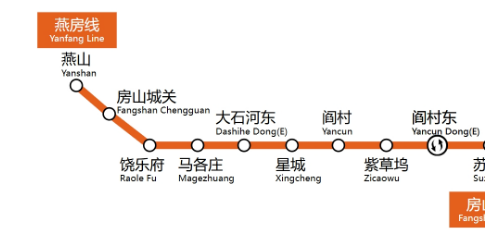
The Yanfang Line is China's first independently developed fully automated metro line. It is said to be an extension of the Fangshan Line: the tracks connect, both lines use an orange-yellow identification color, and through operation is reportedly planned for the long term.
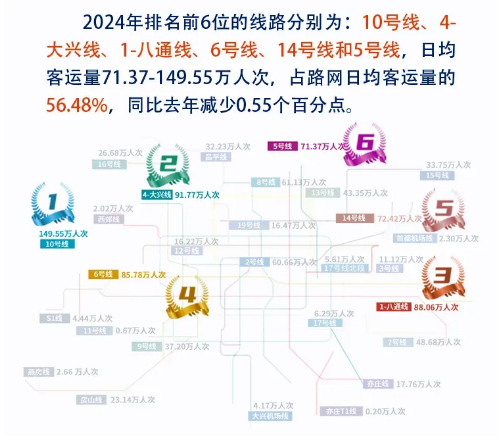
But the Yanfang Line has another defining feature: extremely low ridership. According to the official WeChat account of the Beijing Rail Transit Control Center, Beijing Subway's top three lines by ridership in 2024 were Line 10, at 1.4955 million passenger journeys; Line 4–Daxing, at 917,700; and Line 1–Batong, at 880,600. The Yanfang Line carried just 26,600—remarkably few. The Fangshan Line carried 231,400, almost ten times the Yanfang Line's ridership. With such a gap, how could through operation work?
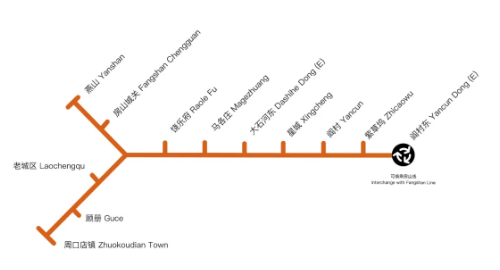
In fact, the Yanfang Line was not originally planned as just one route. Besides the main line, it had a branch. Land acquisition for the branch began in August 2019, with construction originally scheduled to start at the end of 2019 and service to begin at the end of 2020. Once it opened, people would be able to take the subway directly to Zhoukoudian to see Peking Man and Upper Cave Man...
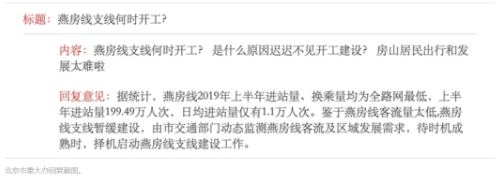
In late 2019, a resident posted a question on the official website of Beijing's Major Projects Office: “When will construction of the Yanfang Line branch begin? Why has work still not started?”
The official reply was:
Statistics show that in the first half of 2019, the Yanfang Line had the lowest station entries and transfers in the entire network. Total entries in the first half were 1.9949 million, averaging only 11,000 daily. Given the Yanfang Line's very low ridership, construction of its branch has been deferred. Municipal transport authorities will dynamically monitor passenger flows and regional development needs and, when conditions are ripe, choose an appropriate time to begin construction.
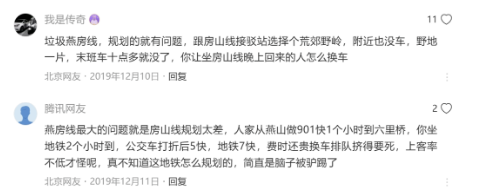
Some internet users point out, however, that residents along the line do need to travel into Beijing; the line is simply badly planned. From Yanshan, express bus 901 reaches Liuliqiao in one hour, while the subway takes two. The bus is cheaper too. This, they argue, is the fundamental reason for the line's low ridership.
Building a subway along express bus 901's route, with a new line from Fangshan's old town to Wanping City connecting to Line 16's Wanping City station, would naturally be much faster. But the route would have to run parallel to the Beijing–Guangzhou Railway and might alter the landscape around Lugou Bridge. It would be enormously costly and difficult to implement.
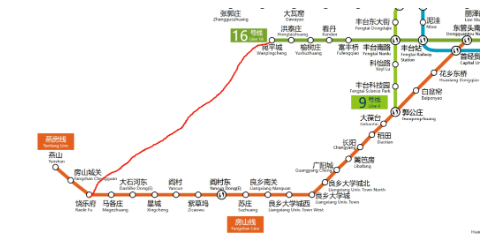
I think the key issue, however, is the industry around the Fangshan and Yanfang lines. On the one hand, many people already need to commute from different parts of Fangshan to Liangxiang. If Liangxiang's industries develop further and provide more jobs, Yanfang ridership will naturally rise. On the other hand, Fangshan's old county town and the Yanshan area have illustrious histories and remain substantial today, at least on the scale of county towns. If their industries continue to develop, the Yanfang Line will naturally grow busier.
The scenery along the line is also beautiful, and the Zhoukoudian site is world-famous. Tourism could develop too; it depends on how the relevant authorities use these resources.
For now, however, there appears to be no plan to build the branch before at least 2027. Perhaps people can look forward to Beijing's fourth-phase rail transit construction plan, due in 2028. I suspect the branch may be put into practice then. After all, it would pass through Fangshan's old town and run directly to Zhoukoudian; it is hardly without merit.
Comments
No account needed. A nickname is required; email is optional. Successful submissions appear publicly without manual pre-moderation.
Comments and nicknames are public. Optional email addresses are not displayed. The selected Waline backend and its hosting provider process comments, nicknames, optional email, IP and browser information. Comments show IP region, without the full IP address or browser and operating system labels. Hosting: Vercel; database: Neon.