I have just entered the population totals and birth rates since 1978 from National Bureau of Statistics data and calculated the number of births each year. To reduce visual fatigue, I shaded the Dragon-year rows light blue. Here are the results:
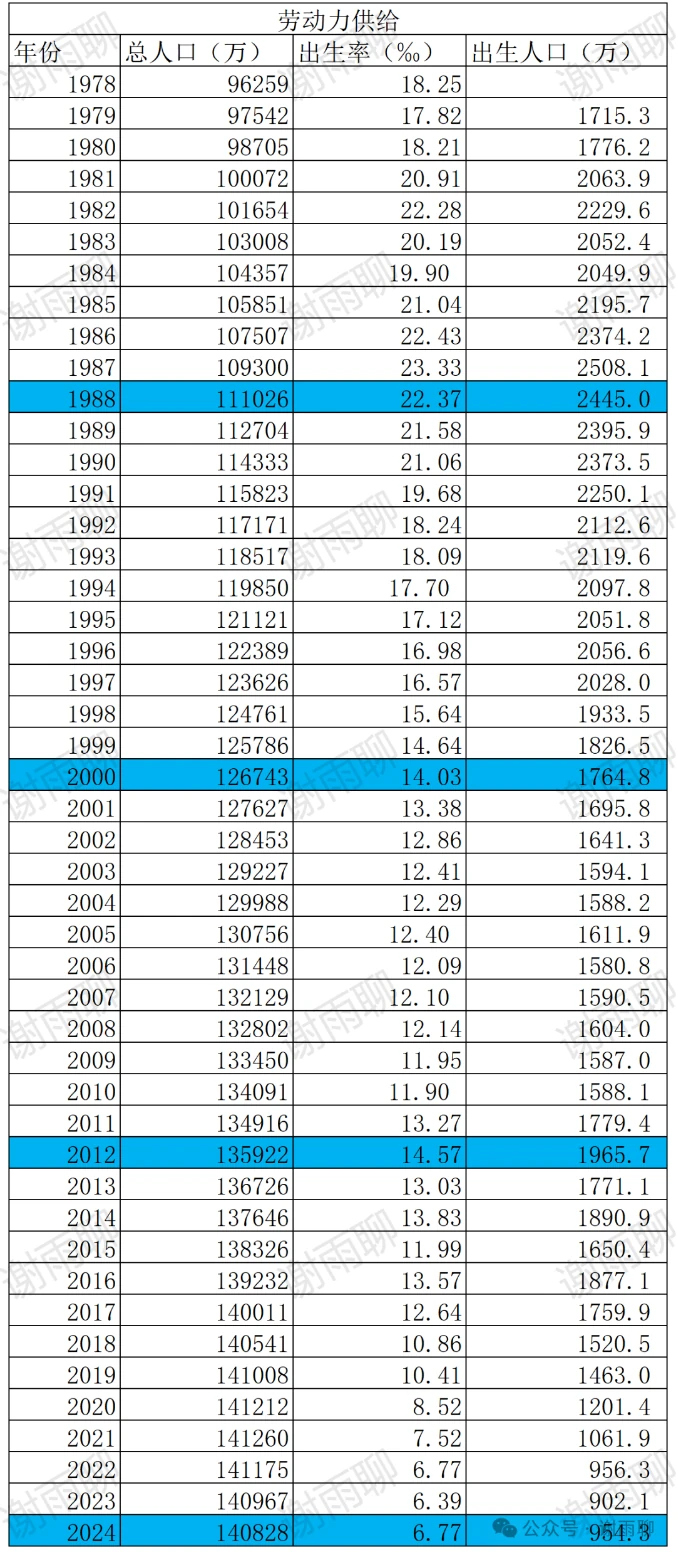
I noticed the following:
1 In 1981, China's population passed one billion; it passed 1.1 billion in 1988, 1.2 billion in 1995, 1.3 billion in 2005, and 1.4 billion in 2017.
2 China's population peaked in 2021 at 1.4126 billion. It declined for the first time in 2022.
3 The universal two-child policy began in 2016, allowing all couples to have two children. Ironically, apart from 2016 itself, births have fallen every year since and never risen again.
4 From 2021, the state allowed couples to have three children, but it did not do a damn thing. That year, some so-called experts predicted that China's population would peak at 1.45 billion in 2027. Who could have expected 2021 itself to be the peak year?
5 Here is something counterintuitive: 221 million people were born in the 1980s, 209 million in the 1990s, 163 million in the 2000s, and 173 million in the 2010s. Yes, the 2010s cohort is ten million larger than the 2000s cohort. Those born in the 2000s are the smallest generation, though certainly larger than the generation born in the 2020s.
6 The 2010s cohort being larger than the 2000s cohort shows that, before 2019, Chinese people still liked having children. The sharp decline in fertility is really a development of only the past few years, and we may not fully feel its impact until twenty years from now.
7 Births rebounded in 2024. The publicity sounds wonderful, but the total was only 9.543 million, somewhat better than 2023's 9.021 million and not even as high as 2022's 9.563 million. The overall trend is therefore toward a declining birth rate in China, and this situation cannot be changed without substantial reform.
8 For at least the next ten years, China's working-age population will only grow, while university graduates continue to increase, making employment difficult. Twenty years from now, however, the balance of supply and demand in the labor market will reverse. China will become relatively short of workers, perhaps resembling Japan today, with rising employment and the beginning of immigration from abroad.
Comments
No account needed. A nickname is required; email is optional. Successful submissions appear publicly without manual pre-moderation.
Comments and nicknames are public. Optional email addresses are not displayed. The selected Waline backend and its hosting provider process comments, nicknames, optional email, IP and browser information. Comments show IP region, without the full IP address or browser and operating system labels. Hosting: Vercel; database: Neon.