In China, we commonly distinguish age groups with expressions such as "post-70s," "post-80s," "post-90s," and "post-00s." It is easy to regard this as natural, since "born after such-and-such a year" is an objective description. In fact, people abroad do not speak this way. Almost nobody in English-speaking countries says "post-00s." Search Google for "post-00s," and almost all the results concern China. Our "post-00s" generally correspond to what they call "Gen Z," or Generation Z.
Looking at mainstream European and American generational divisions, we find a highly systematic set of naming conventions:
Lost Generation: 1883–1900; experienced the First World War and its aftermath of trauma.
Greatest Generation: 1901–1927; lived through the Great Depression and formed the main fighting force in the Second World War.
Baby Boomers: 1946–1964; beneficiaries of the postwar population boom and golden economic age.
Generation X: 1965–1980; grew up toward the end of the Cold War and were called "latchkey children."
Millennials: 1981–1996; embraced the early internet and encountered the subprime mortgage crisis.
Gen Z: 1997–2012; true digital natives and the short-video generation.
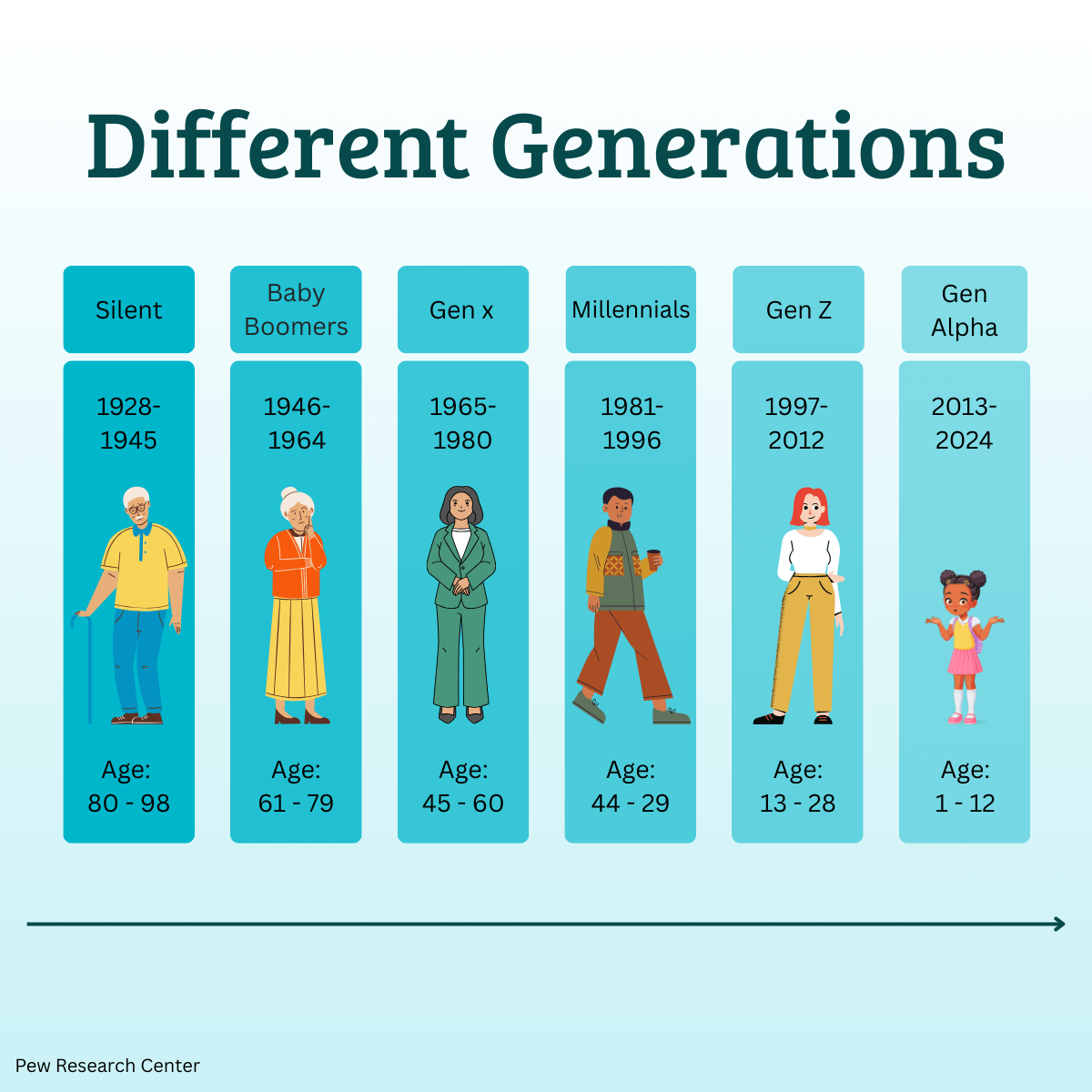
We can see that these generational divisions were actually tailor-made for American society, reflecting its changes and major events: the Second World War, the postwar baby boom, the Cold War, and the American internet. European countries such as Britain, France, and Germany have broadly similar histories since the twentieth century, so they use roughly the same terminology.
Because America and the English language have long held a dominant position since the war, this generational framework, along with other cultural forms, has naturally been exported worldwide. From India and Latin America to the Middle East and Southeast Asia, many countries apply the Gen X, Gen Y, and Gen Z framework directly to their own people despite having entirely different local histories.
That is why my title is "China's Birth Decades and Generations Abroad," rather than "China's Birth Decades and America's Generations." American culture has penetrated every corner of the world. This happens not only with generational divisions but with many other ideological forms, including theories, literature, sports, music, and more. America draws up the model, and other countries clumsily imitate it, following every step. Under this cultural onslaught, few countries can preserve relative independence.
Only a very small number of countries worldwide can retain strongly local generational narratives amid this tidal wave of Western culture. Examples include Japan, South Korea, the former Soviet Union, Iran, and Vietnam. Without exception, these countries possess strong linguistic vehicles and cultural agency capable of resisting assimilation by the so-called "civilized world."
Japan has distinctive terms reflecting its own economic cycles, such as the "Dankai Generation," "Bubble Generation," "Employment Ice Age Generation," and "Yutori Generation";
South Korea has terms recording local social change, such as the "386 Generation," "IMF Generation," and "N-Po Generation";
Iran has labels bearing strong traces of local history, such as "Dehe-80s," referring to those born in the 80s of the Iranian calendar.
Even countries with deep-rooted local cultures, such as Japan and South Korea, have increasingly shown signs in recent years of assimilation into American-style labels such as "MZ Generation" and "Gen Z." Traditional terms like "Yutori Generation" and "386 Generation" are being diluted by the West's uniform letter codes. Today, apart from China's "post-00s," other countries generally call this group "Gen Z." This distinctive system of self-definition is actually precious and difficult to sustain.
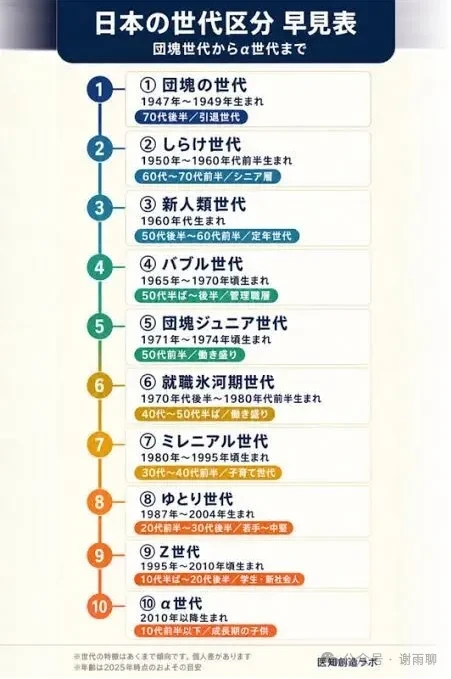
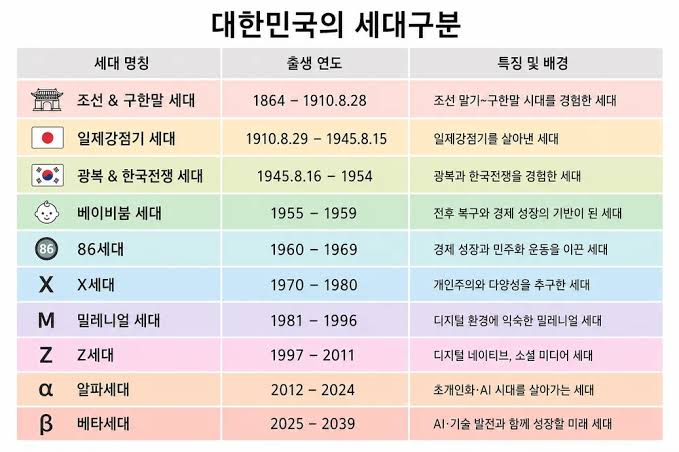
Looking back at China's own "post-such-and-such" divisions, what appears to be a purely objective description also reflects national conditions. In time, China's modern history has been so complex and winding that almost every decade contains several major events. Foreign-style "such-and-such generation" divisions therefore cannot meet our classification needs. Geographically, China is vast and unevenly developed. Among those born in the 1980s, for example, someone in urban Shanghai may have encountered extensive Western culture in childhood, traveled abroad frequently, and developed fairly progressive ideas. Someone in rural Sichuan may have had no extracurricular books available in the village beyond school textbooks and left the province for the first time only after university. Under these circumstances, being born in the 1980s tells us only that they experienced similar social events at similar ages. Other conclusions require additional information.
In China, then, knowing someone's birth decade and place of origin, together with Chinese history and geography, is generally enough to infer the broad outline of their experiences.
History textbooks quote the Qianlong Emperor: "Our Celestial Empire abounds in products and possesses all things. We have no need of the goods of foreign barbarians to exchange for what we lack." This is often used to mock the arrogance and insularity of rulers in late feudal society. From another perspective, however, it also states a real advantage of China's vast territory and abundant resources: the country can produce all the material goods its people need. Is that not a kind of strength? Remember that even when the late Qing was at its most corrupt and degraded, reduced to semicolonial status, its national power remained second only to the Western great powers. To many small countries, the Great Qing was itself a great power. Many people do not realize that late Qing GDP still ranked among the world's top three, while its overall national strength, conservatively estimated, ranked in the top fifteen. It maintained troops in Korea for a long time and, even near its collapse, could send troops to Vladivostok and Mexico to protect overseas Chinese. This immense scale at least gave China room to maneuver toward its future rise.
Likewise, in culture, if the popular symbols, social-science models, artistic and literary works, buzzwords, music, and sports we use and consume can all be produced in Chinese, bear Chinese characteristics, and grow from Chinese soil, is that not also a kind of strength? In fact, we are already a cultural power and always have been. We simply need to keep refining our work, strengthen our influence, advance further from our existing heights, and better develop the theoretical system, political and economic institutions, and culture of socialism with Chinese characteristics.
Of course, this does not conflict with learning from foreign countries, or "learning the barbarians' superior techniques to control them." While studying other countries' science, technology, and culture, we need only keep ourselves at the center and make what we learn serve our own needs. Nor should we learn only from so-called mainstream countries in Europe and America; we should also learn from other, less mainstream countries.
Comments
No account needed. A nickname is required; email is optional. Successful submissions appear publicly without manual pre-moderation.
Comments and nicknames are public. Optional email addresses are not displayed. The selected Waline backend and its hosting provider process comments, nicknames, optional email, IP and browser information. Comments show IP region, without the full IP address or browser and operating system labels. Hosting: Vercel; database: Neon.