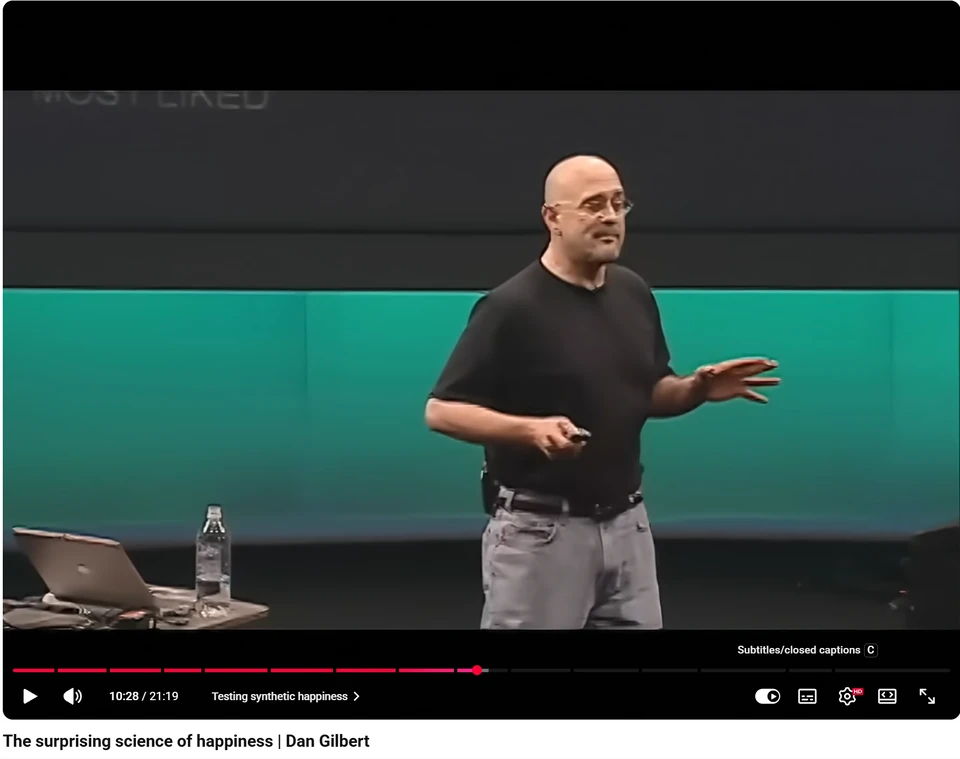
Harvard psychologist Daniel Gilbert gave a classic TED talk, “The surprising science of happiness,” centered on the theory of synthetic happiness. Its main points can be summarized as follows:
1 Over two million years, the human brain evolved a new structure: the prefrontal cortex. This gave us an “experience simulator,” allowing us to rehearse the future in our minds. But it also leads us to misjudge: we overestimate the long-term effects of major events on our happiness. Research shows, for example, that one person winning a $314 million lottery and another becoming paralyzed from the waist down have the same happiness levels a year later. Subjectively, however, we still expect the lottery winner to be happier. This is called “impact bias.”
2 In fact, even major traumas in life have no effect on our happiness after three months, with very few exceptions. This is because humans have a “psychological immune system” that helps us change how we see the world and thereby feel better about the world we inhabit. In other words, the brain can “synthesize happiness.”
Daniel gave many examples of “synthetic happiness”:
For example, Jim Wright, the powerful Speaker of the US House of Representatives, was forced to resign after political opponents uncovered a shady deal. Overnight, he lost all his money and power. Yet he later said: “I am so much better off physically, financially, emotionally, and in almost every other way.”
Another was Moreese Bickham, who was wrongly imprisoned in Louisiana State Penitentiary for 37 years. Only at 78 was he exonerated and released on DNA evidence. Upon release he said: “I don't have one minute's regret. It was a glorious experience.”
And so on.
3 People often dismiss this kind of “self-consolation,” believing that “synthetic happiness” is inferior to “natural happiness.” Natural happiness is what we feel when we get what we want; synthetic happiness is what we make for ourselves when we do not. Yet experimental evidence shows that synthetic happiness is just as real and enduring as natural happiness.
Daniel described an experiment using prints of six Monet paintings. Participants ranked them from most to least liked, then were told they could receive either their third- or fourth-ranked print. They usually chose the third. After some time—perhaps fifteen minutes, perhaps fifteen days—happiness appeared: when they ranked the prints again, the third-ranked painting rose in their estimation and the fourth-ranked one fell.
The same results appeared among patients with anterograde amnesia, who cannot form new memories. This shows that when people synthesize happiness, their feelings about the poster genuinely and concretely change. They are not simply saying “it is good because I own it,” because the amnesiac patients do not even know that they own it.
4 However, the freedom to choose, change, and decide is the enemy of synthetic happiness. When you have a choice, you often feel dissatisfied with the present outcome; when you have none, you synthesize happiness. If you date a man who picks his nose, you will not date him again. If you are married to him, you say: “He has a heart of gold; just don't touch that fruitcake.”
Daniel described another experiment involving a photography course. Harvard students took twelve photographs, selected the best two, and were told they could keep only one; the other had to be submitted for the archive. They had to choose. They were then divided into two groups: one was told it had four days to exchange its choice, while the other was told the decision was final. The results showed that those “forced to accept” their photograph, with no alternative and no possibility of changing their minds, liked it very much. Those still wavering agonized over their choice and disliked their photographs. Even after the exchange period ended, they still disliked them.
Finally, a new group of Harvard students who knew nothing of the experiment were told there were two photography courses. In one, after taking two photographs, they would have four days to change their choice. In the other, they had to decide immediately and could not change their minds.
Sixty-six percent chose the course allowing them to change their minds: the course that would leave them deeply dissatisfied with their photographs.
5 The speaker's final conclusion was that our desires and worries are both, to some extent, exaggerated. We possess the ability to manufacture the very thing called happiness that we constantly pursue. Excessive desire and excessive worry are both harmful.
Here are my thoughts:
1 In the talk, Daniel did not explain the specific physiological mechanisms behind “synthetic happiness” or the “psychological immune system.” He merely described them as general phenomena of the human brain, probably because the mechanisms are too complex for twenty minutes. Physiologically, happiness is simply a feeling produced when neurotransmitters such as dopamine, endorphins, serotonin, and oxytocin activate particular brain regions.
2 The brain's physiology therefore prevents us from remaining infinitely sad or overwhelmingly ecstatic indefinitely; doing so would cause neurological problems. As a regulatory mechanism, “synthetic happiness” keeps happiness around a baseline, safeguarding mental health. Ecstasy cannot, and should not, be a goal. Pursuing it leads to drug use, alcoholism, and permanent brain damage.
3 I therefore think the best state may be a lasting, gentle happiness, occasionally mixed with gentle sadness: neither elated by external things nor saddened by personal circumstances, acting according to one's principles. Such emotional stability is, overall, the happiest condition.
4 Yet we often mock people's “synthetic happiness”: the “Ah Q mentality” in Lu Xun's work, for example, or the “winology” of the so-called online base. But after Ah Q is beaten, what can he do except console himself by saying, “I've finally been beaten by my own son. What a world this has become”? The same applies to “winology.” Many mock us for thinking that criticizing America serves a purpose, but it does: doing so genuinely improves satisfaction with one's life. Indeed, are those who mock “winology” not practicing another form of it? We defeat Americans in our minds; they defeat the people practicing “winology.” We are all Ah Q. There is nothing so bad about that: Ah Q is better than depression.
5 The theory also tells us that someone who constantly complains and is dissatisfied with everything will remain dissatisfied, even if given limitless money and power, unless they change their mindset. Their happiness will rise briefly, then gradually fall to its original level. Li Shangyin wrote: “How could four decades as the Son of Heaven / Fall short of having Mochou in the Lu household?” Emperor Xuanzong of Tang ruled for forty-four years yet still could not match the ordinary household's wife, children, and warm bed. People today, however hard they strive, cannot even become emperors. Once our basic food and clothing needs are met, we should therefore stop excessively pursuing money, power, and beautiful partners. These will not bring further satisfaction. Instead, we should do meaningful things.
6 One important reason religions spread rapidly and gain acceptance is that they amplify the brain's mechanism for “synthetic happiness.” Religion gives suffering meaning, promises that death is a new beginning, encourages people to cherish what they have, and reinforces all of this through collective rituals. In a class society, most people are destined to obtain little of what they desire and therefore little “natural happiness.” Religion offers an inexpensive, efficient route to “synthetic happiness.”
7 Seen this way, the future of the cultural and entertainment industries is very clear, particularly gaming and the metaverse concept. Society's development can continually meet people's material needs, but not their psychological needs. Virtual worlds can meet those needs: as long as virtual games are realistic enough, the happiness people gain in them will be no less substantial or real than happiness in the physical world.
Comments
No account needed. A nickname is required; email is optional. Successful submissions appear publicly without manual pre-moderation.
Comments and nicknames are public. Optional email addresses are not displayed. The selected Waline backend and its hosting provider process comments, nicknames, optional email, IP and browser information. Comments show IP region, without the full IP address or browser and operating system labels. Hosting: Vercel; database: Neon.