I. Organizing Literature in Different Eras
—I built a Coze workflow that automatically turns research papers into "digital knowledge cards."
Every postgraduate student has to write a thesis. There are three key requirements: scientific methods, material and data, and originality. How do you demonstrate originality? First, you must show that you have exhausted the previous research in the field. Since that research mostly exists as papers, writing a paper begins with reading papers.
Human memory is limited, however, so we need notes. Marx, a great scientist, studied earlier authors and excerpted extensively, producing more than fifty notebooks and manuscripts in total. The Chinese historian Fu Zhufu and his team used thick-paper cards to research economic history, classifying and arranging enough copied material to fill several boxes, eventually accumulating 2.2 million Chinese characters of scholarly material. When I was an undergraduate, our teachers also taught us to organize literature on cards, recording excerpts, sources, and so forth on each card and sorting them into categories for easy retrieval.
Academic work is therefore hard labor. Marx suffered from illness in his later years. After his death, Engels spent more than a decade continuing to organize the manuscripts he left behind before publishing the third volume of Capital and other works. Fu Zhufu spent the first half of his life organizing literature and produced almost no works. Only after the Cultural Revolution, when already elderly, did he begin publishing articles intensively. When he died in 1985, his manuscripts kept publishers busy for many more years. As the saying goes: endure ten cold years on the scholar's bench, and write not half an empty sentence.
Today, communication media have changed. Digitization has accustomed us to typing, the internet to reading on screens, and artificial intelligence to handing tedious tasks over to machines. Whether reading or writing papers, we now mostly use computers rather than pen and paper. Nor need we hide the fact that our writing, from collecting material to final polishing, relies on AI assistance. In these circumstances, the traditional method of excerpting literature onto paper cards may indeed be outdated.
Most researchers are exploring ways to organize literature in the AI era. I have recently needed to write a paper too, so I have also been considering this question. I believe we should first clarify our needs, quickly produce a first version, then iterate until we automate literature organization.
II. Define the Needs and Develop a Plan
We ultimately still have to read the papers ourselves. What we are making now is really a digital knowledge card: give AI the papers we have read or intend to read and have it generate summaries for later review and citation.
What should it summarize? At present, I consider the following necessary:
- Basic paper information: title, authors, year, journal or conference, and so on.
- Citation information: China's GB/T 7714 format, the internationally used APA format, and in-text citation forms.
- The paper's abstract.
- Core questions, core methods, and hypotheses or reasoning.
- Main arguments and conclusions, recommendations or outlook, and limitations or concerns.
- A glossary of important terms and their equivalents.
Of course, this design is not perfect, but it can be improved later. Following this idea, I had AI create a prompt and built a workflow in Coze. After repeated testing, it essentially met my needs. Here is the result:
1. Open the Workflow and Upload the Paper Text
You can also upload a PDF here, but DOCX should work better.
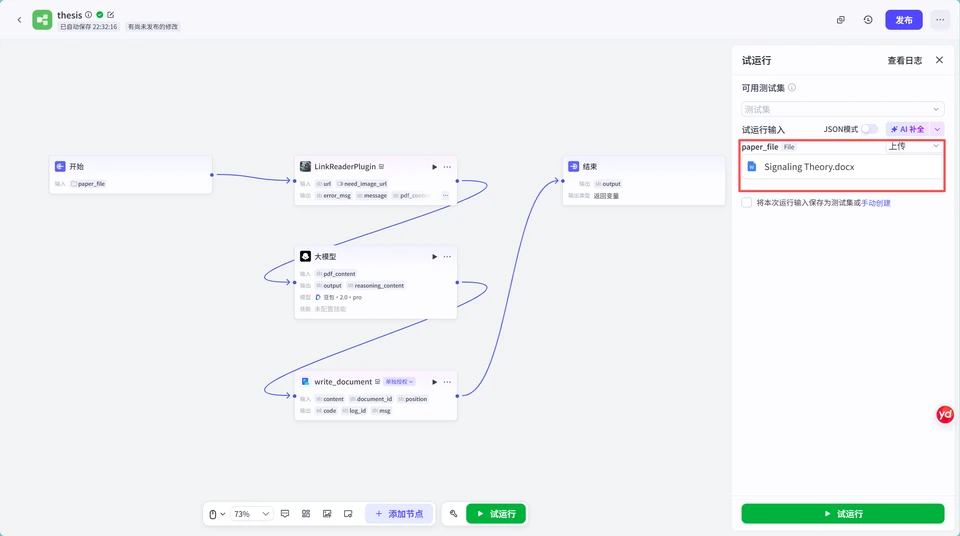
2. Click Test Run and Wait Until It Succeeds
This takes about one or two minutes. Do not operate it during that time.
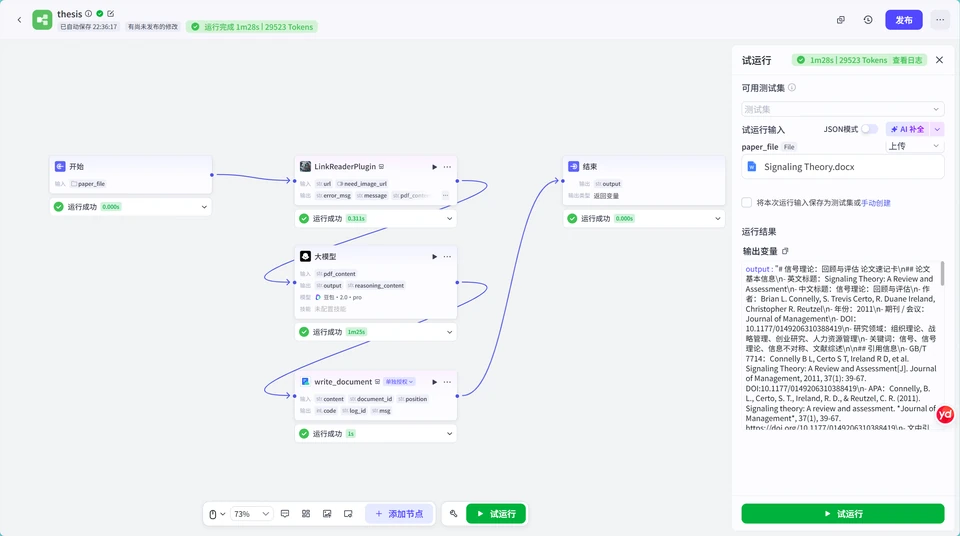
3. Check the Feishu Document
The results have now been written to the specified Feishu document and can be checked.
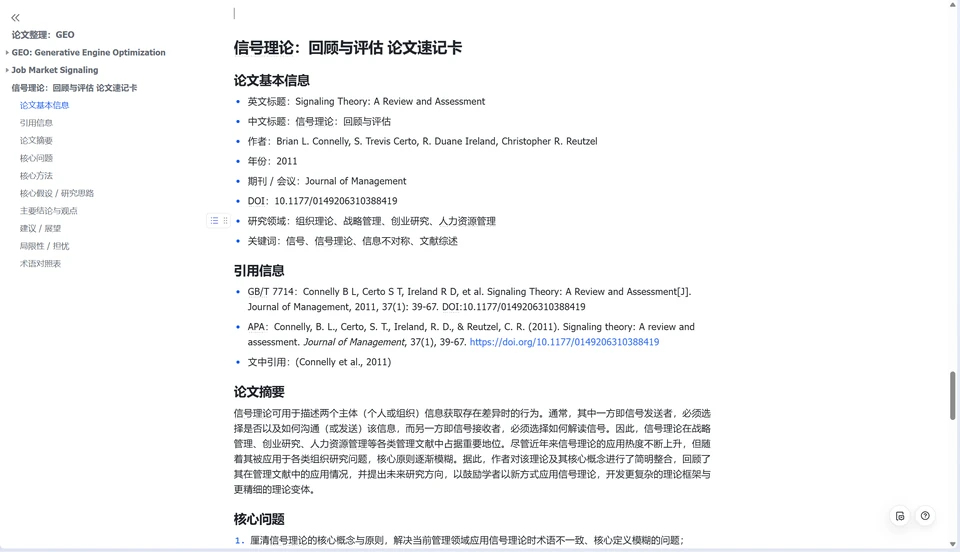
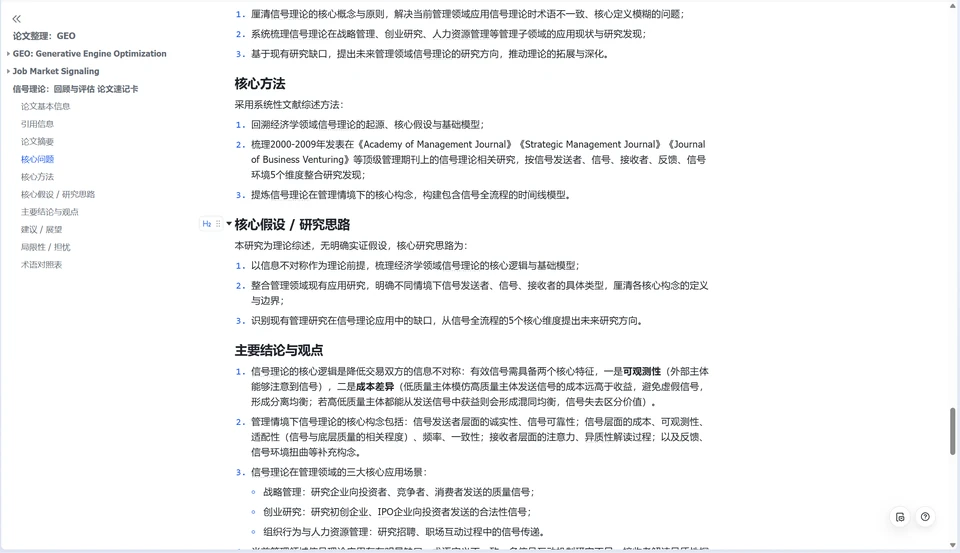
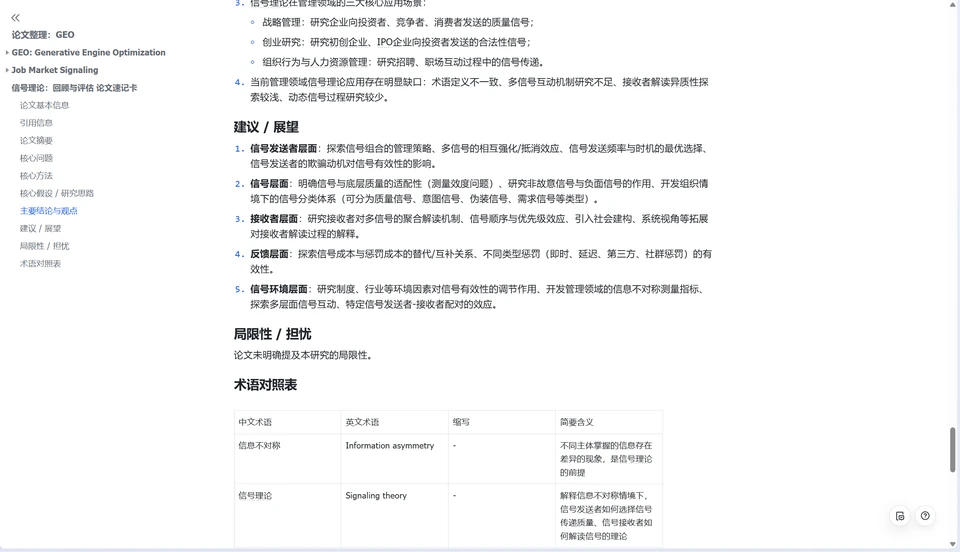
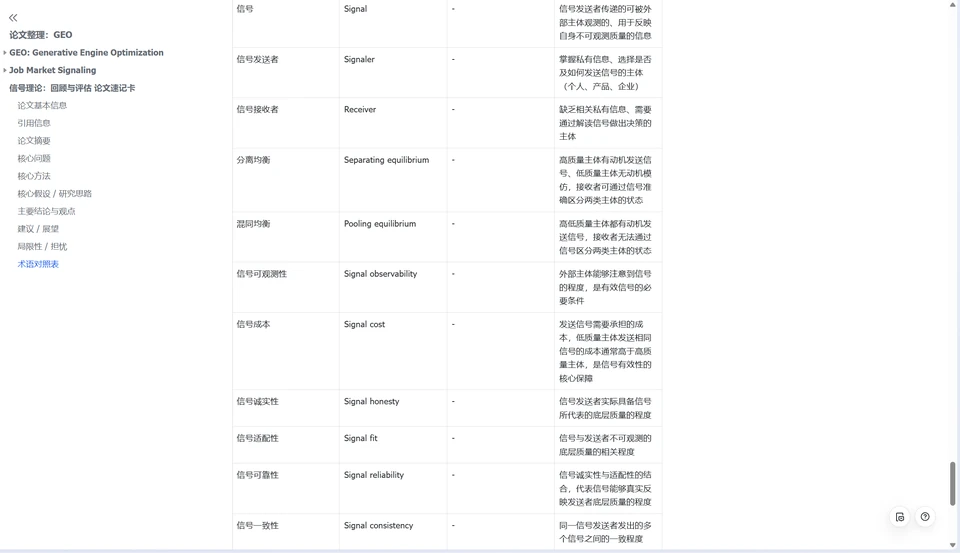
As you can see, the final result is quite good. With this record, even revisiting it several months after reading the paper will quickly remind you of its main arguments. After reading, you can also copy valuable passages below these records. It is convenient when you need to cite the paper too.
With long-term accumulation, even after reading a hundred papers or more, we can still browse all the literature quickly through the contents list and jump to a particular paper's details, opening the original only if something remains unclear. Later, we can also ask AI to compare different papers' research questions, methods, and conclusions and look for connections between studies.
Of course, the prompt can keep improving. For example, replacing the heading here directly with the paper's English title would make it easier to search, like this:
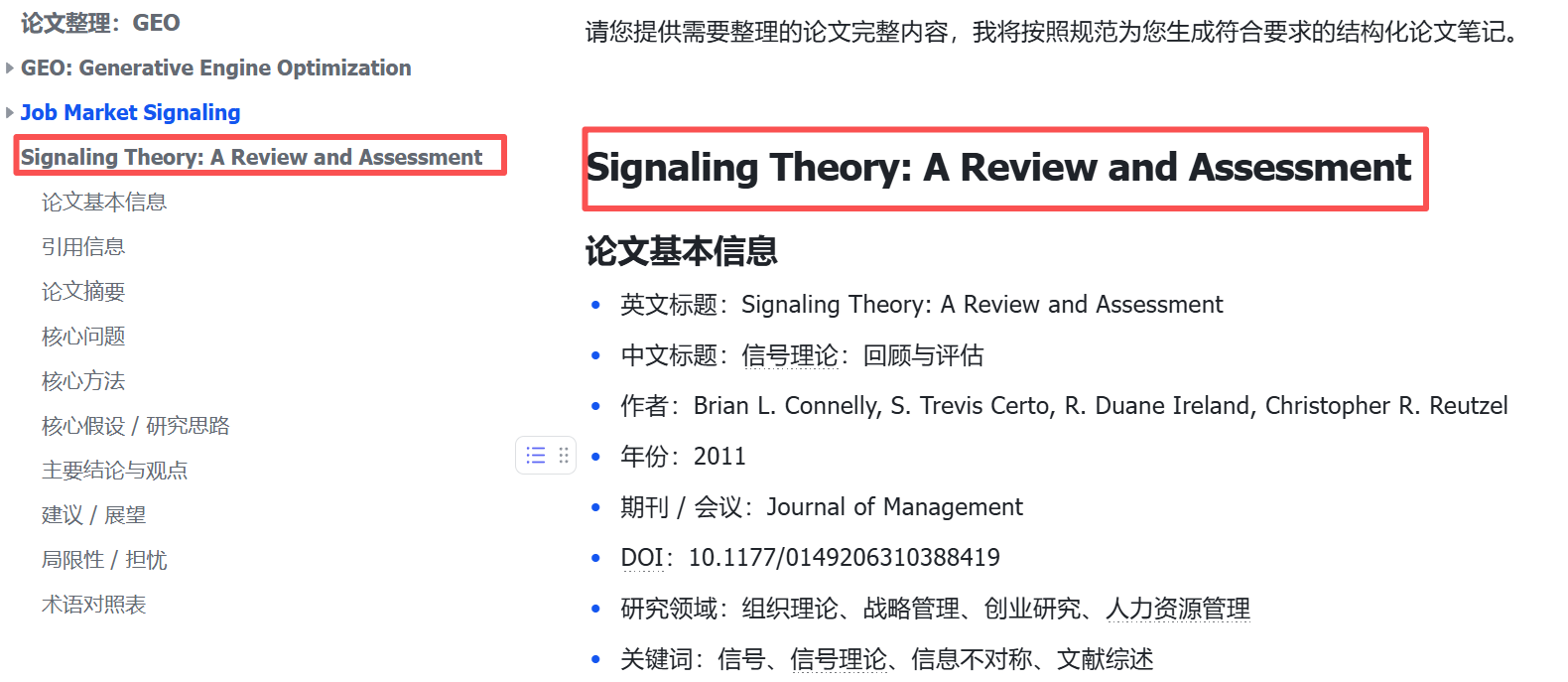
But these details are not important and can be adjusted gradually. The key is to find an automated method of organizing papers, establish a system, and free more time for more valuable work.
III. How to Use This Workflow
I previously built a YouTube learning workflow, and many people were unsure how to deploy it. Here is a brief tutorial with my download link.
1. Download the ZIP; No Extraction Is Needed
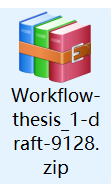
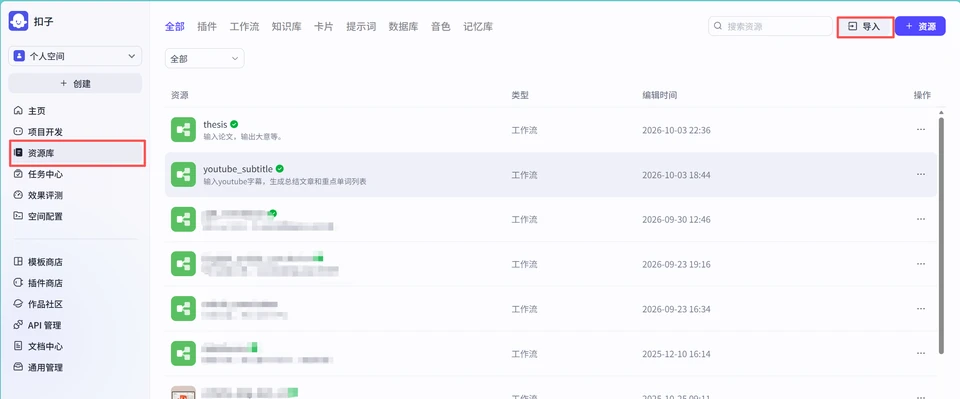
2. Log into Your Personal Coze Space, Click the Resource Library, and Click Import
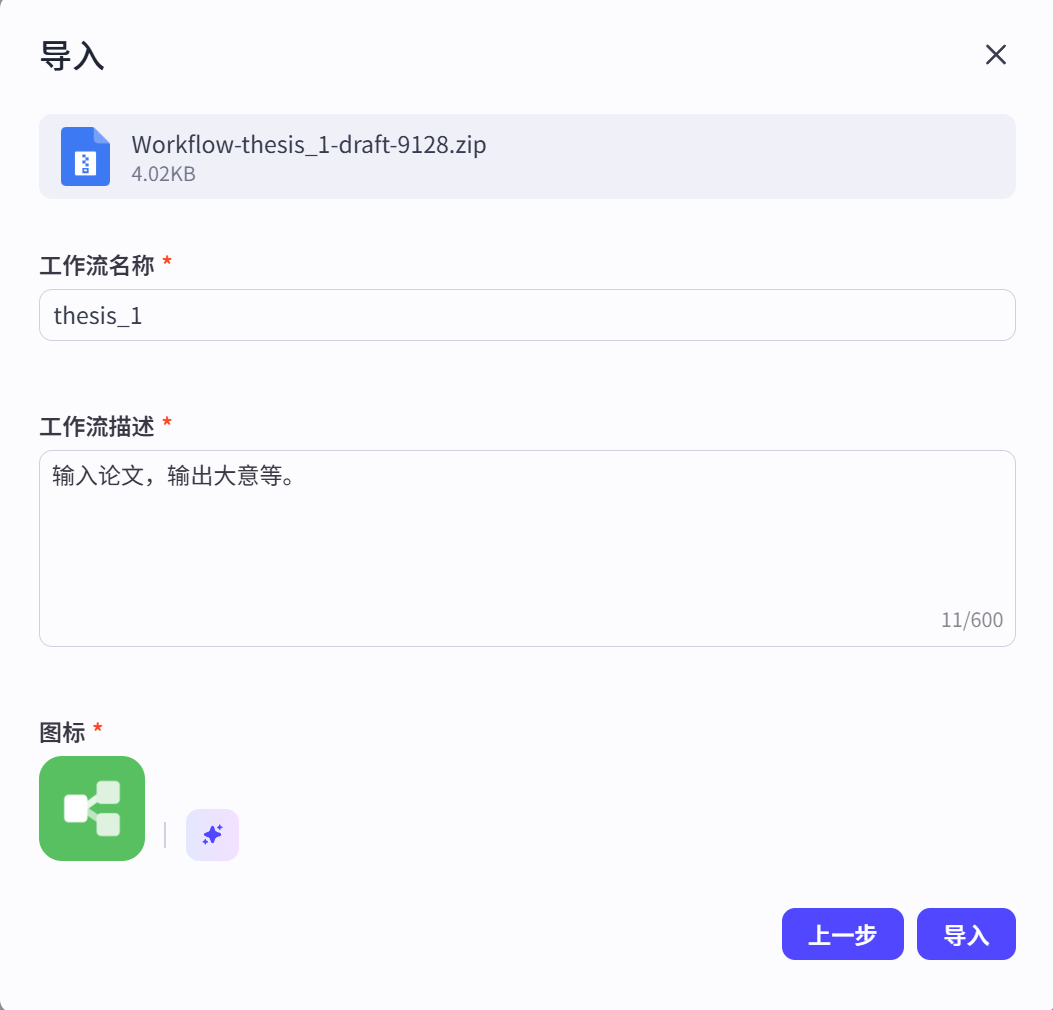
3. Select the File Downloaded Earlier and Click Import
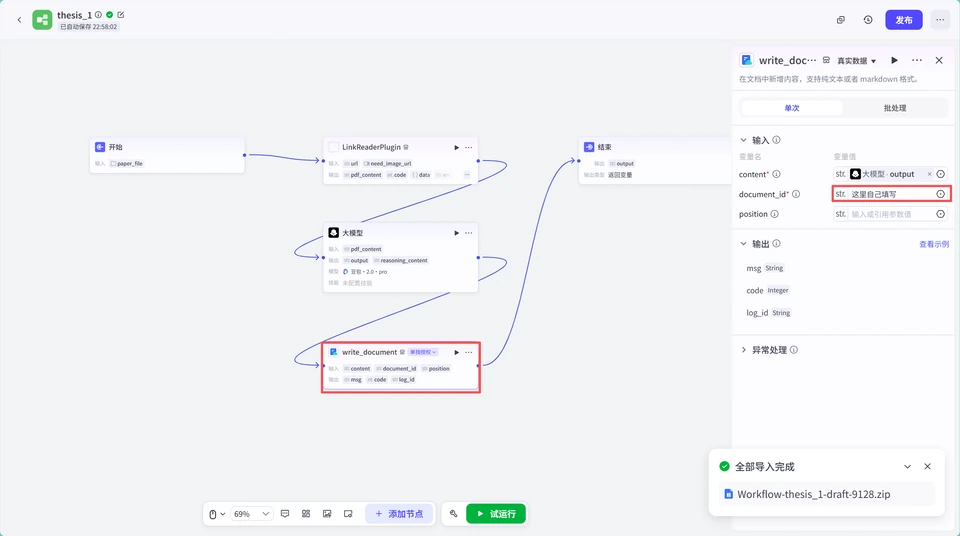
4. Open the Workflow, Click the Module That Writes to Feishu, and Enter Your Feishu Document ID
That is the complete deployment tutorial.
Download links:
Project:
Download the latest version directly:
Download the Coze Paper Quick-Reference Workflow
Coze space URL: https://www.coze.cn/space
References
Liang Jie. (July 2, 2007). Fu Zhufu's Astonishing Final Ten-Year Sprint. Shanghai Securities News, 014.
Pan Fei. A Major Work in the Study of Chinese Economic History: A Review of Fu Zhufu's Economic History of China's Feudal Society. 044–050.
Comments
No account needed. A nickname is required; email is optional. Successful submissions appear publicly without manual pre-moderation.
Comments and nicknames are public. Optional email addresses are not displayed. The selected Waline backend and its hosting provider process comments, nicknames, optional email, IP and browser information. Comments show IP region, without the full IP address or browser and operating system labels. Hosting: Vercel; database: Neon.