I. I Underestimated How Unpleasant Kuala Lumpur's Weather Could Be
In summer, I often thought Kuala Lumpur's weather was very good. Many places in China were suffering summer drought and heat, with quite a few cities approaching 40 degrees. By comparison, Kuala Lumpur seemed fine: around 32 degrees every day, with frequent rain that brought at least some relief from the heat.
But now it is October, and places such as Beijing have already become a little cold. Kuala Lumpur's continuing weather of around 32 degrees suddenly seems thoroughly objectionable.
Last Tuesday at noon, after class, I accompanied a classmate home, had a meal, and then set off for the metro station. The two walks totaled about six kilometers. It was not raining, though neither was the sun blazing overhead. The temperature was between 32 and 34 degrees, with no trees to provide shade, and the second stretch included about fifty meters of uphill climbing in total. Carrying a bag weighing over ten jin, with a gaming laptop inside, I walked nearly ten thousand steps. Back home, I was exhausted and could barely concentrate. I had to lie on the sofa in an air-conditioned room for half an hour before recovering.
Yesterday, two classmates had a six-hour layover in Kuala Lumpur, so I arranged to meet them at Alamanda Shopping Centre in Putrajaya. After lunch, I suggested walking to the Pink Mosque. The route was beautiful, but it was also very hot, and they had a small suitcase, making the walk quite miserable. Looking back, this was a terrible suggestion.
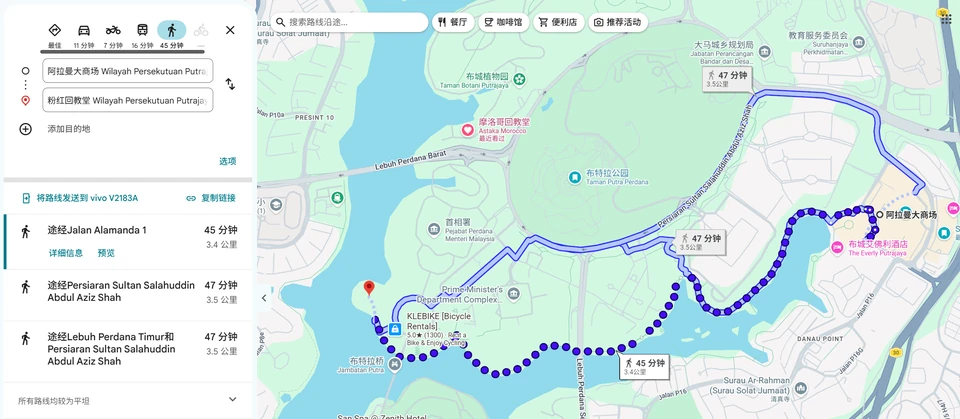
These two experiences made me realize I had underestimated how unpleasant Kuala Lumpur's weather could be. As the saying goes, distance tests a horse's strength, and time reveals a person's heart. I now need to reassess the city's weather.
II. Kuala Lumpur's Climate
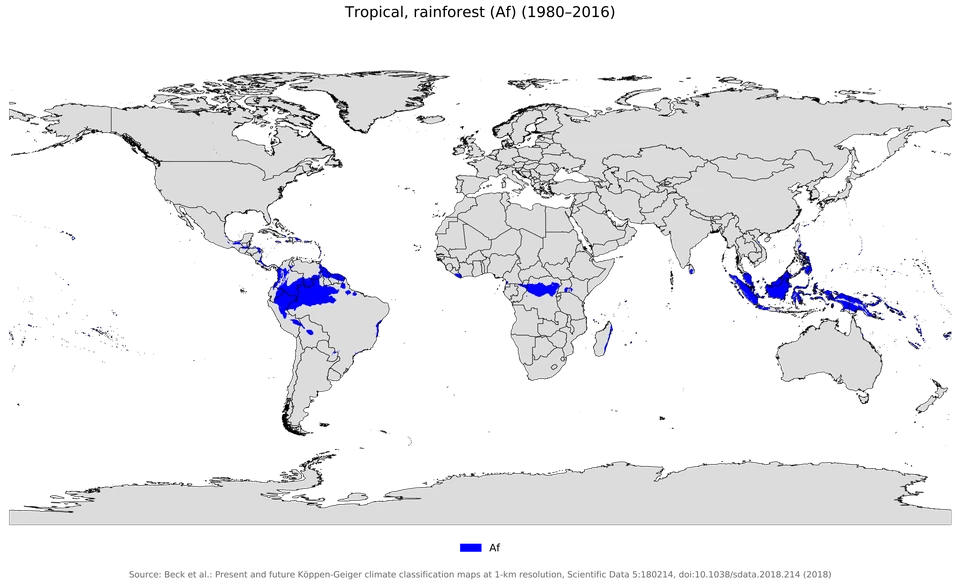
Kuala Lumpur lies at approximately 3.14° N, 101.69° E, only about 350 kilometers from the equator in a straight line. The sun therefore stays high in the sky throughout the year, with little change in day length or seasonal temperatures.
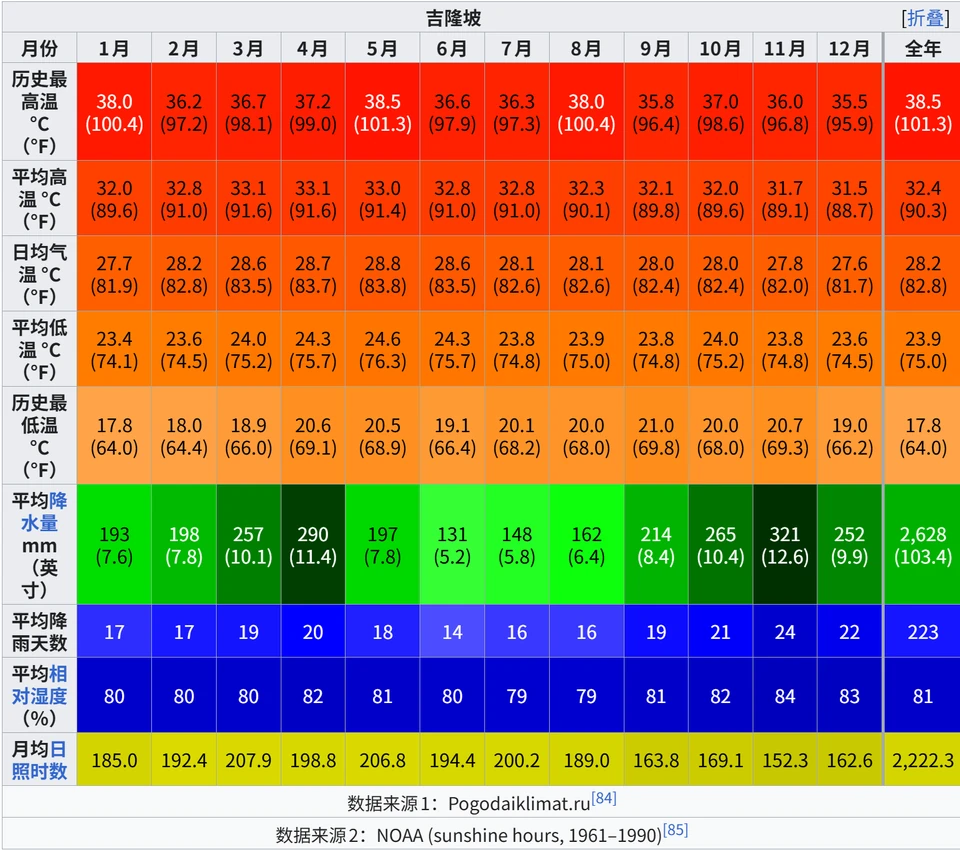
Because of its low latitude, Kuala Lumpur is dominated by the tropical low-pressure belt, giving it high temperatures and abundant rainfall year-round: a typical tropical rainforest climate. According to Wikipedia, average highs remain between 31.5° and 33.1° throughout the year, while average lows range from 23.4° to 24.6°, with little annual variation.
Annual rainfall is around 2,600 millimeters. Relatively speaking, March–April and October–December are the wettest periods, while June–August receive less rain, though still more than a hundred millimeters each month.
Monsoons also affect Kuala Lumpur, though not greatly. The northeast monsoon runs from November to March, and the southwest monsoon from late May to September, with transition periods in between. The northeast monsoon is wetter and the southwest monsoon drier.
III. Typical Weather in Kuala Lumpur
Temperatures in Kuala Lumpur remain fairly similar year-round. Rain falls on more than 220 days a year, mostly as convectional rainfall. We can therefore describe a typical Kuala Lumpur day:
| Time | General Conditions | Implications for Everyday Life |
|---|---|---|
| 06:00–10:00 | Usually less rain and lower temperatures | Best time for outdoor activities |
| 10:00–13:00 | Sunlight strengthens and temperatures rise | Usually still relatively stable |
| 13:00–15:00 | Cumulus clouds develop rapidly | Thunderstorm risk begins |
| 15:00–18:00 | Rain and thunderstorm probability rises rapidly | The period requiring the most caution |
| 16:00–19:00 | Roughly the typical peak period | Heavy showers, lightning, gusts, and traffic congestion |
| 19:00–22:00 | Thunderstorms gradually weaken but may continue | Usually noticeably cooler after rain |
| Late night–early morning | Generally more stable | Sumatran squall lines are possible during the southwest monsoon |
Note that under the influence of the southwest monsoon and Sumatra, rain is more likely in the small hours or morning during June–August, which are themselves relatively drier months. At other times, this typical pattern is easy to feel directly: intense midday heat, sudden afternoon rain and sometimes thunderstorms that do not last too long, followed by rain ending in the evening and slightly cooler conditions.
For example, observations from a weather station in Taman Mutiara, Kuala Lumpur, on October 2, 2026, were as follows:
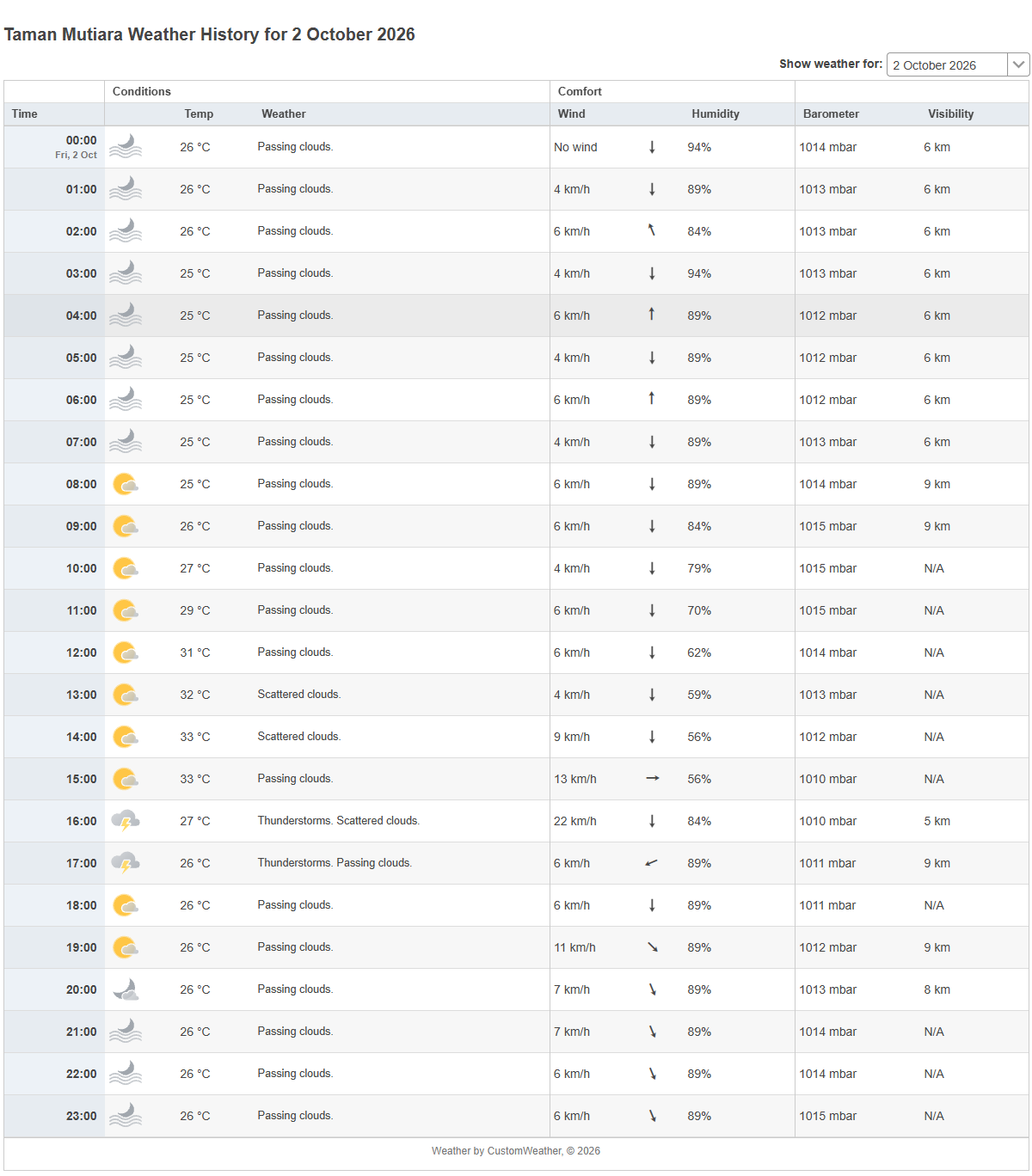
The low was 26 degrees in the small hours, and the high was 33 degrees at 14:00 and 15:00. Heavy rain began at 16:00 and 17:00, rapidly lowering the temperature, and skies cleared at 18:00. Very typical Kuala Lumpur weather.
IV. Coping with Kuala Lumpur's Weather
After this closer analysis, I think Kuala Lumpur's weather is generally uncomfortable, particularly from 10 am to 5 pm: high temperatures, high humidity, weak winds, and strong solar radiation. Add physical activity and a load to carry, and from a thermal comfort perspective, every debuff is stacked. No wonder I was such a wreck last Tuesday.
Daytime in Kuala Lumpur is therefore unsuitable for outdoor walks, though visiting a shopping mall is fine. If you must go out at noon, take sun protection and an umbrella.
The small hours and afternoons after rain are much cooler, and going out then is generally more comfortable.
V. References
Time and Date AS. (n.d.). Past weather in Taman Mutiara, Malaysia — Yesterday or further back. Timeanddate.com. Retrieved October 5, 2026, from https://www.timeanddate.com/weather/@12746875/historic
Tropical rainforest climate. (n.d.). In Wikipedia. Retrieved October 5, 2026, from https://en.wikipedia.org/wiki/Tropical_rainforest_climate
Kuala Lumpur. (n.d.). In Wikipedia. Retrieved October 5, 2026, from https://en.wikipedia.org/wiki/Kuala_Lumpur
Comments
No account needed. A nickname is required; email is optional. Successful submissions appear publicly without manual pre-moderation.
Comments and nicknames are public. Optional email addresses are not displayed. The selected Waline backend and its hosting provider process comments, nicknames, optional email, IP and browser information. Comments show IP region, without the full IP address or browser and operating system labels. Hosting: Vercel; database: Neon.