During middle and high school, I read all nine volumes of Those Things About the Ming Dynasty in vivo Reading. I read them in my spare time, so I took no notes and wrote no summaries. As a result, I have only a general impression and cannot recall many details, which is a real pity.
The Ming dynasty was founded on January 23, 1368, and fell on April 25, 1644. It spanned twelve generations and sixteen emperors, lasting 276 years, excluding the Southern Ming. This period was only about 400–700 years ago, not especially distant, and China still has many Ming remains today. It also overlapped substantially with Europe's Renaissance, Age of Discovery, Reformation, and Scientific Revolution. It is therefore worthwhile to put together a broad overview of the Ming.
When organizing an account of an ancient feudal dynasty, using emperors' reigns as a chronological index makes compilation and consultation easier. (This does not mean I support monarchy or intend to revive the Great Ming.) I plan to make a table mainly to refresh my own memory and provide a reference, and hope it will also help readers. My organizing principles are:
- Record in a table: personal name, reign title, mausoleum (name and location), actual reign dates, major events during the reign (with dates), and contemporaneous major Western events (with dates).
- Arrange entries chronologically by actual reign. An emperor who reigned twice receives the privilege of two rows.
- Omit portraits, temple names, posthumous titles, and lifespan dates. Dates will be given no more precisely than the month, never the day.
- Reign titles and accession dates often differ by a year, but that is unimportant here: the table follows actual time on the throne.
- Begin with Zhu Yuanzhang and end with Zhu Youjian. Omit ancestors whom Zhu Yuanzhang posthumously honored and emperors of the Southern Ming regimes. (This does not mean I disrespect the Ming.)
- Include important events that influenced history. Do not reduce their number because an emperor reigned a long time, or do the reverse for a short reign.
- “Important” mainly covers changes of regime and succession, institutional and fiscal changes, wars and diplomatic events with lasting effects, and representative social and cultural changes.
- Use an “overview table plus event details” structure: the table for quick consultation and scanning, and the details for reading.
- An event occurring during a reign does not necessarily have a causal or strong connection with the emperor personally. It means only that it happened during his tenure; readers should bear this in mind.
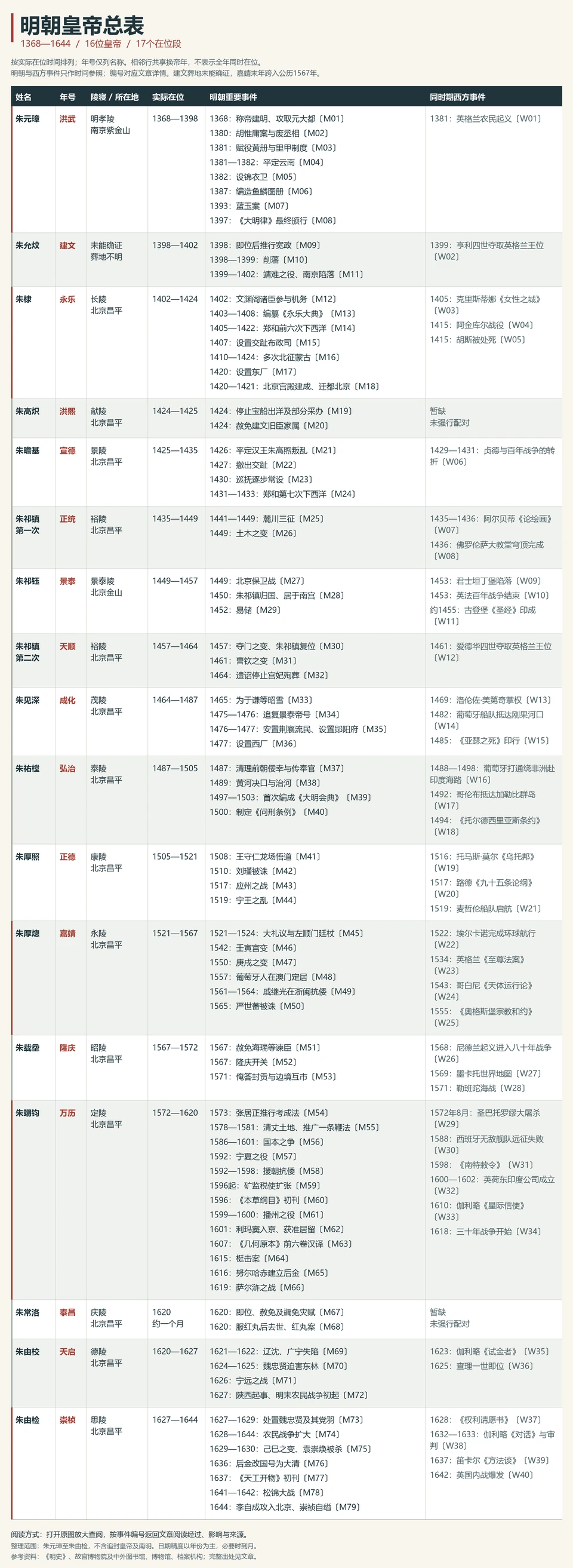
- Finally, attach an image of the overview table that is easy to view and share. An unwatermarked image can be downloaded from my GitHub address.
The following table was generated with ChatGpt doing the drafting, while I selected, checked, and revised its contents. Important entries have sources, and unconfirmed material is marked. I personally take responsibility for any errors.
Overview of Ming Emperors
How to read the table: The entries cover seventeen actual reign periods of sixteen emperors, with Zhu Qizhen's two reigns listed separately. Adjacent rows sharing a succession year do not imply that both emperors reigned throughout that year. The reign-title column gives names only; event numbers refer to the details below.
Dates are displayed primarily by Gregorian calendar year. The twelfth lunar month of the forty-fifth year of Jiajing fell in Gregorian 1567, so Zhu Houcong's reign is shown as 1521–1567.[1]
The Western column mainly selects events in Europe and its overseas navigation, colonization, and trade. Juxtaposition within a period offers only a reference to the broader age. For short reigns without a suitable selected event, the entry is left blank. Relevant sources explain the mausoleum identifications and the uncertainty over Jianwen's burial site.[2][3][4]
| Name | Reign title | Mausoleum (name and location) | Actual reign | Major Ming events | Contemporaneous major Western events |
|---|---|---|---|---|---|
| Zhu Yuanzhang | Hongwu | Ming Xiaoling, Purple Mountain, Nanjing | 1368—1398 | 1368: Proclaiming the Ming and capturing the Yuan capital Dadu〔M01〕 1380: The Hu Weiyong case and abolition of the chancellorship〔M02〕 1381: Tax-and-labor-service Yellow Registers and the lijia system〔M03〕 1381—1382: Pacification of Yunnan〔M04〕 1382: Establishment of the Embroidered Uniform Guard〔M05〕 1387: Compilation of the Fish-Scale Registers〔M06〕 1393: The Lan Yu case〔M07〕 1397: Final promulgation of the Great Ming Code〔M08〕 |
1381: The English Peasants' Revolt〔W01〕 |
| Zhu Yunwen | Jianwen | Burial site unconfirmed | 1398—1402 | 1398: Lenient policies after accession〔M09〕 1398—1399: Reduction of the imperial princes' power〔M10〕 1399—1402: The Jingnan Campaign and the fall of Nanjing〔M11〕 |
1399: Henry IV seizes the English throne〔W02〕 |
| Zhu Di | Yongle | Changling, Changping, Beijing | 1402—1424 | 1402: Wenyuan Pavilion officials participate in state affairs〔M12〕 1403—1408: Compilation of the Yongle Encyclopedia〔M13〕 1405—1422: Zheng He's first six voyages to the Western Oceans〔M14〕 1407: Establishment of the Jiaozhi Provincial Administration Commission〔M15〕 1410—1424: Repeated northern campaigns against the Mongols〔M16〕 1420: Establishment of the Eastern Depot〔M17〕 1420—1421: Completion of Beijing's palaces and transfer of the capital to Beijing〔M18〕 |
1405: Christine de Pizan's The Book of the City of Ladies〔W03〕 1415: The Battle of Agincourt〔W04〕 1415: Execution of Jan Hus〔W05〕 |
| Zhu Gaochi | Hongxi | Xianling, Changping, Beijing | 1424—1425 | 1424: Suspension of treasure-ship voyages and some procurement〔M19〕 1424: Pardons for families of former Jianwen officials〔M20〕 |
None selected (no forced pairing) |
| Zhu Zhanji | Xuande | Jingling, Changping, Beijing | 1425—1435 | 1426: Suppression of Zhu Gaoxu, Prince of Han's rebellion〔M21〕 1427: Withdrawal from Jiaozhi〔M22〕 1430: Provincial governors gradually become permanent appointments〔M23〕 1431—1433: Zheng He's seventh voyage to the Western Oceans〔M24〕 |
1429—1431: Joan of Arc and a turning point in the Hundred Years' War〔W06〕 |
| Zhu Qizhen (first reign) | Zhengtong | Yuling, Changping, Beijing | 1435—1449 | 1441—1449: The three Luchuan campaigns〔M25〕 1449: The Tumu Crisis〔M26〕 |
1435—1436: Alberti's On Painting〔W07〕 1436: Completion of Florence Cathedral's dome〔W08〕 |
| Zhu Qiyu | Jingtai | Jingtai Mausoleum, Jinshan, Beijing | 1449—1457 | 1449: The defense of Beijing〔M27〕 1450: Zhu Qizhen returns and resides in the Southern Palace〔M28〕 1452: Change of crown prince〔M29〕 |
1453: The fall of Constantinople〔W09〕 1453: The end of the Hundred Years' War〔W10〕 c. 1455: Printing of the Gutenberg Bible〔W11〕 |
| Zhu Qizhen (second reign) | Tianshun | Yuling, Changping, Beijing | 1457—1464 | 1457: The Gate-Seizing Coup and restoration of Zhu Qizhen〔M30〕 1461: Cao Qin's rebellion〔M31〕 1464: A final edict ends the sacrifice of imperial consorts〔M32〕 |
1461: Edward IV seizes the English throne〔W12〕 |
| Zhu Jianshen | Chenghua | Maoling, Changping, Beijing | 1464—1487 | 1465: Exoneration of Yu Qian and others〔M33〕 1475—1476: Posthumous restoration of the Jingtai imperial title〔M34〕 1476—1477: Resettlement of Jingxiang migrants and establishment of Yunyang Prefecture〔M35〕 1477: Establishment of the Western Depot〔M36〕 |
1469: Lorenzo de' Medici takes power〔W13〕 1482: Portuguese ships reach the mouth of the Congo〔W14〕 1485: Publication of Le Morte d'Arthur〔W15〕 |
| Zhu Youcheng | Hongzhi | Tailing, Changping, Beijing | 1487—1505 | 1487: Removal of favorites and irregular appointees from the previous reign〔M37〕 1489: Yellow River breach and river-control works〔M38〕 1497—1503: First compilation of the Collected Statutes of the Great Ming〔M39〕 1500: Formulation of the Regulations for Adjudicating Criminal Cases〔M40〕 |
1488—1498: Portugal establishes a sea route around Africa to India〔W16〕 1492: Columbus reaches the Caribbean〔W17〕 1494: The Treaty of Tordesillas〔W18〕 |
| Zhu Houzhao | Zhengde | Kangling, Changping, Beijing | 1505—1521 | 1508: Wang Shouren's enlightenment at Longchang〔M41〕 1510: Execution of Liu Jin〔M42〕 1517: The Battle of Yingzhou〔M43〕 1519: The Prince of Ning's rebellion〔M44〕 |
1516: Thomas More's Utopia〔W19〕 1517: Luther's Ninety-Five Theses〔W20〕 1519: Magellan's fleet sets sail〔W21〕 |
| Zhu Houcong | Jiajing | Yongling, Changping, Beijing | 1521—1567 | 1521—1524: The Great Rites Controversy and court beatings at Zuoshun Gate〔M45〕 1542: The Renyin Palace Incident〔M46〕 1550: The Gengxu Incident〔M47〕 1557: Portuguese settlement in Macao〔M48〕 1561—1564: Qi Jiguang's campaigns against wokou in Zhejiang and Fujian〔M49〕 1565: Execution of Yan Shifan〔M50〕 |
1522: Elcano completes the circumnavigation〔W22〕 1534: England's Act of Supremacy〔W23〕 1543: Copernicus's On the Revolutions of the Heavenly Spheres〔W24〕 1555: The Peace of Augsburg〔W25〕 |
| 朱载坖 | Longqing | Zhaoling, Changping, Beijing | 1567—1572 | 1567: Pardons for Hai Rui and other remonstrating officials〔M51〕 1567: The Longqing opening of maritime trade〔M52〕 1571: Altan's investiture, tribute, and frontier markets〔M53〕 |
1568: The Dutch Revolt enters the Eighty Years' War〔W26〕 1569: Mercator's world map〔W27〕 1571: The Battle of Lepanto〔W28〕 |
| Zhu Yijun | Wanli | Dingling, Changping, Beijing | 1572—1620 | 1573: Zhang Juzheng introduces the performance-assessment system〔M54〕 1578—1581: Land surveys and expansion of the Single Whip Reform〔M55〕 1586—1601: The succession dispute〔M56〕 1592: The Ningxia campaign〔M57〕 1592—1598: Assistance to Korea against the Japanese invasion〔M58〕 from 1596: Expansion of mining supervisors and tax commissioners〔M59〕 1596: First publication of the Compendium of Materia Medica〔M60〕 1599—1600: The Bozhou campaign〔M61〕 1601: Matteo Ricci enters Beijing and receives permission to reside〔M62〕 1607: Chinese translation of the first six books of Euclid's Elements〔M63〕 1615: The Clubbing Assault case〔M64〕 1616: Nurhaci establishes the Later Jin〔M65〕 1619: The Battle of Sarhu〔M66〕 |
August 1572: The St. Bartholomew's Day Massacre〔W29〕 1588: Failure of the Spanish Armada expedition〔W30〕 1598: The Edict of Nantes〔W31〕 1600—1602: Founding of the English and Dutch East India Companies〔W32〕 1610: Galileo's Sidereal Messenger〔W33〕 1618: The Thirty Years' War begins〔W34〕 |
| Zhu Changluo | Taichang | Qingling, Changping, Beijing | 1620 (about one month) | 1620: Accession, amnesty, and remission of disaster-area taxes〔M67〕 1620: Death after taking red pills and the Red Pills case〔M68〕 |
None selected (no forced pairing) |
| Zhu Youxiao | Tianqi | Deling, Changping, Beijing | 1620—1627 | 1621—1622: Loss of Shenyang, Liaoyang, and Guangning〔M69〕 1624—1625: Wei Zhongxian's persecution of the Donglin faction〔M70〕 1626: The Battle of Ningyuan〔M71〕 1627: Uprisings in Shaanxi and the beginnings of the late-Ming peasant wars〔M72〕 |
1623: Galileo's The Assayer〔W35〕 1625: Accession of Charles I〔W36〕 |
| Zhu Youjian | Chongzhen | Siling, Changping, Beijing | 1627—1644 | 1627—1629: Action against Wei Zhongxian and his associates〔M73〕 1628—1644: Expansion of the peasant wars〔M74〕 1629—1630: The Jisi Incident and execution of Yuan Chonghuan〔M75〕 1636: The Later Jin adopts the name Great Qing〔M76〕 1637: First publication of The Exploitation of the Works of Nature〔M77〕 1641—1642: The Songshan–Jinzhou campaign〔M78〕 1644: Li Zicheng enters Beijing and the Chongzhen emperor hangs himself〔M79〕 |
1628: The Petition of Right〔W37〕 1632—1633: Galileo's Dialogue and trial〔W38〕 1637: Descartes's Discourse on the Method〔W39〕 1642: The English Civil War begins〔W40〕 |
Event Details
The following is arranged by reign period. Numbers, dates, and event names match the overview table and image. Accounts of the events' roles and effects are explanatory notes, rather than judgments on the emperor's personal merits or faults.
Zhu Yuanzhang|Hongwu|1368—1398
Ming events
-
M01|1368: Proclaiming the Ming and capturing the Yuan capital Dadu. Zhu Yuanzhang proclaimed himself emperor in Nanjing and founded the Ming dynasty. Xu Da led troops into Dadu, ending Yuan rule in the Central Plains, although the wars of unification continued.[5]
-
M02|1380: The Hu Weiyong case and abolition of the chancellorship. After Hu Weiyong was executed, the court abolished the Central Secretariat and the office of chancellor. The emperor directly supervised the Six Ministries, and five Chief Military Commissions were established in a reorganization. The structure of central power thus changed significantly.[5:1]
-
M03|1381: Tax-and-labor-service Yellow Registers and the lijia system. The court compiled the Yellow Registers for taxes and labor service, recording population, property, taxation, and service obligations through the lijia organization. They became an important basis for local household registration and the collection of taxes and labor service.[6][7][8]
-
M04|1381—1382: Pacification of Yunnan. Fu Youde, Lan Yu, Mu Ying, and others led troops into Yunnan, defeated the remaining Yuan forces, and captured Qujing, Dali, and other places. Ming military and administrative control over Yunnan consequently strengthened.[5:2][9]
-
M05|1382: Establishment of the Embroidered Uniform Guard. Directly controlled by the emperor, the Embroidered Uniform Guard combined duties including palace protection, arrest, and interrogation. It became an important institution in the Ming imperial surveillance system.[10]
-
M06|1387: Compilation of the Fish-Scale Registers. The court sent officials to verify farmland, draw land maps, and record owners, acreage, and boundaries. Centered on land, the Fish-Scale Registers complemented the household-centered Yellow Registers.[6:1]
-
M07|1393: The Lan Yu case. Lan Yu was executed for treason, and the expanding case implicated many others. The group of founding military commanders suffered a further blow, strengthening the emperor's control over military forces.[9:1]
-
M08|1397: Final promulgation of the Great Ming Code. After repeated revisions, the Great Ming Code was finalized and promulgated in the thirtieth year of Hongwu. It established the framework of the Ming dynasty's basic criminal law thereafter.[11]
Contemporaneous Western events
- W01|1381: The English Peasants' Revolt. A peasant revolt led by figures including Wat Tyler broke out in England. Richard II negotiated with the rebels, after which the revolt was suppressed. It offers a point from which to examine late-medieval social tensions and the monarchy's response.[12]
Zhu Yunwen|Jianwen|1398—1402
Ming events
-
M09|1398: Lenient policies after accession. The Jianwen emperor reduced some redundant personnel, remitted tax arrears, and adjusted the severe political measures of the late Hongwu period. These actions reflected the new reign's policy shift.[4:1]
-
M10|1398—1399: Reduction of the imperial princes' power. The court successively took action against the princes of Zhou, Qi, Dai, Min, and others, attempting to weaken the imperial clan's local power. Tensions between the emperor and Zhu Di, Prince of Yan, consequently deepened.[4:2]
-
M11|1399—1402: The Jingnan Campaign and the fall of Nanjing. Zhu Di raised troops to contest the throne with the Jianwen court and ultimately entered Nanjing. Historical sources disagree about the Jianwen emperor's whereabouts after the palace fire, so neither his place of death nor his burial site can be established from these accounts.[4:3]
Contemporaneous Western events
- W02|1399: Henry IV seizes the English throne. Henry Bolingbroke returned to England, deposed Richard II, and ascended the throne as Henry IV. This change of monarch can be viewed alongside succession issues in China during the same period, although the two had no causal connection.[12:1]
Zhu Di|Yongle|1402—1424
Ming events
-
M12|1402: Wenyuan Pavilion officials participate in state affairs. Zhu Di appointed Xie Jin, Huang Huai, and others to serve in the Wenyuan Pavilion and participate in confidential state affairs. This arrangement was an important starting point in the gradual formation of the Ming Grand Secretariat; it was not yet the mature institution of later years.[13]
-
M13|1403—1408: Compilation of the Yongle Encyclopedia. The court organized the compilation of a vast classified encyclopedia. The text was substantially finalized and named the Yongle Encyclopedia in 1407, and fair copying was completed in 1408. A large quantity of earlier literature was thereby gathered and preserved.[14][15]
-
M14|1405—1422: Zheng He's first six voyages to the Western Oceans. Zheng He's fleets sailed six times, operating in Southeast Asia, the Indian Ocean, and elsewhere, conducting tributary diplomacy, trade, and exchanges of people. They expanded Ming contact with the overseas world.[16][17][18]
-
M15|1407: Establishment of the Jiaozhi Provincial Administration Commission. After Ming forces defeated Vietnam's Ho dynasty, the court established the Jiaozhi Provincial Administration Commission and ruled the area directly. Continuing resistance and warfare later contributed to the Xuande reign's withdrawal.[17:1]
-
M16|1410—1424: Repeated northern campaigns against the Mongols. Zhu Di personally led large armies north against the Mongols on several occasions, seeking to eliminate the northern military threat. These wars strengthened Beijing's position as a northern political and military center, while requiring enormous military supplies.[17:2][18:1]
-
M17|1420: Establishment of the Eastern Depot. The court established the Eastern Depot, with eunuchs directing investigative operations. Eunuchs' powers of surveillance over officials and society expanded further.[18:2]
-
M18|1420—1421: Completion of Beijing's palaces and transfer of the capital to Beijing. After the Beijing palace complex was completed, the court formally moved the capital to Beijing in 1421, retaining Nanjing as the secondary capital. The Ming political center of gravity thus shifted north.[18:3][19]
Contemporaneous Western events
-
W03|1405: Christine de Pizan's The Book of the City of Ladies. Christine de Pizan published The Book of the City of Ladies, responding to the denigration of women through accounts of women in history and allegory. It is an important work in the history of European women's writing and thought.[20]
-
W04|1415: The Battle of Agincourt. English forces defeated the French at Agincourt in an important battle of the Hundred Years' War. Lasting from 1337 to 1453, the war saw England's position strengthened by this victory.[20:1][21]
-
W05|1415: Execution of Jan Hus. The Bohemian reformer Jan Hus was executed for heresy, and his followers subsequently launched a movement lasting many years. His criticism of ecclesiastical corruption and authority forms part of the prehistory of the sixteenth-century Reformation.[22]
Zhu Gaochi|Hongxi|1424—1425
Ming events
-
M19|1424: Suspension of treasure-ship voyages and some procurement. After his accession, the Hongxi emperor ordered the suspension of treasure-ship voyages and certain procurement activities. The court began scaling back some of the more costly undertakings of the Yongle period.[23][24]
-
M20|1424: Pardons for families of former Jianwen officials. The Hongxi emperor pardoned some family members of former Jianwen officials who had been condemned to slavery, restored their freedom, and returned their farmland and property. The political punishments imposed after the Jingnan Campaign were somewhat eased.[23:1][24:1]
Contemporaneous Western events
No event selected for this period. This means only that no suitable reference event has been included, not that no important changes occurred at the time.
Zhu Zhanji|Xuande|1425—1435
Ming events
-
M21|1426: Suppression of Zhu Gaoxu, Prince of Han's rebellion. After Zhu Gaoxu, Prince of Han, rebelled, the Xuande emperor personally campaigned against and captured him. The imperial succession was consolidated, and another princely challenge to the central government was suppressed.[25]
-
M22|1427: Withdrawal from Jiaozhi. Ming troops reached a peace agreement with Le Loi's side, and the Xuande emperor ordered the recall of civil and military officials and troops from Jiaozhi. Direct Ming rule there ended, and policy on the southeastern frontier shifted from occupation to diplomatic management.[25:1]
-
M23|1430: Provincial governors gradually become permanent appointments. The court expanded and gradually stabilized the posting of provincial governors, strengthening central coordination of local administration, finance, and public security. Provincial governors did not first appear in this year.[26]
-
M24|1431—1433: Zheng He's seventh voyage to the Western Oceans. The Xuande emperor ordered another expedition in 1430, and the fleet completed its seventh voyage in 1431–1433. This was the Ming court's last large-scale dispatch of Zheng He's fleets overseas.[27][26:1]
Contemporaneous Western events
- W06|1429—1431: Joan of Arc and a turning point in the Hundred Years' War. In 1429 Joan of Arc helped Charles VII achieve coronation at Reims; in 1431 she was executed at Rouen. These events illustrate royal legitimacy and religious mobilization in war. The war itself did not end until 1453.[20:2]
Zhu Qizhen (first reign)|Zhengtong|1435—1449
Ming events
-
M25|1441—1449: The three Luchuan campaigns. The Ming launched three major campaigns against the Si clan's forces at Luchuan, maintaining control over the Yunnan frontier. Prolonged warfare also consumed the military resources of both the court and local areas.[28]
-
M26|1449: The Tumu Crisis. Zhu Qizhen personally campaigned against the Oirats. The Ming army suffered a disastrous defeat near Tumu Fortress, and Zhu Qizhen was captured. The court then enthroned Zhu Qiyu, while Beijing faced an immediate military crisis.[28:1]
Contemporaneous Western events
-
W07|1435—1436: Alberti's On Painting. Alberti wrote On Painting, systematically discussing painting theory, perspective, and the painter's work. It represents the Renaissance effort to combine artistic practice, classical knowledge, and spatial representation.[29]
-
W08|1436: Completion of Florence Cathedral's dome. The dome of Florence Cathedral, designed by Brunelleschi, was completed, an important achievement of Renaissance architecture and engineering. It embodied the combination of architectural practice, engineering technology, and urban public construction.[29:1]
Zhu Qiyu|Jingtai|1449—1457
Ming events
-
M27|1449: The defense of Beijing. Yu Qian and others organized the capital's defenses and repelled the Oirat attack. The Ming retained Beijing, temporarily easing the central government's crisis after Tumu.[30]
-
M28|1450: Zhu Qizhen returns and resides in the Southern Palace. The captive Zhu Qizhen was released and returned home, subsequently residing in the Southern Palace while the Jingtai emperor remained on the throne. The imperial family thus contained both a reigning emperor and a returned former emperor.[30:1]
-
M29|1452: Change of crown prince. The Jingtai emperor removed Zhu Jianshen as crown prince and appointed his own son, Zhu Jianji. The succession further affected relations between the Jingtai and Zhu Qizhen branches of the imperial family.[30:2]
Contemporaneous Western events
-
W09|1453: The fall of Constantinople. The Ottoman Empire captured Constantinople, bringing the Byzantine Empire to an end. This was an important turning point in the restructuring of power in the eastern Mediterranean.[31]
-
W10|1453: The end of the Hundred Years' War. French forces won the Battle of Castillon, and England gradually lost its main territories in France. The Hundred Years' War is conventionally considered to end in this year. The end of prolonged warfare promoted further consolidation of French royal power and state structures.[20:3]
-
W11|c. 1455: Printing of the Gutenberg Bible. The Gutenberg Bible was printed, marking an important moment in the spread of European movable-type printing and promoting the circulation of books and knowledge. This European development came later than East Asia's movable-type printing tradition.[22:1]
Zhu Qizhen (second reign)|Tianshun|1457—1464
Ming events
-
M30|1457: The Gate-Seizing Coup and restoration of Zhu Qizhen. Shi Heng, Xu Youzhen, and others restored Zhu Qizhen to the throne, and the Jingtai emperor was deposed. Yu Qian and Wang Wen were killed, marking another turn in court power and the imperial succession.[32]
-
M31|1461: Cao Qin's rebellion. Cao Qin rebelled in Beijing, attempting to seize control of the palace precincts, but was ultimately defeated by court forces. The incident exposed tensions between military officials and imperial power after the restoration.[32:1]
-
M32|1464: A final edict ends the sacrifice of imperial consorts. Zhu Qizhen's dying edict forbade imperial consorts from being buried as human sacrifices. The practice of making consorts accompany emperors in death, used since the early Ming, thus ceased.[32:2]
Contemporaneous Western events
- W12|1461: Edward IV seizes the English throne. Edward IV became king in 1461 and defeated the Lancastrians at Towton, consolidating his throne. This was a dynastic change within the Wars of the Roses, which continued afterward.[33][34]
Zhu Jianshen|Chenghua|1464—1487
Ming events
-
M33|1465: Exoneration of Yu Qian and others. The court exonerated Yu Qian and released some related family members. Certain political injustices committed after the Gate-Seizing Coup were corrected.[35]
-
M34|1475—1476: Posthumous restoration of the Jingtai imperial title. In the winter of the eleventh year of Chenghua, the court posthumously restored Zhu Qiyu's status as emperor and refurbished his mausoleum. The Jingtai reign's place in the official imperial succession was reaffirmed.[35:1][30:3]
-
M35|1476—1477: Resettlement of Jingxiang migrants and establishment of Yunyang Prefecture. Yuan Jie and others surveyed displaced people in the Jingxiang region, registered them, and organized their resettlement. Yunyang Prefecture was established in 1477. Household registration, the new prefecture, and the allocation of unused farmland strengthened court management of the mountain population.[36][6:2][37]
-
M36|1477: Establishment of the Western Depot. The court established the Western Depot, with Wang Zhi directing investigative operations. Depot-and-guard surveillance expanded further, provoking officials' opposition to abuses of its authority.[36:1][35:2]
Contemporaneous Western events
-
W13|1469: Lorenzo de' Medici takes power. Lorenzo de' Medici gained political influence in Florence and patronized poets, philosophers, and artists. His court became a center from which to observe the development of humanism and Renaissance art.[29:2]
-
W14|1482: Portuguese ships reach the mouth of the Congo. A Portuguese exploratory voyage led by Diogo Cão reached the mouth of the Congo River. It was an important step in Portuguese exploration along Africa's west coast and provided a background to the later route around Africa.[38]
-
W15|1485: Publication of Le Morte d'Arthur. William Caxton printed Thomas Malory's Le Morte d'Arthur. The work and Caxton's publishing activities show how European printing entered the circulation of vernacular literature.[39]
Zhu Youcheng|Hongzhi|1487—1505
Ming events
-
M37|1487: Removal of favorites and irregular appointees from the previous reign. After his accession, the Hongzhi emperor dealt with powerful figures from the previous reign, including Liang Fang and Li Zixing, and dismissed some officials appointed by direct imperial instruction outside normal selection procedures. The court began restoring order in personnel and administration.[40]
-
M38|1489: Yellow River breach and river-control works. The Yellow River breached its banks around Kaifeng, and the court mobilized labor to control the flooding. Flood prevention and its effects on livelihoods and transport became important concerns of the reign.[40:1]
-
M39|1497—1503: First compilation of the Collected Statutes of the Great Ming. The court began organizing the compilation in 1497 and completed it in the twelfth lunar month of the fifteenth year of Hongzhi, or early 1503 in the Gregorian calendar. The work systematically assembled the duties of government offices and institutional regulations, but was not printed during the Hongzhi reign.[40:2][41][42]
-
M40|1500: Formulation of the Regulations for Adjudicating Criminal Cases. The court formulated the Regulations for Adjudicating Criminal Cases, organizing the rules used in criminal trials. Ming legal practice further developed a system of supplementary regulations alongside the basic code.[40:3]
Contemporaneous Western events
-
W16|1488—1498: Portugal establishes a sea route around Africa to India. In 1488, Dias rounded Africa's southern tip; in 1498, da Gama reached India by sailing around Africa. A maritime route connecting Europe and India around Africa was thereby established, expanding trade and colonial competition.[38:1]
-
W17|1492: Columbus reaches the Caribbean. Columbus crossed the Atlantic and reached the Caribbean islands, a key moment in the subsequent sustained contact and colonial expansion between Europe and the Americas. Atlantic routes gradually connected Europe, the Americas, and other regions.[38:2]
-
W18|1494: The Treaty of Tordesillas. The Crown of Castile and Portugal agreed to divide rights of overseas expansion along a north–south line 370 leagues west of the Cape Verde Islands. The treaty illustrates the connection between oceanic exploration and state competition. It represented the two countries' claims, rather than a boundary universally recognized by the world.[43][44]
Zhu Houzhao|Zhengde|1505—1521
Ming events
-
M41|1508: Wang Shouren's enlightenment at Longchang. Exiled to Longchang in Guizhou, Wang Shouren developed his understanding of the relationship between mind and principle amid adversity. His Longchang enlightenment became an important turning point in the formation of Yangming philosophy, although his teachings continued to develop afterward.[45]
-
M42|1510: Execution of Liu Jin. The eunuch Liu Jin was exposed and executed, and his associates were investigated. The important power network he had controlled was broken.[46]
-
M43|1517: The Battle of Yingzhou. Ming forces fought Mongol troops at Yingzhou, with Zhu Houzhao participating in command. It was an important event in the reign's northern frontier defense.[46:1]
-
M44|1519: The Prince of Ning's rebellion. Zhu Chenhao, Prince of Ning, raised troops. Wang Shouren rapidly organized forces, suppressed the rebellion, and captured him. Another princely attempt to seize the throne failed.[46:2]
Contemporaneous Western events
-
W19|1516: Thomas More's Utopia. More published Utopia, using the account of an ideal society to satirize political corruption and social imbalance in reality. It is a representative work of Renaissance humanist literature and political thought.[39:1][47]
-
W20|1517: Luther's Ninety-Five Theses. Luther published the Ninety-Five Theses, criticizing indulgences and other issues, in an event conventionally marking the beginning of the Reformation. His criticisms spread rapidly, driving profound changes in Europe's ecclesiastical and political order.[48]
-
W21|1519: Magellan's fleet sets sail. Magellan led a fleet out of Spain in search of a westward route to the Spice Islands. The voyage continued until 1522, beginning in the Zhengde reign and ending in the Jiajing reign.[38:3]
Zhu Houcong|Jiajing|1521—1567
Ming events
-
M45|1521—1524: The Great Rites Controversy and court beatings at Zuoshun Gate. The Jiajing emperor and officials disputed for years over his biological father's honorific title and relationship to the imperial succession. In 1524, protests and court beatings occurred at Zuoshun Gate. A ritual dispute developed into a major political confrontation between emperor and bureaucracy.[49]
-
M46|1542: The Renyin Palace Incident. A group of palace women attempted to kill the Jiajing emperor. Their attempt failed and was suppressed. The incident became an important crisis in the reign's palace politics.[49:1]
-
M47|1550: The Gengxu Incident. Altan led Mongol forces toward Beijing, and the capital was placed under martial law. Weaknesses in northern defenses were exposed, while warfare and trade relations between the Ming court and the Mongols still awaited adjustment.[49:2]
-
M48|1557: Portuguese settlement in Macao. The Portuguese began settling and trading in Macao. It gradually became an important center of foreign trade and cultural exchange, while remaining under Ming sovereignty.[50]
-
M49|1561—1564: Qi Jiguang's campaigns against wokou in Zhejiang and Fujian. Qi Jiguang trained troops and defeated wokou in the 1561 battles around Taizhou and subsequent operations in Fujian. Together with the actions of Yu Dayou and other commanders, these campaigns helped improve southeastern coastal defenses.[51][52]
-
M50|1565: Execution of Yan Shifan. After Yan Song lost power, Yan Shifan was executed. The Yan family's power group, which had long influenced Jiajing politics, suffered a further blow.[49:3]
Contemporaneous Western events
-
W22|1522: Elcano completes the circumnavigation. Elcano brought the surviving Victoria back to Spain, completing the circumnavigation begun in 1519. Magellan had died in 1521; the remaining crew completed the full voyage.[38:4]
-
W23|1534: England's Act of Supremacy. The English Parliament passed the Act of Supremacy, establishing the monarch as supreme head of the Church of England and rejecting papal jurisdiction. The English Reformation thus became bound up with the restructuring of relations between Crown and Church.[39:2]
-
W24|1543: Copernicus's On the Revolutions of the Heavenly Spheres. Copernicus published his explanation of celestial motions through a heliocentric system, changing discussion of Earth's place in the universe. The theory subsequently underwent prolonged argument and controversy, becoming an important starting point of the Scientific Revolution.[53]
-
W25|1555: The Peace of Augsburg. A political settlement was reached in the conflict between Catholics and Lutherans in the Holy Roman Empire, followed by several decades of relative peace. It shows that the Reformation changed not only belief but also political relations between the Empire and its princes.[54]
朱载坖|Longqing|1567—1572
Ming events
-
M51|1567: Pardons for Hai Rui and other remonstrating officials. After his accession, the Longqing emperor pardoned Hai Rui and other officials punished for remonstrance and stopped some Daoist ritual activities. Certain political measures of the late Jiajing period were adjusted.[55]
-
M52|1567: The Longqing opening of maritime trade. The court permitted licensed private overseas trade through Yuegang in Fujian, giving southeastern private maritime commerce greater legal scope. This was a limited opening; trade with Japan and some other activities remained restricted.[56]
-
M53|1571: Altan's investiture, tribute, and frontier markets. The Ming court invested Altan as Prince of Shunyi and opened frontier markets. Ming–Mongol relations shifted from prolonged conflict toward a more stable tribute-and-market arrangement, easing pressure on northern defenses.[55:1]
Contemporaneous Western events
-
W26|1568: The Dutch Revolt enters the Eighty Years' War. The Netherlands' war against Spanish rule is conventionally dated from 1568, with religious persecution, local privileges, and taxation all important background factors. After a truce in 1609–1621, the war ended only in 1648, after the Ming had fallen.[57]
-
W27|1569: Mercator's world map. Mercator published a world map using his projection, enabling courses of constant bearing to appear as straight lines. Improvements in cartographic technique served oceanic navigation and the development of geographical knowledge.[58]
-
W28|1571: The Battle of Lepanto. In October 1571, the Holy League fleet, including Spanish and Venetian forces, defeated the Ottoman fleet. It was an important battle in sixteenth-century competition over Mediterranean sea power and religious politics.[59]
Zhu Yijun|Wanli|1572—1620
Ming events
-
M54|1573: Zhang Juzheng introduces the performance-assessment system. The court used registers and deadlines to assess officials' handling of state affairs, strengthening administrative supervision at every level. The assessment system was an important means by which Zhang Juzheng reformed official administration and finance.[60][61]
-
M55|1578—1581: Land surveys and expansion of the Single Whip Reform. The court conducted nationwide land surveys and expanded the Single Whip Reform around 1581, combining various taxes and labor-service obligations into payments collected in silver. Land registration and the collection of taxes and service obligations consequently underwent important changes.[6:3][62][63]
-
M56|1586—1601: The succession dispute. The court debated the appointment of a crown prince for years, finally installing the emperor's eldest son, Zhu Changluo, in 1601. The succession issue profoundly affected relations between emperor and officials and political divisions in the late Ming.[61:1][64]
-
M57|1592: The Ningxia campaign. Pubei and others mutinied in Ningxia, and the Ming court sent Li Rusong and others to suppress them. The campaign restored military control over Ningxia and was one of the Three Great Campaigns of the Wanli reign.[60:1][65]
-
M58|1592—1598: Assistance to Korea against the Japanese invasion. Toyotomi Hideyoshi's regime invaded Korea, and the Ming sent troops to fight alongside Korean forces. Japanese forces withdrew in 1598. The war defended Korea and the Ming frontier, while imposing a heavy military-financial burden.[66][67][68]
-
M59|from 1596: Expansion of mining supervisors and tax commissioners. The Wanli emperor sent eunuchs across the country to open mines and levy commercial taxes, increasing extraction from local industry and commerce. Harassment and excessive exactions by mining and tax officials provoked resistance in many places.[69][70]
-
M60|1596: First publication of the Compendium of Materia Medica. The Compendium of Materia Medica, compiled by Li Shizhen over many years, was first published. It brought together pharmaceutical knowledge from earlier materia medica and field observation, becoming an important work in the history of Chinese pharmacology.[71]
-
M61|1599—1600: The Bozhou campaign. Ming forces campaigned against Yang Yinglong, the native chieftain of Bozhou, capturing Hailongtun in 1600 and ending the local Yang chieftains' rule. Native administration was replaced by regular officials after the war. It was one of the Three Great Campaigns of the Wanli reign.[72][64:1]
-
M62|1601: Matteo Ricci enters Beijing and receives permission to reside. Matteo Ricci presented clocks and other objects to the Ming court and received permission to live in Beijing. His subsequent contacts with Chinese scholars, writings, and translations promoted the dissemination of European scientific knowledge.[73]
-
M63|1607: Chinese translation of the first six books of Euclid's Elements. Xu Guangqi and Matteo Ricci jointly completed a Chinese translation of the first six books of Euclid's Elements. European geometry and its deductive method thus entered China through a systematic translation.[74][75]
-
M64|1615: The Clubbing Assault case. Zhang Chai entered Ciqing Palace, where Crown Prince Zhu Changluo lived, carrying a wooden club. His arrest provoked disputes between the palace and court officials. Whether the case involved a political conspiracy to murder the crown prince remains disputed.[76]
-
M65|1616: Nurhaci establishes the Later Jin. Nurhaci founded the Later Jin regime, further unifying Jurchen forces. This state became an increasingly powerful northeastern opponent of the Ming.[61:2]
-
M66|1619: The Battle of Sarhu. Ming troops attacked the Later Jin in separate columns. The forces of Du Song, Ma Lin, Liu Ting, and others suffered successive crushing defeats. Ming military superiority in Liaodong was severely damaged.[64:2][61:3]
Contemporaneous Western events
-
W29|August 1572: The St. Bartholomew's Day Massacre. French Catholic forces massacred Huguenot Protestants, with violence spreading from Paris to other cities. The event intensified hatred and political opposition in the French Wars of Religion.[20:4]
-
W30|1588: Failure of the Spanish Armada expedition. The Spanish fleet attempted to invade England but failed under the effects of English attacks, severe weather, and other factors. It was a notable moment in Anglo-Spanish maritime rivalry, although Spain retained important naval power afterward.[39:3][77]
-
W31|1598: The Edict of Nantes. King Henry IV of France issued the Edict of Nantes, granting Huguenots certain religious and political protections. It was a key arrangement in easing the French Wars of Religion.[20:5]
-
W32|1600—1602: Founding of the English and Dutch East India Companies. The English East India Company received a royal charter in 1600. The Dutch East India Company, or VOC, was founded in 1602 and granted an Asian trade monopoly and powers including building forts and waging war. Both demonstrate the combination of corporate organization, state authorization, overseas commerce, and armed expansion.[78][79]
-
W33|1610: Galileo's Sidereal Messenger. Galileo published Sidereal Messenger, reporting telescopic observations of the Moon's surface, the Milky Way, Jupiter's moons, and more. New instruments and observational evidence expanded understanding of the heavens.[80]
-
W34|1618: The Thirty Years' War begins. Confessional divisions and political conflict sparked the Thirty Years' War, with other countries later joining in pursuit of power and interests. The war lasted from 1618 to 1648; its later stages extended through the Tianqi and Chongzhen reigns, and it ended after 1644.[54:1]
Zhu Changluo|Taichang|1620 (about one month)
Ming events
-
M67|1620: Accession, amnesty, and remission of disaster-area taxes. After ascending the throne, Zhu Changluo proclaimed a general amnesty and remitted rents and taxes in disaster-stricken areas. He reigned for only about a month, leaving the new reign's policies little time to unfold.[64:3][81]
-
M68|1620: Death after taking red pills and the Red Pills case. Seriously ill, Zhu Changluo took red pills presented by Li Kezhuo and died soon afterward. Disputes over the medication and responsibility formed the Red Pills case; the precise cause of death remains contested.[64:4][81:1]
Contemporaneous Western events
No event selected for this period. This means only that no suitable reference event has been included, not that no important changes occurred at the time.
Zhu Youxiao|Tianqi|1620—1627
Ming events
-
M69|1621—1622: Loss of Shenyang, Liaoyang, and Guangning. The Later Jin captured Shenyang and Liaoyang, then took Guangning. Ming defensive lines in Liaodong contracted further, increasing the importance of defenses west of the Liao River.[82][83]
-
M70|1624—1625: Wei Zhongxian's persecution of the Donglin faction. Wei Zhongxian's group attacked its opponents. Officials including Yang Lian and Zuo Guangdou died in prison, and academies in many places were destroyed. Eunuch power and factional struggle intensified the court's crisis.[82:1]
-
M71|1626: The Battle of Ningyuan. Yuan Chonghuan and others used city defenses and artillery to repel Nurhaci's attack, and the Later Jin failed to take Ningyuan. The battle demonstrated the important role of heavy cannon in Liaodong's urban defenses.[83:1][67:1][82:2]
-
M72|1627: Uprisings in Shaanxi and the beginnings of the late-Ming peasant wars. Wang Er and others rose in Shaanxi, and the late-Ming peasant wars began developing. Local uprisings under pressure from famine, taxes, and labor service expanded into larger-scale warfare in the following Chongzhen reign.[84]
Contemporaneous Western events
-
W35|1623: Galileo's The Assayer. Galileo published The Assayer, emphasizing the understanding of nature through mathematics. The work reflects the Scientific Revolution's exploration of research methods and ways of expressing natural laws.[80:1]
-
W36|1625: Accession of Charles I. After James I died, Charles I inherited the English throne. Parliament authorized him to collect customs duties for only one year that same year. Disagreement over parliamentary authorization of taxation gradually deepened between Crown and Parliament.[85]
Zhu Youjian|Chongzhen|1627—1644
Ming events
-
M73|1627—1629: Action against Wei Zhongxian and his associates. After ascending the throne, the Chongzhen emperor moved against Wei Zhongxian's group, and Wei hanged himself. The court continued investigating associated officials and compiled the register of the treason case in 1629, reshaping the political order.[86][87]
-
M74|1628—1644: Expansion of the peasant wars. Uprisings in Shaanxi and elsewhere expanded under famine and tax-and-service pressures. The forces of Li Zicheng, Zhang Xianzhong, and others developed into nationwide military powers. The Ming court had to contend simultaneously with prolonged inland warfare and northeastern frontier defense.[86:1][87:1]
-
M75|1629—1630: The Jisi Incident and execution of Yuan Chonghuan. Later Jin troops bypassed Ming defenses, breached the Great Wall, and approached Beijing. Ming troops came to the capital's aid. Yuan Chonghuan was subsequently imprisoned and executed in 1630. The capital's crisis and problems of military command in Liaodong became intertwined.[86:2]
-
M76|1636: The Later Jin adopts the name Great Qing. Hong Taiji proclaimed himself emperor, changed the state's name from Later Jin to Great Qing, and adopted the Chongde reign title. The northeastern rival's political organization and titles entered a new stage.[88]
-
M77|1637: First publication of The Exploitation of the Works of Nature. Song Yingxing's The Exploitation of the Works of Nature was first published, systematically recording production processes and practical knowledge in agriculture and handicrafts. It is an important source for understanding Ming production technology.[89]
-
M78|1641—1642: The Songshan–Jinzhou campaign. Hong Chengchou led troops to relieve Jinzhou, but Qing forces cut their supply routes and defeated the reinforcements. Songshan fell in 1642, Hong was captured, and Zu Dashou surrendered at Jinzhou, dealing a severe blow to Ming defenses beyond the pass.[90][87:2]
-
M79|1644: Li Zicheng enters Beijing and the Chongzhen emperor hangs himself. Li Zicheng's army entered Beijing, and Zhu Youjian hanged himself, ending the Ming central government in Beijing. The reign timeline presented here stops at this point.[87:3]
Contemporaneous Western events
-
W37|1628: The Petition of Right. Charles I accepted Parliament's Petition of Right, which opposed taxation without parliamentary consent and arbitrary imprisonment. It is an important document for understanding the conflict between the English monarchy and Parliament.[85:1]
-
W38|1632—1633: Galileo's Dialogue and trial. Galileo published his Dialogue in 1632. In 1633, he was tried by the Inquisition for his support of the Copernican system and placed under house arrest. The episode illustrates the conflict between scientific argument and ecclesiastical authority.[80:2]
-
W39|1637: Descartes's Discourse on the Method. Descartes published his French-language Discourse on the Method in Leiden, accompanied by Optics, Meteorology, and Geometry. It provided an important text on rational method and scientific inquiry, adding a philosophical dimension to this period.[91]
-
W40|1642: The English Civil War begins. The conflict between Charles I and Parliament turned into civil war, with royal authority, taxation, and religion all among its causes. The war transformed England's political order and brought the relationship between parliamentary and monarchical power into sharp focus.[92]
Supplementary Notes on Sources and Conventions
-
The name is written both 朱载坖 and 朱载垕; this article consistently uses the former spelling.
-
The Jianwen emperor's fate and burial place cannot be clearly established from surviving accounts. Legendary burial sites are not listed as confirmed imperial mausoleums.
-
The Jingtai Mausoleum is at Jinshan in Beijing, while Qingling is among the Thirteen Ming Tombs in Changping. Qingling reused the abandoned site of Jingtai's unfinished lifetime mausoleum; this does not mean Zhu Qiyu was buried at Qingling.
-
Actual reign periods differ from the periods when reign titles were used. Lunar months in historical sources must be converted before being presented as Gregorian months. Most dates in the table are given only by year.
-
The Thirty Years' War ended in 1648, beyond this article's endpoint of 1644. What is included is its beginning and the stages contemporaneous with the late Ming.
-
The historical date for restoring the Jingtai imperial title is the winter of Chenghua's eleventh year. That lunar winter crossed Gregorian 1475–1476; the span is retained until a specific month can be established.[36:2]
-
The Palace Removal case of 1620 occurred after Zhu Changluo's death and before Zhu Youxiao's formal accession, in the transition between reigns. It is included as a supplementary note, rather than as an event during Zhu Changluo's reign.[93]
Name spellings follow [94]; the distinction between the Jingtai Mausoleum and Qingling follows [2:1][3:1][4:4][81:2].
Verification Sources
Overview Table Image
The image below retains every event number and entry in the text table. Open the original image to zoom in.
Open or download the original overview table (PNG, no watermark)

www.ebsco.com: sources on the end of Jiajing and the Gregorian year boundary. ↩︎
Palace Museum: sources on mausoleums and burial sites. ↩︎ ↩︎
Palace Museum: sources on mausoleums and burial sites. ↩︎ ↩︎
Palace Museum: sources on the Yellow Registers and lijia system. ↩︎
National Museum of China: sources on the Yellow Registers and lijia system. ↩︎
National Museum of China: sources on establishing the Embroidered Uniform Guard. ↩︎
Royal Household: sources on the English Peasants' Revolt. ↩︎ ↩︎
National Library of China: sources on compiling the Yongle Encyclopedia. ↩︎
National Museum of China: sources on compiling the Yongle Encyclopedia. ↩︎
wwj.beijing.gov.cn: sources on Beijing's completed palaces and the capital's relocation. ↩︎
Metropolitan Museum of Art: sources on Christine's City of Ladies. ↩︎ ↩︎ ↩︎ ↩︎ ↩︎ ↩︎
www.college-of-arms.gov.uk: sources on the Battle of Agincourt. ↩︎
Metropolitan Museum of Art: sources on Hus's execution. ↩︎ ↩︎
Palace Museum: sources on suspending treasure-ship voyages and some procurement. ↩︎ ↩︎
Palace Museum: sources on provincial governors gradually becoming permanent. ↩︎ ↩︎
Metropolitan Museum of Art: sources on Alberti's On Painting. ↩︎ ↩︎ ↩︎
Metropolitan Museum of Art: sources on the fall of Constantinople. ↩︎
Royal Household: sources on Edward IV's seizure of the English throne. ↩︎
cdn.nationalarchives.gov.uk: sources on Edward IV's seizure of the English throne. ↩︎
Palace Museum: sources on exonerating Yu Qian and others. ↩︎ ↩︎ ↩︎
wlt.hubei.gov.cn: sources on resettling Jingxiang migrants and establishing Yunyang. ↩︎
German Historical Museum: sources on Portuguese arrival at the Congo's mouth. ↩︎ ↩︎ ↩︎ ↩︎ ↩︎
Metropolitan Museum of Art: sources on the publication of Le Morte d'Arthur. ↩︎ ↩︎ ↩︎ ↩︎
xbbjb.ucass.edu.cn: sources on the first compilation of the Collected Statutes of the Great Ming. ↩︎
ctext.org: sources on the first compilation of the Collected Statutes of the Great Ming. ↩︎
avalon.law.yale.edu: sources on the Treaty of Tordesillas. ↩︎
pares.cultura.gob.es: sources on the Treaty of Tordesillas. ↩︎
www.sxfj.gov.cn: sources on Wang Shouren's enlightenment at Longchang. ↩︎
Library of Congress: sources on Luther's Ninety-Five Theses. ↩︎
Palace Museum: sources on the Great Rites Controversy and Zuoshun Gate beatings. ↩︎ ↩︎ ↩︎ ↩︎
www.icm.gov.mo: sources on Portuguese settlement in Macao. ↩︎
www.zjtzzx.gov.cn: sources on Qi Jiguang's campaigns in Zhejiang and Fujian. ↩︎
lcm.loc.gov: sources on Copernicus's On the Revolutions of the Heavenly Spheres. ↩︎
German Historical Museum: sources on the Peace of Augsburg. ↩︎ ↩︎
jtyst.fujian.gov.cn: sources on the Longqing opening of maritime trade. ↩︎
Rijksmuseum: sources on the Dutch Revolt and Eighty Years' War. ↩︎
ejercito.defensa.gob.es: sources on the Battle of Lepanto. ↩︎
Palace Museum: sources on Zhang Juzheng's performance-assessment system. ↩︎ ↩︎ ↩︎ ↩︎
www.ctaxnews.net.cn: sources on land surveys and the Single Whip Reform. ↩︎
Palace Museum: sources on land surveys and the Single Whip Reform. ↩︎
en.chnmuseum.cn: sources on assisting Korea against Japan. ↩︎
www.mod.gov.cn: sources on assisting Korea against Japan. ↩︎ ↩︎
Palace Museum: sources on expanding mining supervisors and tax commissioners. ↩︎
Palace Museum: sources on expanding mining supervisors and tax commissioners. ↩︎
wlt.hubei.gov.cn: sources on the first publication of the Compendium of Materia Medica. ↩︎
www.ihns.ac.cn: sources on Ricci's arrival in Beijing and permission to reside. ↩︎
lcsm.hunnu.edu.cn: sources on the Chinese translation of the first six books of Elements. ↩︎
journal.bit.edu.cn: sources on the Chinese translation of the first six books of Elements. ↩︎
www.rmg.co.uk: sources on the Spanish Armada's failed expedition. ↩︎
www.britishmuseum.org: sources on founding the English and Dutch East India Companies. ↩︎
nationaalarchief.nl: sources on founding the English and Dutch East India Companies. ↩︎
www.sites.hps.cam.ac.uk: sources on Galileo's Sidereal Messenger. ↩︎ ↩︎ ↩︎
Palace Museum: sources on accession, amnesty, and disaster-tax remission. ↩︎ ↩︎ ↩︎
Palace Museum: sources on the loss of Shenyang, Liaoyang, and Guangning. ↩︎ ↩︎
dfz.shaanxi.gov.cn: sources on the Shaanxi uprisings and early late-Ming peasant wars. ↩︎
Palace Museum: sources on action against Wei Zhongxian and his associates. ↩︎ ↩︎ ↩︎ ↩︎
Palace Museum: sources on renaming the Later Jin as Great Qing. ↩︎
National Museum of China: sources on the first publication of The Exploitation of the Works of Nature. ↩︎
www.cambridge.org: sources on Descartes's Discourse on the Method. ↩︎
UK Parliament: sources on the outbreak of the English Civil War. ↩︎
Palace Museum: sources on the Palace Removal case and imperial succession. ↩︎
www.bjwmb.gov.cn: sources on the two spellings 朱载坖 and 朱载垕. ↩︎
Comments
No account needed. A nickname is required; email is optional. Successful submissions appear publicly without manual pre-moderation.
Comments and nicknames are public. Optional email addresses are not displayed. The selected Waline backend and its hosting provider process comments, nicknames, optional email, IP and browser information. Comments show IP region, without the full IP address or browser and operating system labels. Hosting: Vercel; database: Neon.