Where there are people, there is a social world, and where there is a social world, there are social conventions and relationships to navigate. What lies at their heart? I believe it is respect. Respect for what? A person's worth. And what does worth mean? Meeting other people's needs.
Human beings are social animals. Beyond eating and sleeping, they need recognition from others: recognition that they are valuable, or useful, to society, a group, other people, or something else. Finding one's worth gives life motivation.
“Value” here does not mean value in political economy, which can be understood as commodity value. It is more like political economy's “use value”: the quality of satisfying some human need.
One remark vividly captures this meaning of worth: the sigh often heard from older people, “We're old now. We're no use anymore…” Being “no use” means no longer being able to meet some need of other people, and therefore having no worth.

Self-respect means recognizing your own worth. Respect means recognizing another person's worth. Everyone has different values and judges the worth of the same thing differently. Some put righteousness above profit; some emphasize practical results; some believe in freedom; some prize justice. Values differ, but the desire to be a person of worth is human nature.
Maslow's hierarchy of needs has five levels, from lowest to highest: physiological needs, safety, belonging, esteem, and self-actualization. In my view, the fourth seeks others' recognition of one's worth, while the fifth involves recognizing and transcending one's own worth. Both of the highest levels concern worth.
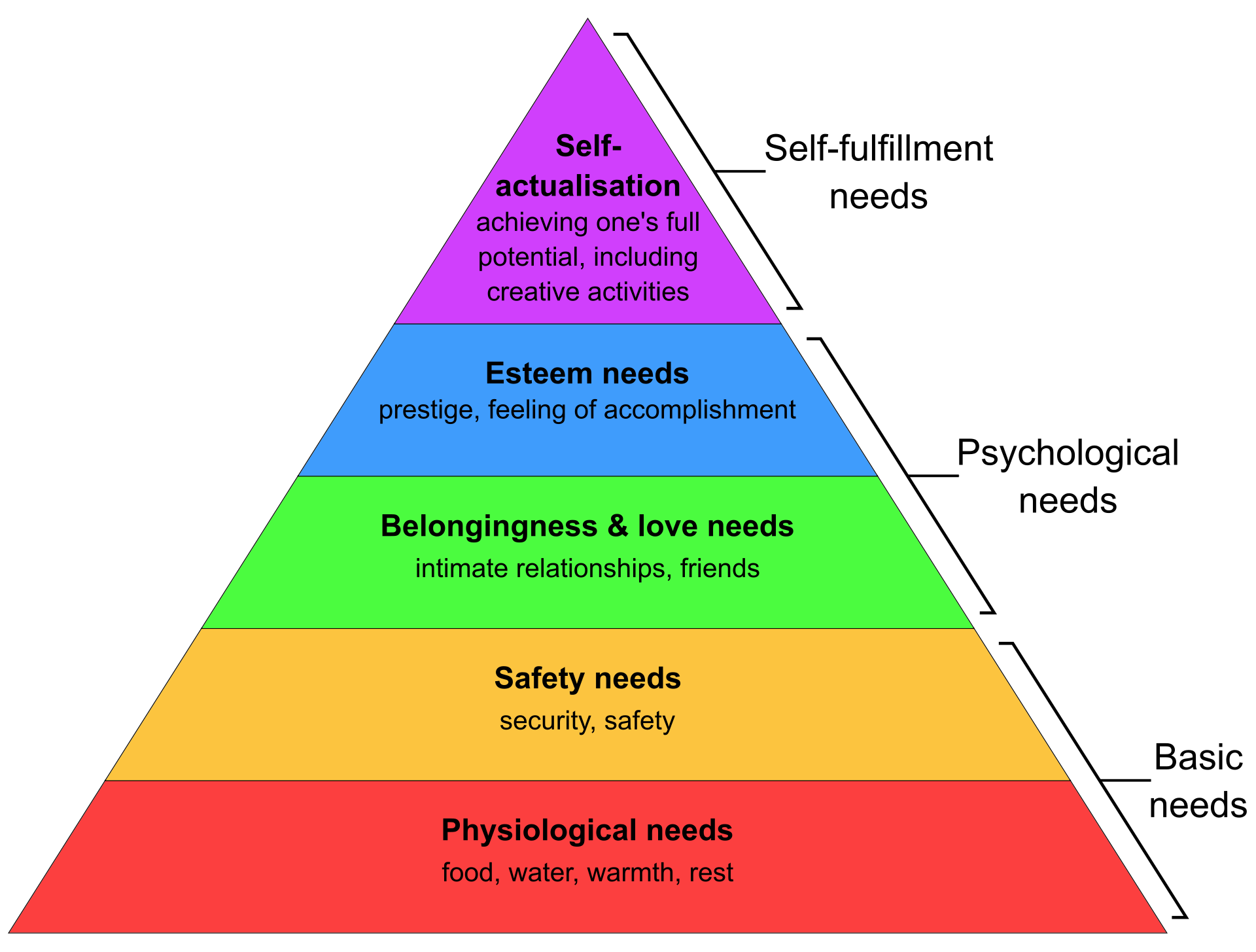
Moreover, because people are social animals, meeting physiological, safety, and belonging needs also requires interaction with others, which inevitably raises questions of worth. As a baby, for example, you have done nothing good and create endless trouble. Why should your parents raise you? Ultimately, raising you realizes their own worth, and they believe that you, too, will become a person of worth.
Studying interpersonal relationships therefore necessarily involves two concepts: needs, and the worth that comes from meeting them.
To handle relationships well, we can likewise begin with “meeting needs” and “respecting worth.”
Everything above is theoretical, though I believe perceptive readers can already connect it with real life. Here are some examples to start the discussion:
1 The most fundamental way to gain others' respect is to become a person of worth: someone who can meet their needs. More concretely, you can earn respect through wealth and power, exceptional professional skills, or a reputation for helpfulness and dedication.
2 Conversely, seeking respect through other superficial things usually does not last. For example, some self-styled socialites split the cost of luxury goods and flaunt their supposed wealth on social media. They can fool people only temporarily. It is entirely normal for them to have no real friends and receive no genuine respect. I have also heard of teenagers attracting attention through tattoos, smoking, and self-harm to prove that “someone cares about them.” These are real cases, but such behavior cannot earn genuine respect either.

3 Similarly, if you cannot meet certain people's needs, you have no worth to them, and need not demand extra respect. A wealthy person walking down the street receives no different treatment from us than anyone else: however rich he is, it has nothing to do with us, and we have no reason to run over and fawn on him. Likewise, many parents treat their children well in their own way, yet the children do not appreciate it. What parents regard as good behavior is not necessarily good in their children's eyes.
4 In social interactions, if someone consistently recognizes your ideas and treats you courteously and respectfully, you feel that your worth is recognized. You then regard that person more favorably, find them easy to get along with, and become more inclined to cooperate. Likewise, if you respect others, they will form a good impression of you.
5 Conversely, imagine someone who constantly opposes you, finds fault with every idea you propose, rejects you, and continually criticizes your shortcomings while ignoring your strengths. You can feel that this person is constantly denying your worth. Naturally, you will not want to deal with them and may even look for an opportunity to get back at them.
6 When interacting with people, then, first learn to find their bright spots, respect their worth, and praise them more. Your relationship will not be too bad. When you disagree with someone, pay attention to your tone. Do not reject the whole person over one incident. Only when you broadly affirm a person can they psychologically accept your criticism of particular aspects of themselves. In other words, only by affirming someone do you earn the right to change them.
7 Many Chinese-style parents fail on point 6. Although they love their children deeply, their frustration at the children's failure to meet expectations means that every conversation turns into fault-finding. Naturally, children do not want to talk to such parents. Education should therefore emphasize encouragement: find children's strengths and encourage them to realize their worth. This truly helps children grow and greatly improves parent-child relationships.

8 Leading a team and developing subordinates work the same way. If you belittle and manipulate a subordinate through PUA-style tactics, they may obey temporarily, but their mental health and long-term development suffer greatly. People are not fools, either. Once they understand what happened, they will curse you every time they think of you. If instead you care for them, identify their strengths, and cultivate their potential, they will grow quickly and soon become capable of taking charge independently. Even after leaving you, they will remain grateful.
9 Besides finding others' bright spots, be good at finding your own. Recognizing your strengths and affirming your worth builds self-esteem and fills you with motivation.
10 Most important is having a coherent system of values. Then, when others attack you, you will not readily deny your own worth.
Countless similar examples arise in marriage, at work, over meals, and elsewhere. There are many rules and complex situations, but focusing on “meeting needs” and “respecting worth” will greatly improve your relationships.
Of course, these are only my own modest views. Additions and discussion are welcome.
Comments
No account needed. A nickname is required; email is optional. Successful submissions appear publicly without manual pre-moderation.
Comments and nicknames are public. Optional email addresses are not displayed. The selected Waline backend and its hosting provider process comments, nicknames, optional email, IP and browser information. Comments show IP region, without the full IP address or browser and operating system labels. Hosting: Vercel; database: Neon.