I. Who Orders More Takeaway: The Poor or the Rich?
This question may not be so easy to answer.
On the delivery side, consumption centers on meals, desserts, and drinks, but also covers groceries, fresh produce, medicines and health products, flowers and plants, and many other categories.
On the human side, "poor" and "rich" are relative definitions to begin with. Take Shen Lei in the TV series A Long Way to Go: a civil servant in a central ministry, with a monthly after-tax salary of 7,000 yuan, a housing allowance of 1,500, housing provident fund contributions of a little over 2,000, and a year-end bonus of ten or twenty thousand. To most ordinary people, he is unquestionably rich. But to his wife Xie Meilan, Shen Lei lacks ambition. Never mind comparing him with her boss: her own salary is three times his. How could Shen Lei count as rich?
The question therefore calls for closer analysis.
II. Food Delivery Has Existed Since Ancient Times
Food delivery has existed since antiquity and is more widespread today than ever. The "Food and Fruit" entry in Volume Two of The Eastern Capital: A Dream of Splendor records:
Also sold for takeaway were soft-cooked lamb, buns of various kinds, pork and lamb parcels, roast meat and dried meat, jade-slab fermented fish, bundles of fermented fish, sliced sauces, and the like.
Of course, "takeaway" here can be understood as collection or food packed to go.
The "Popular Customs" section in Volume Two of the same work records:
Once a major wine house had seen a small shop buy wine two or three times, it would readily lend it silver vessels worth three to five hundred taels. Even poor households ordering wine from the shop had it delivered in silver vessels. If people drank through the night, the vessels were collected the next day. Brothels simply ordered wine from the shops, and it was likewise delivered in silver vessels. Such lavish generosity was unmatched anywhere under Heaven.
This describes wine houses using very expensive vessels yet willingly lending them to small shopkeepers and poor people—an exceptionally generous practice. Some customers drank all night, and the shop came to collect the vessels the next day. Brothels sent people to order wine, and the wine houses likewise delivered it in silver vessels.
Along the River During the Qingming Festival also contains someone who appears to be a "delivery guy": carrying a food box in his left hand and chopsticks in his right, he strides forward, looking travel-worn.
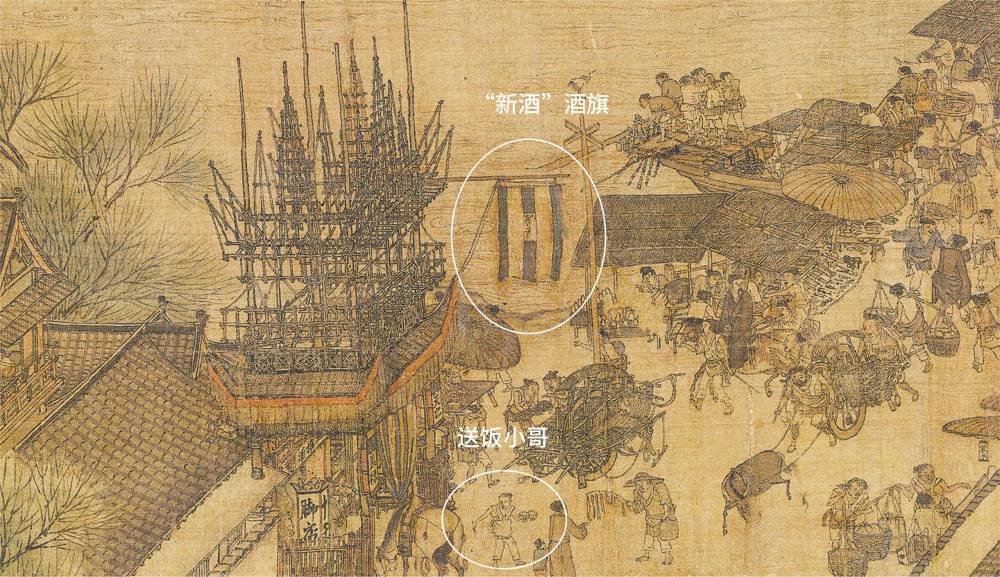
All of this counts as takeaway delivery. It was simply small in scale and uncommon at the time. There were no telephones or WeChat, so ordering required sending someone to the shop first. But if you could send someone to the shop, why not have that person collect the food directly? Only customers who knew the shop well, ordered enough, or arranged a time in advance could therefore enjoy delivery by the shop.
III. From KFC Delivery to Meituan Takeaway
The spread of telephones and the emergence of fast-food chains created new conditions for delivery to develop.
In the second half of 2006, KFC China first introduced "KFC Delivery" in Shanghai, entering the delivery market before expanding nationwide. When I was in secondary school, I had not yet heard of Meituan, but we had already learned to phone shop owners and arrange for them to pass grilled-meat rice meals over the school wall with a bamboo pole at an agreed time and place.
The spread of smartphones and mobile payments truly brought takeaway delivery "into ordinary people's homes."
In April 2009, the Ele.me website officially launched. On November 18, 2013, Meituan Takeaway began trial operations in Beijing. Today, Chinese people are thoroughly accustomed to the model of a delivery platform plus a courier.
IV. Who Orders More Takeaway?
So do the poor or the rich actually order more takeaway?
Perhaps it should be the rich, or at least the middle class. As mentioned earlier, to enjoy delivery in ancient times, you first had to live in a major city and then have a servant to order it, or be able to patronize a brothel and have its staff order for you. A dozen or so years ago, generally only establishments such as KFC offered delivery, and people who could afford KFC then were certainly not poor. In short, takeaway had a somewhat aristocratic origin.
Everyone also knows that dining out may cost two or three times as much as cooking at home, while delivery costs a few yuan more than eating in. A sufficiently rational poor person would therefore cook whenever possible; ordering takeaway seems a little extravagant.
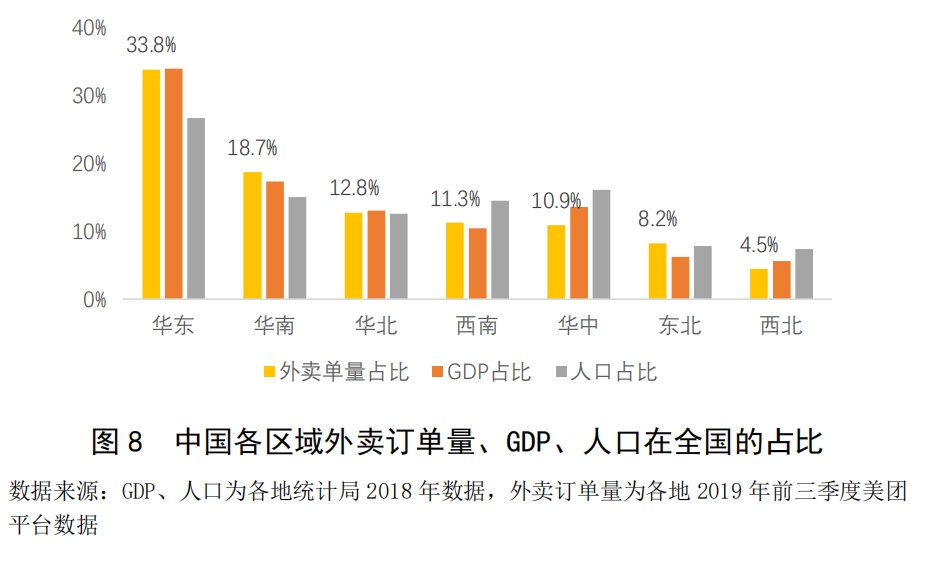
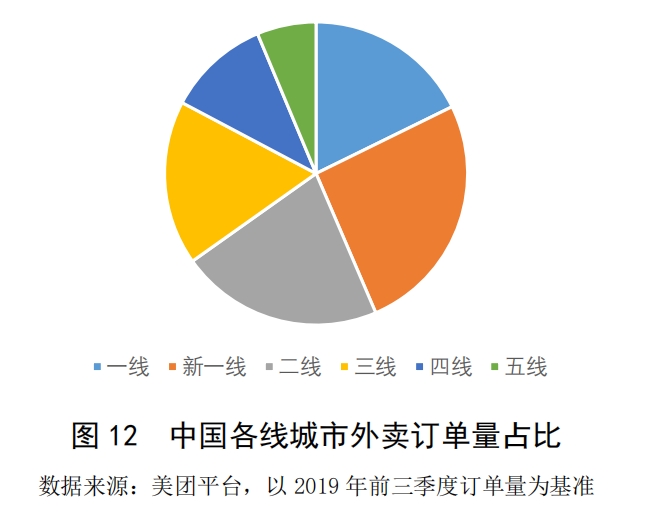
Big data also appears to support this conclusion. The Meituan Research Institute's Survey Report on China's Food Delivery Industry (First Three Quarters of 2019) states:
"Delivery order volume is positively correlated with regional economic development, and higher-tier cities are the main consumer market."
"First- and second-tier cities are the main consumer market for delivery, with Beijing, Shanghai, Guangzhou, and Shenzhen leading the country."
In fact, when Meituan first entered food delivery, it initially used low-price subsidies to capture the campus market in a cash-burning battle with Ele.me. Later, it shifted its focus to the premium white-collar market, challenging Baidu Takeaway, which had the same positioning.
If poor people order more takeaway, why did all the major platforms independently start with schools, upscale offices, and first-tier cities?
From history to present reality, from data to intuition, we seem to arrive at one conclusion: takeaway was originally a product of the middle class and above.
V. The Future of Takeaway: Beyond Rich and Poor
But is it really that simple? If we view the question in terms of development, the answer may not necessarily remain the same.
Decades ago, farmers in my hometown in Sichuan could eat meat only once a week and saw little fat in their daily meals. In film footage from the same period, some Beijing families were already regularly dining out on lamb hotpot. Today, rural Sichuan banquets are covered in meat dishes, and Sichuan migrant workers elsewhere have no shortage of cheap food heavy in oil, salt, and sugar. Yet truly wealthy people have begun studying healthy eating and championing lighter diets.
Meat and rich food symbolized prosperity decades ago, but as society has developed, heavy oil, salt, and lavish meat dishes have become more associated with poor people.
The same applies to takeaway. Although its origins were aristocratic, I believe its popularization is an inevitable product of social development and the division of labor. Perhaps "takeaway" once went together with "rich" and "respectable," but this has quietly changed.
For example, Fat Cat ordered budget group-buy meals costing only a little over ten yuan. Although his income made him rich, his consumption and actual way of life surely made him poor. For poor people with no time to cook, is a ten-yuan group-buy meal not a practical choice?
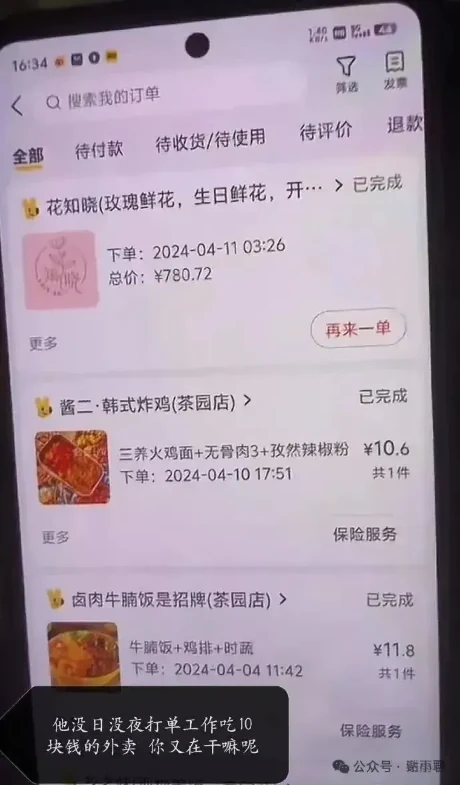
The social division of labor lets you enjoy someone else's cooking, but that does not make you superior to the cook. It lets you enjoy delivery, but that does not make you superior to the courier. On the contrary, it gradually strips away your cooking skills and eats into the time you have to visit restaurants, letting you focus single-mindedly on your job and become an ever more complete corporate workhorse. Then, looking back suddenly, you discover that cooking—even eating in a restaurant—has become a luxury, a privilege for those with money and leisure.
As a way of eating, then, it is hard to say whether takeaway is consumed more by the rich or the poor. We can at least say that it is spreading, reaching less affluent markets, and gradually becoming a common way to eat.
But it is still only a way to eat.
Perhaps the future will look like this:
The poor will use takeaway to survive; the middle class to save time; and the rich to enjoy life.
Different lives, the same takeaway: we all have a bright future.
Main Reference
Meng Yuanlao. The Eastern Capital: A Dream of Splendor [M]. Translated and annotated by Hou Yinguo. Xi'an: Sanqin Publishing House, 2021.
Comments
No account needed. A nickname is required; email is optional. Successful submissions appear publicly without manual pre-moderation.
Comments and nicknames are public. Optional email addresses are not displayed. The selected Waline backend and its hosting provider process comments, nicknames, optional email, IP and browser information. Comments show IP region, without the full IP address or browser and operating system labels. Hosting: Vercel; database: Neon.