I. Getting Information Noticed in the Internet Age: SEO and GEO
In the internet age, a great deal of information is online, and we have become accustomed to obtaining it there. AI marks another watershed: before its rise, we used search engines to find information; afterward, we have increasingly become accustomed to asking AI directly. In the former model, we are more likely to find content ranked highly in search results; in the latter, content likely to be cited by AI.
That is the information consumer's perspective. What about the producer's? Someone who wants others to know certain information must study how information travels. Before AI, they needed to study how to improve search rankings: SEO, short for Search Engine Optimization. In the AI era, they need to study how to get AI to cite them: GEO, short for Generative Engine Optimization.
SEO and GEO are essentially the study of making particular information more likely to become known to others in the internet age. Their main task is to investigate how search rankings or AI citations work and optimize published online content accordingly so more people encounter it. Organizations or individuals hoping to sell a product or improve their visibility, reputation, or influence will come into contact with SEO and GEO to some extent.
Individuals can learn some SEO and GEO too. Applied directly, this knowledge might help us build personal brands in the future. Applied critically, it can also help us stay alert and avoid being misled by AI-generated marketing content.
II. Main GEO Methods
In August 2024, several authors from the Indian Institutes of Technology and Princeton University jointly published a paper titled GEO: Generative Engine Optimization, introducing the concept of GEO for the first time. Only a year or two has passed since then. Here is an introduction to the paper's main conclusions:
1. Individual Strategies
In this paper, the authors tried various methods of optimizing articles and tested AI's preferences for them.
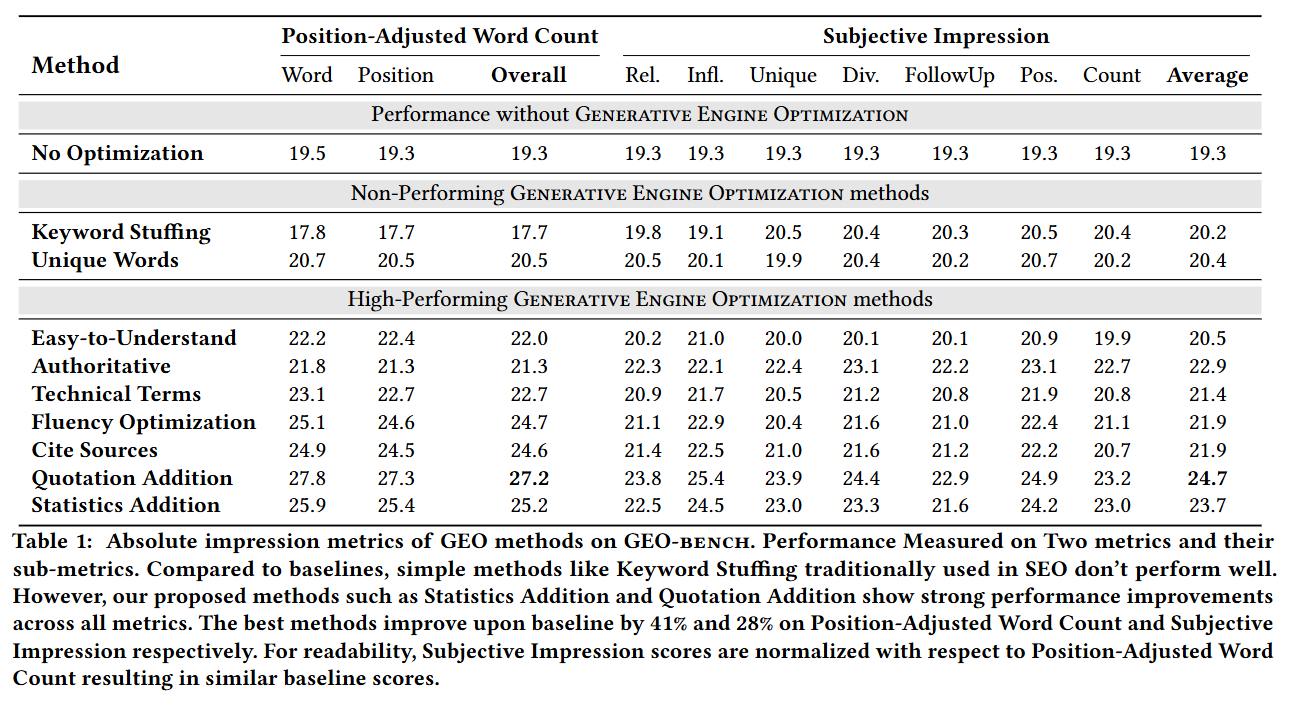
They found that traditional methods such as keyword stuffing and distinctive vocabulary performed poorly, while adding introductions, adding statistics, and citing sources performed best. An authoritative tone also worked well, and improving fluency and readability helped increase AI's preference for citing the content.
2. Combined Strategies
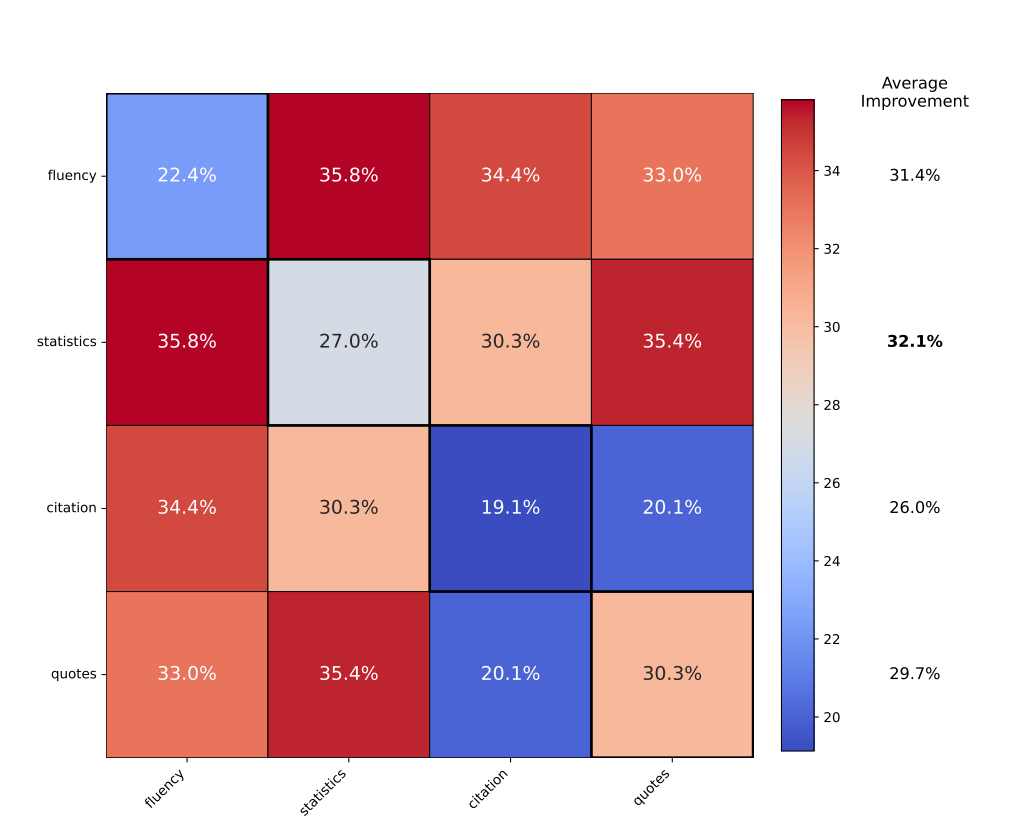
Combining strategies produced greater improvements. The best combinations included improving fluency plus providing data (35.8%), and adding introductions plus providing data (35.4%).
3. Differences Across Domains
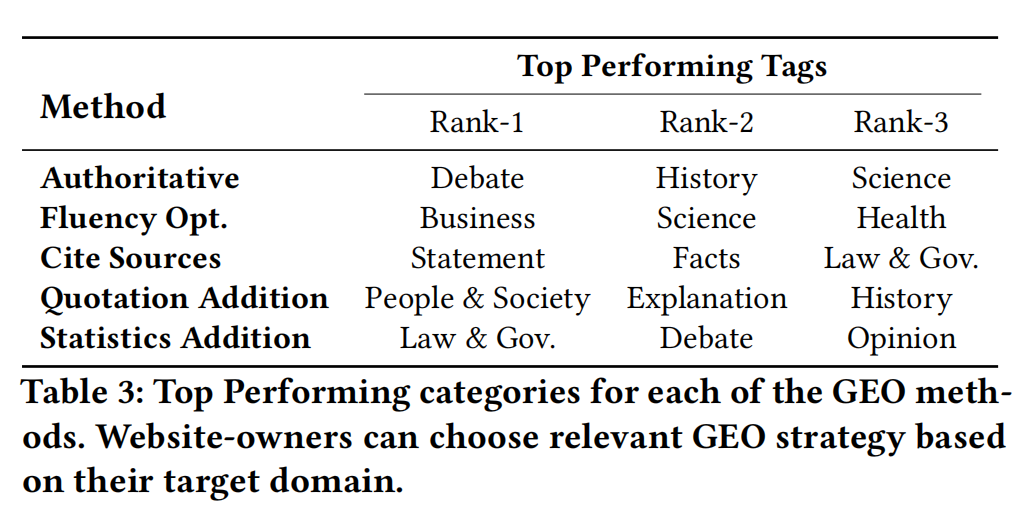
Different domains also vary in their sensitivity to optimization strategies. The following are some of the domains where each method works best:
- Authoritative tone: debate, history, and science.
- Fluency optimization: business, science, and health.
- Citing sources: statements, facts, and law and government.
- Adding introductions: people and society, explanations, and history.
- Adding statistics: law and government, debate, and opinions.
4. Effects on Websites at Different Rankings
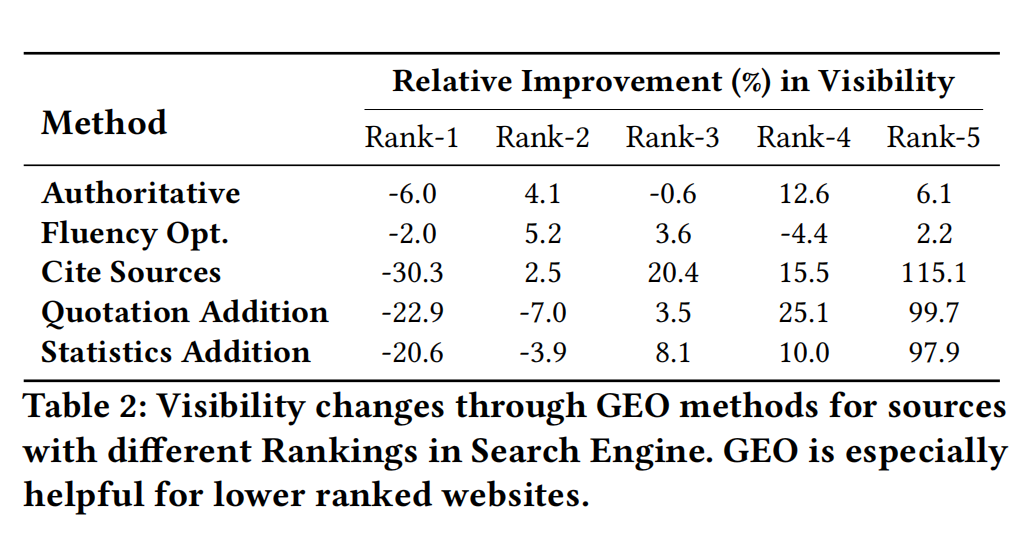
The paper points out that GEO optimization has the greatest effect on websites ranked fourth or fifth. If everyone uses GEO strategies, the advantage of the first-ranked website diminishes. GEO therefore breaks the monopoly traditional search engines grant high-authority websites and benefits smaller creators.
III. GEO's Limitations
In an era of overproduction, sales become very important. In an AI internet age of overproduction, generative engine optimization becomes exceptionally important—but nothing matters more than the product itself.
GEO can make your copy more likely to be cited by AI, but it does not improve your product itself, nor does it improve other people's evaluations of that product. Even if you take GEO to the limit, a poor product means your claims are overstated. Users will vote with their wallets and reviews, the product's reputation will eventually deteriorate, and no marketing will help. Conversely, if your product is excellent, even without any GEO, good wine needs no advertising. Internet users will naturally help build its reputation, and third-party reviews can still lead AI to recommend it.
For a company, then, the most important task is refining its products and services to meet users' needs better. For an individual, it is improving character and ability to serve others better. GEO is a marketing tool for the AI era that can add the finishing touch.
IV. References
Aggarwal, P., Murahari, V., Rajpurohit, T., Kalyan, A., Narasimhan, K., & Deshpande, A. (2024). GEO: Generative Engine Optimization. In KDD 2024 - Proceedings of the 30th ACM SIGKDD Conference on Knowledge Discovery and Data Mining (pp. 5-16). (Proceedings of the ACM SIGKDD International Conference on Knowledge Discovery and Data Mining). Association for Computing Machinery. https://doi.org/10.1145/3637528.3671900 Wikipedia: Generative Engine Optimization. https://en.wikipedia.org/wiki/Generative_engine_optimization
Comments
No account needed. A nickname is required; email is optional. Successful submissions appear publicly without manual pre-moderation.
Comments and nicknames are public. Optional email addresses are not displayed. The selected Waline backend and its hosting provider process comments, nicknames, optional email, IP and browser information. Comments show IP region, without the full IP address or browser and operating system labels. Hosting: Vercel; database: Neon.